

Stralsund, Germany
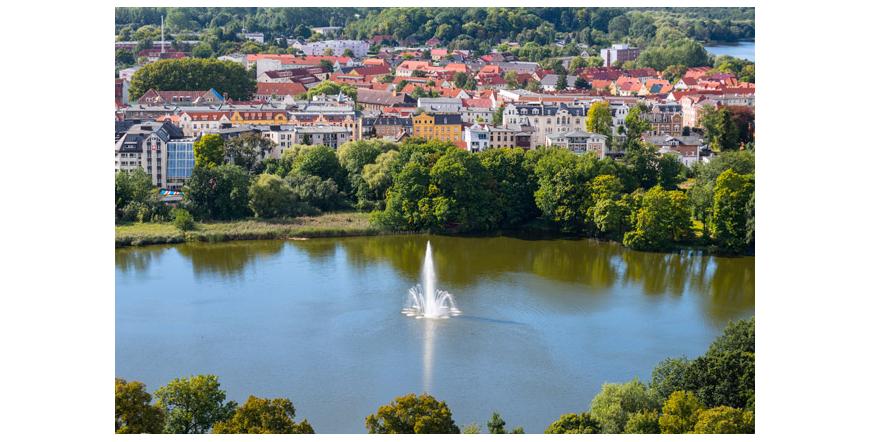
Stralsund is a city in northern Germany, located on the Baltic Sea. The city is an important administrative, commercial and tourist center.
The first settlement on the territory of today's Stralsund arose around 1200 years ago, to be an important port center from which goods and passengers were transported to the island of Rügen. The settlement grew into a city in 1234 after its territories were annexed to the Holy Roman Empire. A few years later, in 1293, the city was already an important member of the Hanseatic League and an important Wendish city.
The importance of Stralzung also grew due to the fact that Stralzung ships were used by great powers such as Great Britain, Norway, Livonia, Portugal, Spain and France to transport their goods. In the 14th century, Stralzung flourished, which is evident from the buildings built at that time - among them the church "St. Nicholas", which is the first church combining the Gothic style with traditional North German architecture. According to the peace treaty of 1648, signed after the end of the Thirty Years' War, Stralsund became Swedish territory.
Due to its location on the German coast of the Baltic Sea, the city became an important defensive and administrative center of Sweden. The city recorded several subsequent occupations in its history - in 1807 it was occupied by France, in 1814 by Denmark, and in 1815, by virtue of the Congress of Vienna, Stralsung passed to Prussia. Since 1945, Stralzung has been in the occupation zone of the USSR, and since 1949 it has become part of the German Democratic Republic.
In 2002, the city center, with its adjacent 812 buildings, was added to the UNESCO World Heritage List.
In July 2008, a modern oceanarium was opened in the German city of Stralsund, which is considered one of the largest in Europe.
The complex consists of 39 giant aquariums, which, thanks to their volume of about 2.5 million liters of water, are home to about 7,000 fish, crabs and other typical and rare inhabitants of the Baltic Sea, the North Sea, the Atlantic Ocean and the Arctic. It is reported that around 550,000 people visit the attraction annually.
Like most cities, Stralsund has its old part, where some of the city's tourist attractions are located. The most notable of the houses, for example, are the Gothic Wolflamhaus and the three-story baroque building of the former headquarters of the Swedish commandant.
The list of sights of Stralsund includes two remarkable churches. One of them is "St. Spirit" on Wasserstrasse - a beautiful late-Gothic building from the 15th century, which also has a "St. Spirit" hospital. The other is the Church of St. James, located at the eastern end of Bötcherstrasse, which in its own right is a unique Gothic basilica from the 14th-15th centuries.
A visit to the Museum of Cultural History is not to be missed, which exhibits, for example, medieval gold jewelry from the island of Hidensee, works of medieval religious art, and tells about the town's folk traditions and history.
The Sea Museum is the next attraction of Stralsund. It houses one of Europe's largest tropical fish aquariums.
This does not exhaust the wealth of cultural, historical and natural sights of the city. Stralzung just has to be impressed.
Vote:
Rating 5 from 1 voted
More sights in Germany


