

Sigmaringen Castle, Germany
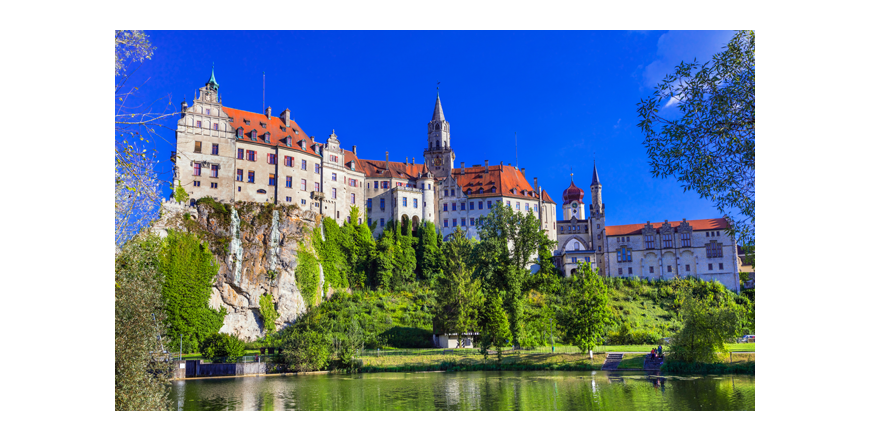
Sigmaringen Castle is an architectural landmark that we can call without hesitation a place with an extraordinary history. There are legends about Sigmaringen Castle, and the palace itself has all the qualities to be considered extraordinary. If a person is given the opportunity to visit Germany, he must visit Sigmaringen Castle - the castle enchants not only with its history, but also with the unique legends and traditions that are told about it.
The flags on the towers of Sigmaringen Castle fly 855 meters above sea level. In summary, the Sigmaringen Castle first appeared as a fortress in the 11th century and was the lavish home of the Prussian royal family. Sigmaringen Castle was destroyed and rebuilt twice. The Sigmaringen Castle acquired its current appearance after restoration at the end of the 19th century. But let's start the story like this.
In the German city of Sigmaringen, located in the southern part of the state of Baden-Württemberg in Germany, the biggest impression is definitely the Sigmaringen Castle. The Sigmaringen Castle is situated on a hill above the Danube River, in the low mountains of the Swabian Alps, and stands just above the low reaches of the river here. Sigmaringen Castle has been the official residence of the Hohenzollern family for centuries and is considered the largest along the Danube.
The history of Sigmaringen Castle begins eight centuries ago, when a German prince decided to build a fortress to serve as a place from which to rule a small settlement. In 1077, this fortress was already famous as a beautiful castle, picturesquely perched on the banks of the beautiful blue Danube. The first mention of the Sigmaringen estate dates back to 1077 in the annals of the Peterhausen monastery.
Over the centuries, Sigmaringen Castle has been a place where battles, negotiations and treaties have been fought in its dark stone halls. The Sigmaringen Castle expressed its importance and one day became the cradle of one of the most influential dynasties in Germany – Hohenzollern-Sigmaringen. It is this family that rules Prussia and the German Empire, and several kings of Romania also have its blood in their veins.
Another dynasty that ruled Europe also had Sigmaringen Castle as their palace - the Habsburg dynasty. The Sigmaringen Castle became the property of the family in 1200, but nearly 200 years later, in 1399, the royal dynasty returned it to Württemberg. Sigmaringen Castle remained theirs until 1534, when the emperor of the new Roman Empire, Ferdinand I, handed it over to Charles II, so that he too could found his own dynasty. The reason for this is that unfortunately the Werdenberg dynasty is left without a male heir.
Between 1627 and 1630, Sigmaringen Castle underwent a major transformation, transforming it into a true Renaissance palace. Hans Albert of Dillingen was chosen as the architect of this transformation. Around 1650, a new building of Sigmaringen Castle was constructed from the two separate buildings remaining from the Werdenberg family period under the brilliant direction of the architect Michael Beer.
The narrative up to this point is like a fairy tale. A stone becomes a masterpiece. Unfortunately, even in fairy tales there are bad moments. In the tumultuous centuries that followed, Sigmaringen Castle became the center of a small principality, went through a heavy Swedish siege and survived the Second World War.
Today, Sigmaringen Castle has been transformed into a museum, a library and a place that attracts thousands of tourists. Among other things, Sigmaringen Castle has also been a muse for many writers who have drawn inspiration for their creepy novels.
A tourist tour through the halls of Sigmaringen Castle is a kind of journey back in time and gives a true sense of the lifestyle that the nobles led. Decorated furniture, paintings and precious porcelain objects are everywhere. One of the largest private collections of weapons in Europe can be viewed in the museum exposition of the Hall of Arms, with the collection containing exhibits from the Middle Ages to the present day.
Vote:
Rating 5 from 1 voted
More sights in Germany


