

Hohenschwangau Castle, Germany
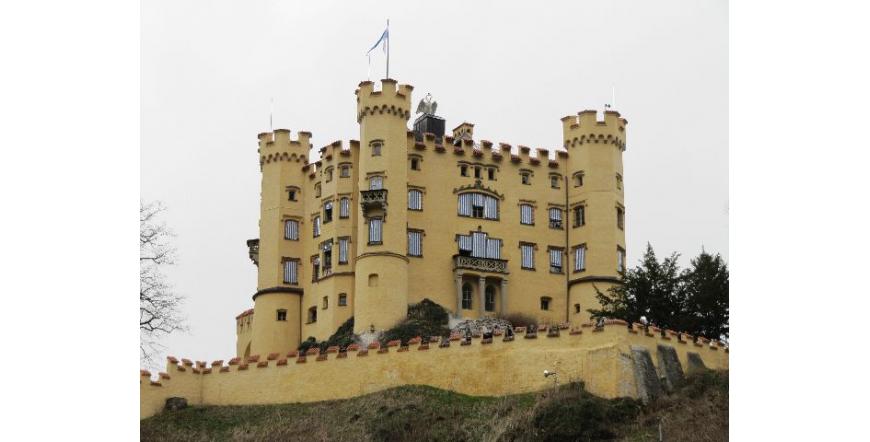
Hohenschwangau Castle is a beautiful German castle dating back to the 19th century. It is located outside the German village of Schwangau, near the town of Füssen in southwestern Bavaria. Hohenschwangau Castle was built by the will of the Bavarian King Maximilian, in close proximity to Neuschwanstein Castle, on the remains of the medieval Schwanstein Fortress from the 12th century. Hohenschwangau Castle is one of the pearls of medieval construction not only for Bavaria, but also for the whole of Germany.
The medieval Schwanstein castle was built by the Schwangau knights, but after the death of the knights of the family in the 16th century, the castle was neglected and gradually began to crumble. The Napoleonic Wars caused even greater destruction to the castle. Impressed by the beauty of the area, Crown Prince Maximilian purchased the ruins in 1832 and organized a massive reconstruction in the period 1833 to 1837.
The ruler hired the architect and artist Domenico Quaglio to restore the Hohenschwangau royal castle building in the Gothic style. Quaglio was unable to complete his work on the Hohenschwangau Castle as he died, so his work was continued by the architect Josef Daniel Ohlmüller. The Hohenschwangau Castle served as the summer residence of the royal family and Ludwig II and Otto I spent their childhood there. After Ludwig's death, their mother Maria Frederica of Prussia lived there for about three years until her death in 1889.
In 1905, the Hohenschwangau Castle was inherited by Ludwig, who decided to fully electrify it and install an electric elevator. After his death in 1912, Hohenschwangau Castle was turned into a museum. During the Second World War, the heirs of the Bavarian family were again given the right to move into their family estate. It began functioning as a museum again in 1913 after the death of Luitpold of Bavaria.
At the beginning of the 20th century, the name of the castle was changed from Schweinstein to Hohenschwangau, and in 1923 the ownership of the castle was restored to the former royal family.
While the facade of the castle is entirely in the neo-Gothic style, its interior is in the Biedermeier style, designed by the artist Moritz von Schwind. The park was created according to a project by Peter Josef Lehne.
Vote:
Rating 5 from 1 voted
More sights in Germany


