

Bamberg, Germany
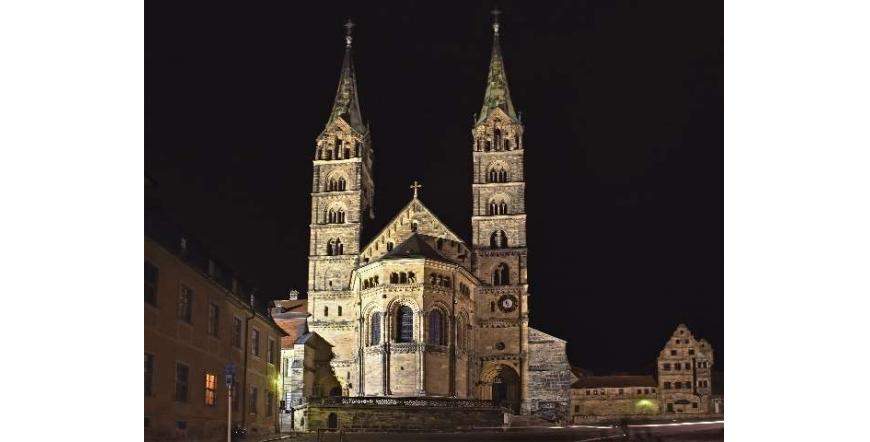
The course of the river Regnitz, which merges with the river Main, flows beautifully through Bamberg. The city is located 63 km north of Nuremberg and 101 km east of Würzburg. The city is an important university center, and its old part has been on the UNESCO World Heritage List since 1993. Bamberg is one of the best preserved cities in the heart of Europe. Bamberg is often called "Little Venice" or "French Rome" - Bamberg spreads picturesquely on seven hills, each of which is crowned with a beautiful church.
Bamberg is a city with over 1000 years of history. It was originally built as an episcopal center. The city was mentioned for the first time in 902. Historical texts tell of a fortified settlement called Castrum Babenberch on the hill where today's cathedral is located. It was then under the rule of the East Franconian aristocratic Babenberger family.
From the 10th century, Bamberg became an important center and connection with the Slavic peoples, especially those from Poland and Pomerania. The city saw its greatest flourishing and prosperity around the 12th century, when a large part of the medieval buildings that can still be seen in the German city were built. Their architecture at that time was strongly influenced by the architectural currents that had already established themselves in Northern Germany and Hungary.
At the end of the 18th century, Bamberg became the main center of the Enlightenment in the southern part of Germany, and prominent philosophers and writers of the rank of Hegel and Hoffmann lived here. Bamberg is among the few German cities that remained intact after World War II. Bamberg's many notable sites and buildings are included in the UNESCO World Heritage List.
These are the Old part of the city together with the cathedral from 1237 in the late Romanesque-early Gothic style, the adjacent Old Palace, the Old Town Hall - a bridge tower from the 14th century, as well as a large number of Baroque burgher houses. Thanks to its survival after the Second World War, Bamberg has managed to preserve a treasure trove of medieval and historical buildings and cultural monuments.
Among the sights of Bamberg is the Cathedral, which is part of the so-called "New residence". The cathedral is built mainly in the Gothic style, like the interior, and initially startles with its huge, detailed and richly ornamented dimensions. Today, Bamberg Cathedral houses the State Gallery, which is impressive with its painted gilded ceilings.
On the road between the Old Town Hall and the New Residence, there are more than 30 antique shops that can take you back to the 16th-17th centuries.
Bamberg is also quite famous for its many breweries and beer production, with the specialty of the city being smoked beer. You can try this attractive drink in the Schlenkerla Tavern, located on the Dominican Street in Bamberg. This is definitely one of the beer capitals of Germany.
In this city of contrasts there is also a Carmelite monastery and a Benedictine monastery. Bamberg is a city of contrasts - between the silence of the past and the beauty of the present, you can live here dreaming of Venice and Rome at the same time.
Vote:
Rating 5 from 1 voted
More sights in Germany


