

Berlin Cathedral, Germany
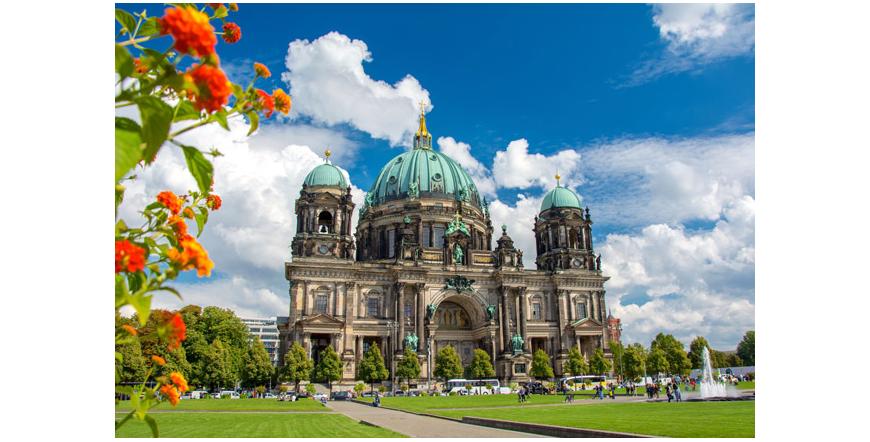
Among the glamorous and grand symbols of Berlin, the Berlin Cathedral is at the forefront. The Berlin Cathedral is located in the western part of the German capital, rising on an island in the middle of the Spree River, also known as the Museum Island. The Berlin Cathedral is mostly distinguished by its beautiful architecture, an impressive basilica also known as the Protestant St. Peter. The Berlin Cathedral is the third spiritual temple to be built on the museum island, with its length reaching 114 meters and its width is 73 m.
Designed originally as a baroque model, the Berlin Cathedral was completed in neoclassical style by Berlin architect Carl Friedrich Shinkel in 1905. The foundations of the religious temple were laid in 1894 and the cathedral was finally completed 11 years later.
Where the Berlin Cathedral rises today, there were other religious temples over time. The first church was built in 1465, in the form of a modest building, which later became a family chapel of the Hoenzollern family. Between 1745 and 1747, a cathedral was erected on the church, which was designed by Johann Bowman. This Berlin Cathedral was renovated in classic architectural style between 1816 and 1822, this time the project was entrusted to the notorious architect Carl Friedrich Shinkel.
This construction of the Berlin Cathedral was completely destroyed at the behest of Emperor Wilhelm II in 1894 to implement the project of Julius Rashdorf, from which the present-day Berlin Cathedral was born. The Berlin Cathedral is a highlighted baroque structure with an Italian Renaissance influence in architectural terms. It is much larger in size than previous religious temples, and is erected as a Protestant counterbalance of the Catholic Rome.
The Berlin Cathedral has been another architectural victim of Berlin since World War II. Bobmbards predict a huge fire in the temple, actually destroying it. The restoration of the interior interior of the Berlin Cathedral began in 1984 and was completed in 1993. Three years later, the Berlin Cathedral was consecrated for the second time. During the large-scale reconstruction, its original design was brought to a simpler option.
The final version of the Berlin Cathedral is a very richly ornamented building for a Protestant temple. Its dome is decorated with a complex and beautiful mosaic. It takes 270 steps, quite wide and with resting places. The organ is extremely interesting - there are more than 7000 pipes. Impressive are the neobaric pulpit and the stained glass windows, the work of Anton von Werner's mastery.
The main altar of the Berlin Cathedral dates back to 1850. The beauty of the walls along which one passes in order to reach the dome should not be overlooked. They are decorated with interesting historical photographs and models. The crypt located in the cathedral is also of historical importance. There are about 80 sarcophagi of Prussian royalty.
Vote:
Rating 5 from 1 voted
More sights in Germany


