

Augsburg, Germany
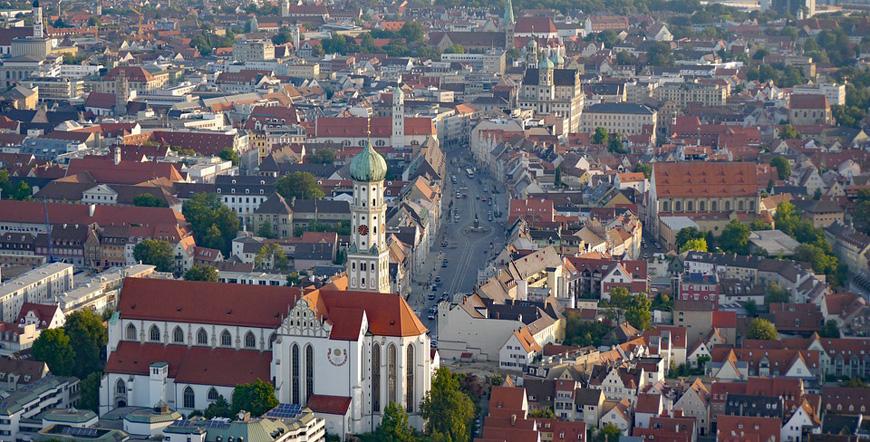
Augsburg is a German city belonging to the province of Bavaria. Augsburg is situated around the rivers Wertach and Lech. It is the third largest city in Bavaria after Munich and Nuremberg. 36% of the city's area is residential buildings and infrastructure, 24% of the area is forests. The city is a road and rail transport hub. Its name originates from the name of the Roman settlement from 15 BC. Augusta Vindelicorum. Augsburg is a city with a rich historical past and many monuments from the Middle Ages.
The first historical information about the city exists from the 15th century BC. The time is marked as the period in which Augsburg was founded by Nero Claudius Drusus and Tiberius as a Roman settlement under the name of Augusta Vindelicum. Shortly afterwards it became the capital of the Roman province of Rhaetia. In 955, Bishop Ulrich managed to repulse the Hungarians who were aiming at the lands of Augsburg. A few centuries later, in 1316, the city officially received its status as a free city. In 1521, the oldest social dormitory in the world was founded - Flugeray. In 1555, the Augsburg Peace Treaty was signed in the city, officially ending the religious war.
In 1632, Swedish King Gustav II Adolf captured the city during the Thirty Years' War. Augsburg became part of the newly created state of Bavaria in 1806. In 1840, the first train ran on the line between Augsburg and Munich, and in 1970 the university was founded.
Augsburg is an industrial and commercial center. Machine-building, energy, printing, aircraft-building, textile and food industries are developing in the city. The city is the headquarters of the MAN company, which produces buses and trucks.
Like all cities on the Romantic Road, Augsburg has a charming Old Town. Walking through the streets with ancient houses, one cannot fail to notice the several delightful fountains: the fountain of Neptune with a trident in one hand and a dolphin in the other; the two fountains Mercury and Herculesbrunnen in front of Schäselerpalle, which are on the UNESCO list and the August fountain, which is one of the most beautiful and is located in the square in front of the town hall and is also on the UNESCO list.
The town hall is a building with remarkable architecture and the impressive tower next to it. The City Hall is most visited by tourists for its glittering interior, most notably the Golden Hall with its sumptuous paintings, magnificent coffered ceiling and furnishings considered the pinnacle of artistic design of its time. The gardens and graceful social houses of the Fugger family from 1512 are lovely, but unfortunately not open to the public. The Kurhaus in Göningen Park was conceived as an entertainment facility with a winter garden, dance hall and theater. With architect Jean Keller, the finished building has been called a "construction miracle".
Today, the renovated building is used for theater, concerts, revues, balls and important meetings. Wedding parties and Christmas markets are organized in the garden. Visiting this magnificent building is a great experience. For art lovers is the exhibition at Schäzler Palace. In the former residence of the Prince-Bishops of Augsburg in the Old Town from 1740, wonderful works of art and a lovely garden can be seen.
Vote:
Rating 5 from 1 voted
More sights in Germany


