

Lübeck, Germany
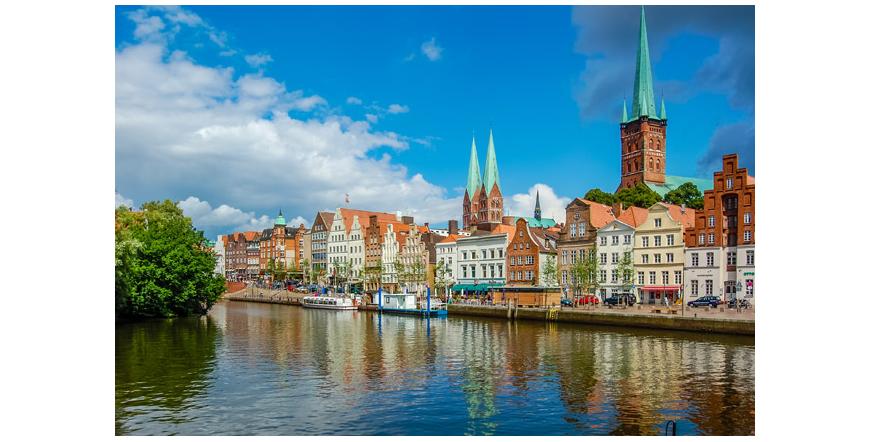
Lübeck is a beautiful old German city in the province of Schleswig-Holstein, northern Germany. The city is the largest port city, as it is located on the Baltic Sea, near the mouth of the River Trave, as well as the second largest city in the province. Its name derives from the Slavic word Ljubitsa.
For many may be this is ridiculous that Lübeck is the former Queen of the Hanseatic League. But to the surprise of many, this unremarkable town, according to some, for three centuries - from XIII to XVI, was at the head of the Hanseatic League - the most powerful trade union in Europe, uniting in its heyday more than 150 cities. To this day, its official name is the Hanseatic City of Lübeck. Unfortunately, today Lübeck has lost its commercial importance, which is why it raises suspicions about its past. For this, it has preserved its incredible medieval atmosphere.
The history of the city began in 1143, when the Duke of Schauenburg conquered the Slavic settlement of Lubice, located on an island in the Trava River. The Germans changed the name of the settlement to Lübeck and the name of the river to Trave, but the city remained on the same island from which all the main trade routes in northern Germany were controlled. The center of Lübeck, formed in the middle of the 12th century, has been preserved over the centuries without significant changes or destruction.
Lübeck is a rich city in terms of architectural monuments, historical sights, museums, etc. The city has over 1,000 buildings worth seeing as architecture - Romanesque, Gothic and Neoclassical. The old town in Lübeck contains unique old buildings and has been declared a World Heritage Site by UNESCO.
Undoubtedly, one of the most beautiful buildings is that of the city hall. It is a representative of the Romanesque style from the 13th century. In front of the town hall of Lübeck is the market square, in the middle of which is a platform on which criminals condemned to public censure were once exposed.
When it comes to religious temples, the emphasis falls on the most beautiful church in Lübeck - undoubtedly "St. Virgin Mary". The Church of the Virgin Mary was almost destroyed by the bombings, but today it has been restored and amazes with its Gothic architecture. Many other churches throughout Europe were modeled after the one in Lübeck.
There are a total of five Gothic churches in Lübeck, which astonish travelers as they approach the city, as their towers can be seen from afar. Because of them, Lübeck was called the City of the Seven Golden Towers in the Middle Ages.
But the most majestic are the towers of the Holstentor - the western gateway to the city, which is one of the most famous buildings in Germany. The door leans slightly on one side and the locals joke that Lübeck is twice as beautiful as Pisa because it has not one but two leaning towers.
Lübeck can be justifiably proud of the famous people to whom it was born. These are the winners of the Nobel Prize writer Günter Grass, the former West German chancellor Willy Brandt, as well as Thomas Mann, who in 1929 received the Nobel Prize for Literature for his novel "The Buddenbrocks".
Besides the beautiful religious temples, Lübeck also has quite a few interesting museums. Museum Kirche Sankt Katerinen, Lübecker Teaterfigurenmuseum and the Holstentor, which is the local history museum, are just a few of the many must-sees.
Vote:
Rating 5 from 1 voted
More sights in Germany


