

Weimar, Germany
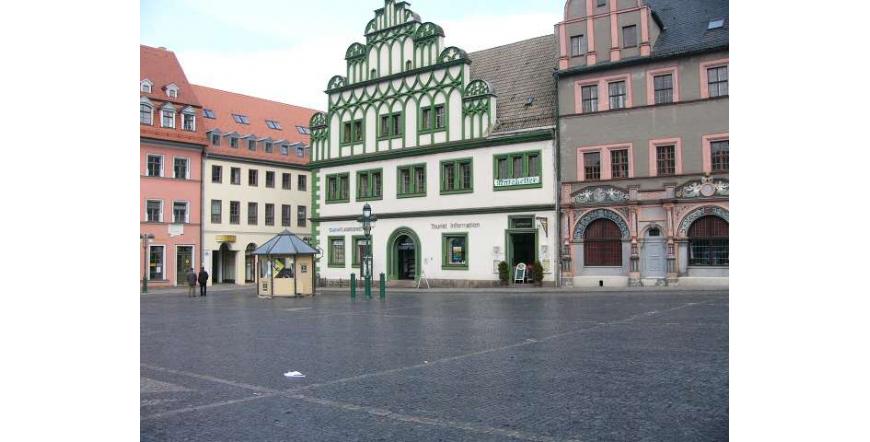
Weimar is a city in the picturesque German province of Thuringia, lying at the foot of the Thuringer Wald mountains and close to the cities of Erfurt, Halle, and Leipzig. Weimar is a small, peaceful city located in central Germany, on the river Ilm. The river Ilm flows quietly and calmly through Weimar itself. The entire city is located on an area of 84.26 square kilometers, and its population reaches about 65,000,000 inhabitants. The earliest records of Weimar date back to 899.
Over the centuries, today's city was known by the names Vimares, Vimari and Vimar until it reached Weimar. In 1552, the city was granted the privilege of becoming the capital of the Duchy of Saxe-Weimar and retained its status as such until 1918. During the regency of Anna Amalia, spanning the period 1758-1775, and her son Karl August in the period 1809-1828, Weimar became an important cultural center of Europe and a lobby of the German intelligentsia of Europe. Great names such as the luminaries Goethe, Schiller and Herder, as well as the virtuoso pianist Hummel, who was a student of Mozart, worked and created in it.
A very important fact in the history of Weimar is that after the First World War, the new constitution of Germany was created in the city, abolishing the monarchy and the German Empire. Weimar's name was also decisive for the creation of the Weimar Republic, which lasted from 1919 to 1933, as well as for the name of the republic itself.
Weimar is one of the cultural centers of Europe. In this small town, spectacular events took place that determined human history for decades and centuries. The great philosophers Goethe and Schiller were not born in Weimar, but they worked and died in this city, writing its cultural history. Weimar is also associated with the name of the theologian and philosopher Johann Herder, who developed the ideology of humanism as a philosophical category.
Weimar may not be the birthplace of great scientists, but it is the birthplace of the innovative Bauhaus design school. The founder was Walter Gropius, managing a group of artists united by the idea of uniting the Weimar School of Fine Arts with Henry van de Velde's School of Arts and Crafts, with the aim of initiating an innovative design style for the needs of architecture and, in general, for the new time after the war.
Thus, thanks to the design school, various furniture, pottery and wallpapers are produced. The original Bauhaus school building in Weimar today houses the Bauhaus-Universität-Weimar. The city also has a museum dedicated to this style. In the Bauhaus Museum you can see typical examples and objects of the school's style of furniture. Both buildings are included in the UNESCO World Heritage List.
In addition to the university and the museum, Weimar's interesting sights are the Franz Liszt Conservatory, the Georg Muche House, the Weimar National Theater, the Baumhaus, the baroque Vitumpalas Palace, as well as the Belvedere Castle, located southwest of Weimar, built in 1724. From an outstanding importance for the city and its tourism are the tombs of Goethe and Schiller, as well as their archives - they are one of the most visited cultural and historical sights in Weimar.
Last but not least is the monument to Goethe and Schiller, and in front of it - a statue of the two artists holding hands, as well as Goethe's house.
Vote:
Rating 5 from 1 voted
More sights in Germany


