

Bremen, Germany
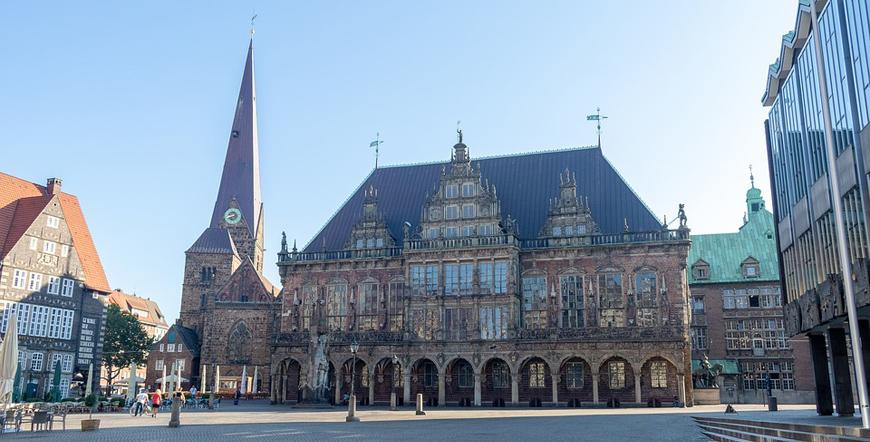
Bremen is a city in northern Germany. Its official name is Freje und Hansestadt Bremen due to its membership in the medieval Hanseatic League. It is located on the River Weser and together with Bremerhaven forms the province of Bremen, founded in 1947. The city was once called "Northern Rome" because of the enormous historical and architectural wealth that lies between its squares, streets and coastlines. Bremen is also the oldest German coastal city.
Today, Bremen is as historically valuable as it is a modern developed city. In addition, the city is the second largest port in Germany, surpassed only by Hamburg. His fame around the world is carried by Bremen city musicians. History does not specify the exact date when the lands of present-day Bremen were inhabited, but prehistoric elephant bones from around 150,000 BC have been found, as well as human bones from 10-12,000 BC near Wildeshausen. It is believed that Saxon tribes lived on the lands of present-day Bremen.
The medieval history of present-day Bremen dates back to the 7th century, when Charlemagne fought battles with local tribes and established control over the area, and this is the date when the city of Bremen was first mentioned in historical texts. On August 10, 965, Emperor Wilhelm I granted commercial law, monetary law, and customs law to the Archbishop of Bremen. In the 11th century, a massive fortification appeared around the city, which was supposed to protect Bremen from the Norman invasion.
The first free market for Bremen and the oldest for Northern Germany was opened on October 16, 1035. Today it is celebrated annually on the old market square - Marktplatz. Around it are located most of the architectural and historical masterpieces of Bremen. Some of the buildings surrounding the square have stood here since the 13th century, which is why Bremen's market square has been declared a UNESCO World Heritage Site.
Bremen is rich in history, rich in architecture, monuments and beautiful buildings. For example, St. Peter's Cathedral, the Town Hall, built in 1414, the City Hall, Fallturm, the tower for measuring acceleration, and Schnoor, a UNESCO World Heritage Site.
The statues of the Bremen Town Musicians, as well as the statue of Roland, which are also on the business card of this German city, should not be overlooked.
The Botanical Garden, the City Park and the Rhododendron Park are also challenges for visitors to the city.
The remarkable building of the city council, adorning the square in Bremen, was called the Rathaus and was erected in the early 15th century, in Gothic style, later transformed into Weser Renaissance style. On the opposite side of the square is the Guild building - Schötting, which combines architectural Renaissance and Gothic style. The building of the Bremen Parliament - House der Bürgerschaft was erected in 1966 and is remarkable for its facade of glass, steel and concrete.
The remarkable and sacred statue of Roland rises and adorns the center of Bremen. The statue depicts Roland holding a sword of justice and a shield, with an imperial halo hovering over it. During the Second World War, special measures were taken to protect it from bombing, because it was believed that as long as the statue was intact, Bremen would be a free city.
Vote:
Rating 5 from 1 voted
More sights in Germany


Weather in Bremen, Germany

18.89 °C
Wind: 1.54 m/s
Humidity: 88 %
Pressure: 1003 hpa
Clouds: 20 %
Wind: 1.54 m/s
Humidity: 88 %
Pressure: 1003 hpa
Clouds: 20 %