

Würzburg, Germany
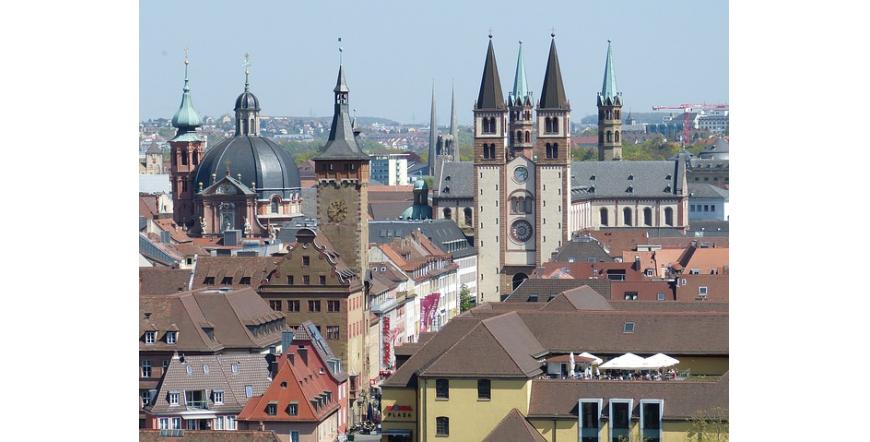
Würzburg is a city in central Germany, belonging to the province of Bavaria. It is located 115 km southeast of Frankfurt and 115 km northwest of Nuremberg. Würzburg is a remarkable and beautiful German city, the main center of the picturesque region of Lower Franconia, beautifully situated along the river Main.
The history of Würzburg, told with the most important years in its development, begins as early as the beginning of the 8th century, with the first historical data about the then settlement dating from 704. 742 - Saint Burchard was appointed the first bishop of Würzburg by Saint Boniface . 788 - the first church of Würzenburg was built and consecrated by King Charlemagne.
The bishops gradually created an episcopal secular state, to which large parts of Franconia were annexed in the 12th century. 1040 - the construction of the still existing cathedral in Romanesque style begins. 1631 - during the Thirty Years' War, Würzburg was captured by the Swedish king Gustav Adolf. 1803 – the city was annexed to the province of Bavaria. 1805 - the city became the capital of the established Duchy of Würzburg. On March 16, 1945, during the Second World War, Würzburg was almost completely destroyed by British aviation. The next 20 years were a period of rebuilding the city, with many historic buildings restored to their original pre-war appearance.
A Würzburg sightseeing tour includes many must-sees. In the center of the city, the City Hall building, the beautiful Old Cathedral and its impressive high Gothic towers, as well as the new "New Münster" cathedral, which impresses with its lavish baroque architecture, are of interest. Also in Baroque style is the Bishop's Residence in Würzburg.
The episcopal residence in Würzburg is the palace of the bishops who ruled the secular episcopal state. The construction of the residence in Würzburg lasted from 1720 to 1744. The design of the residence was by the leading Baroque architects Johann Lucas von Hildebrand, Maximilian von Welsch, Robert de Cotte and Germaine Beaubrand. But the main architect was Balthazar Neumann, architect of the Prince Bishop of Würzburg Johann Philipp Franz von Schonborn and his brother Carl Friedrich von Schonborn. The walls of the episcopal residence were painted by the Venetian Giovanni Battista Tiepolo. The residence was inscribed on the UNESCO World Heritage List in 1981.
In addition to the old and new cathedrals, there are several churches in Würzburg, one of which is the Red Cathedral of the Virgin Mary, located on the west bank of the Main River and existing since ancient times.
Vote:
Rating 5 from 1 voted
More sights in Germany


