

Worms, Germany
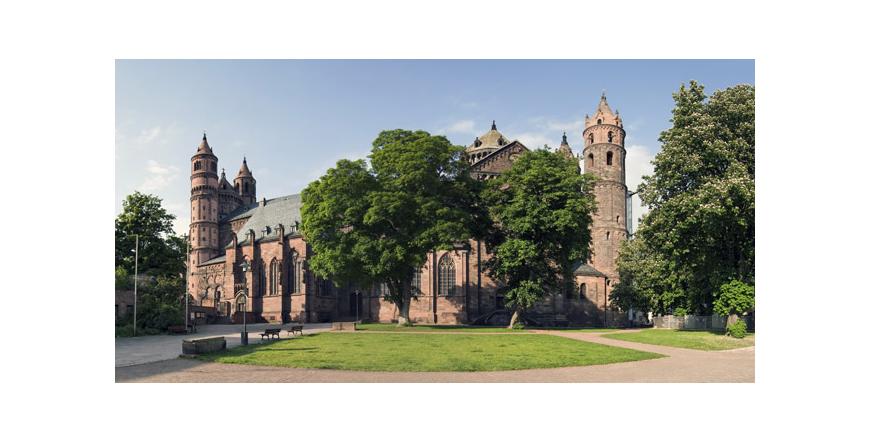
Worms is a city in western Germany, located in the state of Rhineland-Palatinate. It is located in the Rhine Valley, between Mainz and Ludwigshaven, and is part of the Rhine-Neckar European Metropolitan Region. Worms connects the Rhine-Neckar metropolitan region with the Rhine-Main region to the north. Its strategic location between the Donnersberg and Odenwald mountains makes it one of the warmest and driest cities in Germany.
Worms is divided into 13 municipalities, and its population amounts to about 82,212 people, most of whom are Protestants and Catholics. Worms is the only German representative in the "Oldest European Cities" category, although it is in constant competition for this title with the cities of Cologne, Augsburg and Trier.
Worms is a city with a rich historical past, which is not surprising considering the fact that it is among the oldest cities in Germany. Worms is believed to have been built by the Celts, who gave it the name Borbetomagus - land of Borbet. After them, around the III-IV century, the Romans came to the lands of today's city, which they named Civitas Vangionum. His name remained so until the 16th century.
Emperor Charlemagne was among the rulers who ruled the lands of present-day Worms. He makes the city his winter residence. Between the 12th and 16th centuries, many bishops and city rulers competed for power over this area. In 1521, it was in Worms that Martin Luther defended his theses before Emperor Charles V, and the city became the center of the Reformation.
In 1689, the city was destroyed by the troops of Louis XIV. Worms was a French possession in the period 1792-1814, as well as a possession of the Duchy of Hesse after 1816. After the Second World War, Worms was almost completely destroyed. From 1968 to 2000, the city belonged to the district of Rheinhessen-Pfalz.
In Worms, the chemical industry, mechanical engineering and metalworking are developed. 46% of the population work in the surrounding larger cities of Mannheim, Ludwigshafen, Mainz and Frankfurt.
Worms is the third largest wine region in Rhineland-Palatinate. It is also known as the city of the Nibelungen, as the city of Luther, and for its St. Peter's Cathedral.
Surpassing physically and historically most of the old buildings in the city, the religious temple "St. Peter" is a majestic basilica, a wonderful example of the Roman era.
An interesting landmark of the city is the old Jewish quarter. Until World War II, Worms was one of the oldest Jewish communities. Today in the city there is still the Synagogue, which was built in the 11th century and destroyed in 1938, but then rebuilt again.
Vote:
Rating 5 from 1 voted
More sights in Germany


