

Aachen, Germany
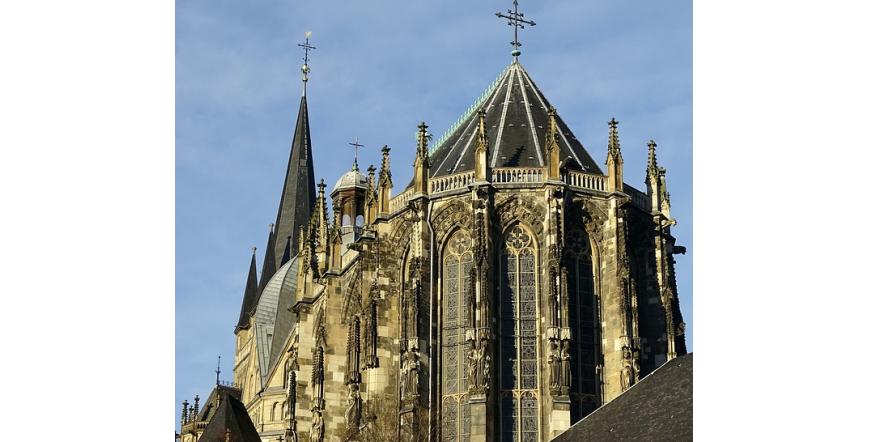
Aachen is a city and spa center in North Rhine-Westphalia, Germany, located 65 km west of Cologne. It is the westernmost city in Germany. Aachen is located near the point where its border meets the borders of Belgium and the Netherlands. Aachen is a railway junction. The coal mining, engineering, textile and glass industries are developed in the city. Aachen is also a spa resort.
Thanks to its technical university, considered one of the best in Germany, the city is also a university center. Around the Technical University of Aachen, founded in 1870, a town of computer and software manufacturers has formed. Aachen is and remains the city of Charlemagne - the Franks who united half of Europe through Christianity; the patron who gave the Vatican State a chance to become what it is now; the statesman who established a school of fine arts in his palace.
Aachen is believed to have been inhabited since the Neolithic, as evidenced by an ancient quarry discovered near the city. The first large settlements on today's lands appeared only in the early Middle Ages. The city was first mentioned as a Roman settlement in the 1st century. In the 8th century, today's city of Aachen was already known as the residence of the Merovingians.
During the Middle Ages, Aachen remained a city of regional importance, depending heavily on its proximity to Flanders. The city is directly vassal to the Holy Roman Emperor, but does not have the political power to influence its neighbors. From 936 to 1531, the coronation of the kings of the Holy Roman Empire took place in Aachen Cathedral.
It was built in 805 and is included in the UNESCO World Heritage List. In the year of his coronation, Charlemagne came to Aachen for the first time and spent the Christmas holidays there. He liked the place, and from then until the end of his life spent near the springs almost every winter. In 1656 A great fire burns Aachen to ashes.
But thanks to the hot springs of Aachen, discovered since Roman times, in the 17th century it began to attract visitors seeking healing, as well as the center of many historical myths. Since Aachen was among the cities with the highest prostitution for two centuries, the patients treated at the springs were mostly people suffering from syphilis. In 1748, a peace treaty was signed in the city after the end of the War of the Austrian Succession. From 1798 to 1814, Aachen was a French possession, and a year later its lands passed under the authority of Prussia. During World War II, Aachen was almost completely destroyed by bombing and artillery. It was the first German city freed from Nazi rule.
Among the biggest attractions of the city is the cathedral. It is undoubtedly the most important historical monument in Aachen. The cathedral's palatial chapel, where her heart actually beats, dates from around 800 and belonged to Charlemagne. Its central octagonal part is the oldest in Northern Europe, and its altar is an important piece of architectural art during the Carolingian, Ottonian and Romanesque periods. In the 14th century, the cult of Charles IV was revived and a golden bust of him was made at his will. It is among the most valuable things kept in the Treasury of the Aachen Cathedral. The bust is crowned with the golden crown of Charles IV.
His relics are also kept in the Treasury, stored in a golden chest with figures of the Virgin Mary, his patron Saint Catherine and the emperor himself, as well as relics contained in the so-called A relic with three towers - again from the time of Charles IV. Among the treasures are the sarcophagus of Proserpina, encased in gold from the right hand of Charlemagne, dating from the 2nd century, in which the emperor's body was laid, and Lothar's cross.
Another main landmark of Aachen is the building of its town hall. It was built as early as the 14th century, with the Throne Hall of the burnt royal palace serving as its foundation. The building was originally built in the Gothic style, but a series of fires led to its remodeling after 1656 in the Baroque style by the Aachen architect Johann Joseph Kouven and after 1883 in the Neo-Gothic style. Five halls are currently open to visitors in the City Hall, including the Coronation Hall, the White Hall and the Assembly Hall.
Among the preserved historical sights of Aachen are the preserved gates - Marchtiertor and Pontor, as well as the Langer Turm tower, all part of the former fortress walls around the city.
Between the City Hall and Pontor there is an interesting museum - the International Museum of Printed Editions, containing about 160,000 museum exhibits, including first and anniversary editions and the so-called "curiosities".
Vote:
Rating 5 from 3 voted
More sights in Germany


