

Heidelberg, Germany
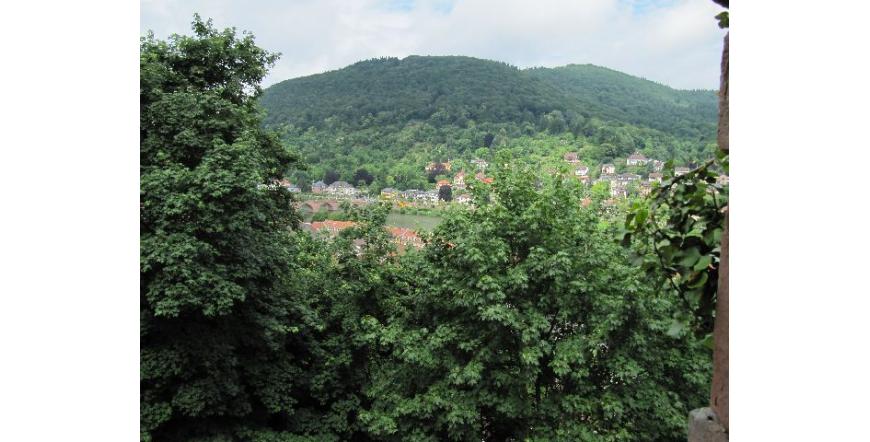
Heidelberg is a city in southern Germany, in the northwestern part of the federal state of Baden-Württemberg. The city is located on the lower reaches of the river Neckar, which divides the city in two, between the cities of Frankfurt am Main and Stuttgart, and near the cities of Mannheim and Ludwigshafen. The city is surrounded on the east by the peaks of Koenigsstuhl, Geisberg and Heiligenberg.
Heidelberg is part of the German tourist road Bergstrasse, which unites settlements on the western slopes of the Odenwald mountain. Heidelberg covers an area of 108.83 square kilometers, which houses a population of about 150,000 people.
Heidelberg is located in one of the warmest areas of Germany. This prerequisite is very important so that plants atypical for these latitudes, such as almonds, figs or olives, can be grown here.
The history of Heidelberg can be traced back to the time of the Celts, Alemanni, Franks and Romans. But the name of this city was first mentioned in 1196, because then it was mentioned in a charter of the monastery of Schonau. From this city in the past even ruled the Holy Roman Empire, as for centuries Heidelberg was the capital of its emperors - the princes of Kurpfalz. These five centuries have been centuries of prosperity. In 1386, the first university in Germany, for example, was established.
The romantic Heidelberg also suffered destruction, but was rebuilt in the Baroque style. In 1803 the city became part of the Grand Duchy of Baden. In the 19th century, Heidelberg became a creative home for many philosophers and poets, and the city of Neckar began to develop as a university center.
Today, Heidelberg is a wonderful blend of traditional and modern. In the past and now it is a scientific and artistic center. Its old reputation as a science center is imprinted in the face of some of the oldest universities in Europe and many research centers. Due to its many attractions and the Old Town, which bears the stylistic features of different eras and especially the Baroque, it has become one of the main tourist destinations in Germany and Western Europe.
About 3 million tourists from all over the world visit Heidelberg every year to enjoy its authentic Baroque architecture and at the same time see its modern face.
Heidelberg is one of the few larger German cities that has a significantly large preserved old part. This is thanks to a lucky star who saved the city from the enduring and severe of World War II.
In its old part, Heidelberg is the proud owner of one of the longest pedestrian areas in Europe. It is on it that everyone who takes a pleasant walk can experience real pleasure. Because you are immersed in the wonderful world of many landmarks, museums, as well as numerous shops, cafes and bars. Much of the architecture of the old town is marked by the preserved Baroque architecture.
There are many different museums in Heidelberg. The Kurpfalz Museum houses a rich collection dedicated to the history of the city and Kurpfalz. Ethnographic Museum, Museum of the Art of the Mentally Ill, Museum of Pharmacy, Museum of Packaging, House Museum of the First Reich President - Friedrich Ebert and others. - The list of museums is not exhaustive with them.
One of the emblems of Heidelberg is the castle in Heidelberg. It rises majestically with its reflections in pastel tones between the old quarters of the city and the hill. Today it is undoubtedly one of the biggest tourist attractions in the city. Styles and eras between the 13th and 17th centuries are intertwined in the architecture of the castle. This castle was the main residence of the princes of Kurpfalz.
The world-renowned Heidelberg University Center owes its fame to Ruprecht-Carls-University or Heidelberg University for short. It was founded in 1386 and is one of the oldest in Europe. The University of Heidelberg was founded by Ruprecht I and the Grand Duke Karl-Friedrich of Baden, after whom it was actually named. Heidelberg's fame as a university center is in the field of medicine and natural sciences. It is rare to find a university that has given the world 9 Nobel Prize winners.
Vote:
Rating 1 from 1 voted
More sights in Germany


Weather in Heidelberg, Germany

18.57 °C
Wind: 2.06 m/s
Humidity: 95 %
Pressure: 1007 hpa
Clouds: 100 %
Wind: 2.06 m/s
Humidity: 95 %
Pressure: 1007 hpa
Clouds: 100 %