

Hamburg, Germany
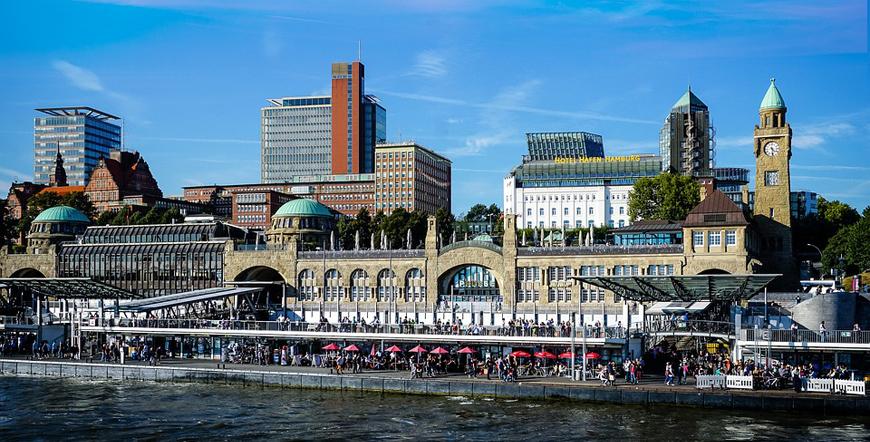
Hamburg, or the Free Hanseatic City of Hamburg, is the second largest city in Germany and seventh in the European Union, as well as the largest non-capital city in the EU.
It is located where the rivers Ulster and Bile flow into the river Elbe, about 110 km from its confluence with the North Sea. Hamburg is the German city with the most millionaires, who traditionally donate part of their wealth to about 1,000 foundations focused on various aspects of city life. Hamburg is also known as the city with the most bridges, as well as the greenest city in Germany. Hamburg is also home to the country's largest river island, home to the Wilhelmsburg district. The number of bridges with Hamburg surpasses even the beautiful Venice, which is notable in this regard. Even Amsterdam and London have fewer bridges, which makes Hamburg a leader and puts it on the crown of the European city with the most bridges.
The history of Hamburg begins in the 4th century BC, when the first settlers arrived here. It all starts with a church that was built in 810 by Charlemagne to baptize the pagan north. To protect both the population and the church, the fortress of Hamburg was built. The history of today's city was enriched after Louis the Pious established a diocese in Hamburg in 831, which soon became an archbishopric. Hamburg was conquered successively by the Vikings in 845 and the Encouraged in 915.
In the 14th century Hamburg became a member of the Hanseatic League, and in 1558 one of the first German trading exchanges opened its doors here. Gradually, Hamburg remains one of the most important trade centers in northern Germany, whose progress is not hindered by any historical events, and even more and more progress in economic development.
In the 20th century, Hamburg-America became the largest transatlantic shipping company. The city is also home to other shipping companies, with lines to South America, Africa, India and East Asia.
Famous for its past, Hamburg is still one of Germany's main industrial centers. It houses the Airbus factory, the Bloom & Foss shipyard, the Nivea plant and production plant and theses for the consumer goods manufacturer Beiersdorf, the German Philips plant, Europe's largest copper plant Aurubis, one of the two grand piano factories and Steinway Piano, the Mont Blanc Pen Company, the Holsten Brewery, the German headquarters of the consumer goods manufacturer Unilever and many more.
The city is not only industrial, but also one of the largest media centers in the country. Hamburg is home to the state television ARD, the headquarters of the GDR radio and television company, the headquarters of the largest German news agency DPA, the largest publishing house in Europe Gruner & Yar and some of the largest publishing houses in Germany such as Spiegel, Zeit, the Hamburg branch of Axel Springer, the headquarters of many international advertising agencies, the German headquarters of Warner Music and others.
Like most Western European cities, Hamburg has remarkable multi-style architecture and majestic buildings. But the trademark of the landscape are the six towers that penetrate the city panorama. These are the towers of the five main churches of the city, as well as the town hall tower. The church "St. Michael” is the emblem of the city. The specific for this famous Hamburg church "St. Nikolai” is that today no services are held in it, but it simply exists as a memorial to the Second World War.
The town hall tower is the secular opposite of the church towers. The town hall building was built in 1897 and has a total of 647 richly decorated halls and rooms. Other architectural landmarks of the city include the Chilehaus commercial building from the late 1930s, the Central Station, opened in 1906, Speicherstadt - a complex of duty-free warehouses, a cultural monument from 1991, the Planetarium, Landungsbrucken, etc. In fact, no less famous are, for example, the port, the Kolbrand Bridge, the fish market, and the Hagenbeck Zoo - interesting in that it is the first in the world without animal cages.
Hamburg's main arteries are Jungfernschig, as well as the main shopping street Mönkebergstraße.
Hamburg is a city that is blessed with numerous parks and green spaces. The State Park, where the planetarium is located, is preferred by the residents for walks, sports and picnics. Plant un blomen is the old botanical garden and is located in the heart of the city.
Another thing that is not missing in Hamburg are the museums. The city has about 50 museums. Among the most famous are the Hamburg Historical Museum, which has the largest collection of objects related to urban history in Germany, the Museum of Arts and Crafts, Spicy's - the Museum of Spices, the Neuengame Concentration Camp, the Museum of Erotic Art and The Ethnological Museum.
The cultural life in Hamburg is at an extremely good level. The first public opera in Germany was opened on January 2, 1678 in Hamburg. Today, she is known all over the world and can boast of the fact that Montserrat Cabaye began her world-famous career there, and her guests were stars of the rank of Luciano Pavarotti and Maria Callas. There are two public and many private theaters in Hamburg. Bulgarian director Teddy Moskov regularly tours Hamburg with his productions.
Hamburg is considered the German capital of musicals. Andrew Lloyd Webber's "Cats" was played here for the first time in the country. Current performances are "The Lion King", "Mamma mia!" and Dirty Dancing. Along with them, many smaller famous musicals are played.
Continuing with what is not missing in Hamburg, it is time for celebrations and fiestas. The biggest event is the celebrations on May 7, dedicated to the birthday of the port. They last for three days and the number of visitors exceeds one million.
Other major events are the so-called Alsterfergnugen around Lake Ulster (August) and the Kirschblütenfest, which testifies to the warm relations between Hamburg and Japan (May). The most famous street festivals are Shanzenfest at the end of summer and Altonale.
Vote:
Rating 5 from 1 voted
More sights in Germany


Weather in Hamburg, Germany

17.97 °C
Wind: 1.54 m/s
Humidity: 85 %
Pressure: 1004 hpa
Clouds: 0 %
Wind: 1.54 m/s
Humidity: 85 %
Pressure: 1004 hpa
Clouds: 0 %