

Dragon Castle, Germany
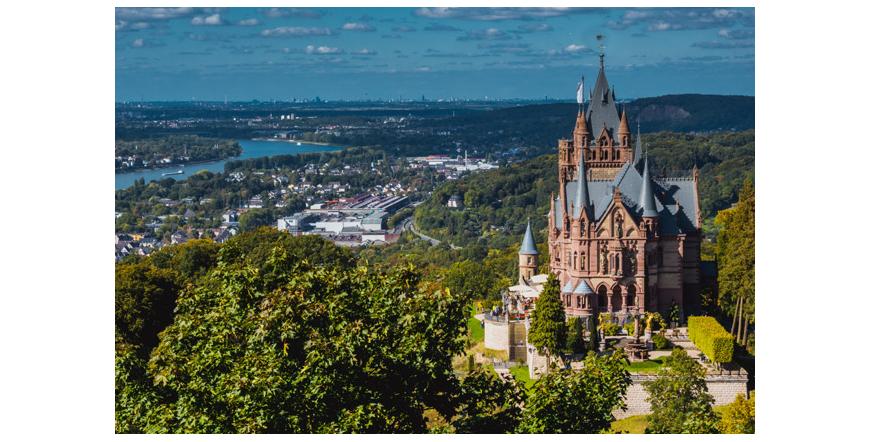
High above the banks of the Rhine, Germany in the heart of the Siebengebirge area near Bonn - a Dragon Castle (Schloss Drachenburg) perched picturesquely. Amazing landscape. It was here that Siegfried, the hero of the Nibelungen legend (also sung by Richard Wagner), defeated the dragon and became invisible. A legend tells how this hero smote the dragon Finfir, which won him the affection of the people and the love of Queen Brunhilda. Impressed by Siegfried's courage, the queen presented him with the treasures guarded by the dragon, among which was a ring belonging to the Nibelungs (translated as "children of darkness").
Drachenburg Castle, also known as the Dragon Castle, is a stunning architectural masterpiece that impresses with its beauty and perfection. The seasons have a strong influence on its radiance, but it is difficult to judge when it is most magnificent - in winter or summer, during the day or at night. It is so imposing that its bearing impresses tourists even before they step into its exquisite halls.
The Dragon Castle is man-made and is located in the northern part of one of the German states of Rhine-Westphalia. Drachenburg Castle is built on the slope of the Drachenfels mountain, from where a spectacular view of the Rhine River opens up.
Dragon Castle was built in the incredibly short period of two years - in the period from 1882 to 1884 as a private home for a bohemian at heart and a banker by profession. The idea to build the Dragon Castle was provoked by the decision of Baron Stefan von Zarter, who is a banker and wanted to retire from the hectic life of the stock exchange in Bonn, spending the rest of his life in nature in a calm and quiet place.
The banker stopped in Westphalia and assigned the project for the construction of his residence to three of the most famous German architects - Leo von Abbema, Bernhard Tueshaus and Wilhelm Hoffmann. Given a field for expression, the three talented architects put their all into creating a masterpiece, which is recognized as one of the largest palace complexes of the 19th century. Unfortunately, ironically, the baron never lived in it.
After the death of Baron von Zarter in 1902, the Dragon Castle passed into the hands of the Baron's nephew – Jacob Biesenbach. Jacob decides to transform the castle and turn it into an elite hotel. The Dragon Castle had an extraordinary Exhibition Hall where, over many years, Baron von Zerter had collected extremely valuable and beautiful works of art.
After inheriting the residence, Jakob Beisenbach sold off the collection so that he could invest heavily in the upkeep of the exceptional castle. After his death, the ownership of the castle changed several times, with the owners turning it into a Catholic boarding school and a railway school. When Adolf Hitler came to power, the castle was turned into a National Socialist military school. The Second World War and its hostilities did not pass the Dragon Castle and it was partially looted and destroyed by bombing.
The post-war period was also cruel and the castle was completely neglected and became a ruin. But he rose like a phoenix from the ashes thanks to Paul Spinat. He saved the unique masterpiece from destruction in 1972, after buying the ruins of the castle, and in just one year managed to restore it completely. Paul Spinat moved to live here and yet, until his death in 1989, left the castle doors open to all who wished to visit.
Today, this unique architectural creation is owned by the province of Westphalia and is annually visited by hundreds of thousands of tourists from all over the world.
Vote:
Rating 5 from 1 voted
More sights in Germany


