

Freiburg, Germany
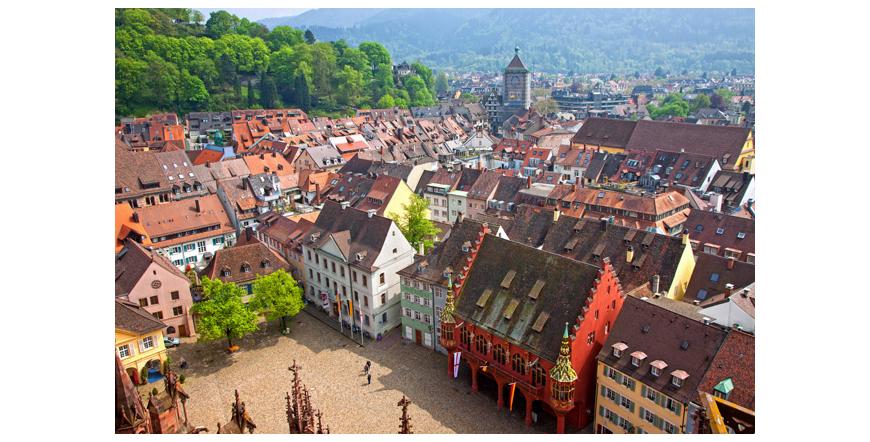
Freiburg is the fourth largest, as well as the southernmost, German city in the state of Baden-Württemberg. Freiburg is located in the Black Forest, on both banks of the river Dreisam at the foot of the Schlossberg hill. Its location is strategic. It is located at the crossroads between the North Sea and the Mediterranean and between the major European rivers Rhine and Danube.
Duke Konrad Tseringensky laid the foundations of the city in the twelfth century, distinguishing it, due to its strategic position, as a free trade city, whence its name. In 1368, today's Freiburg became the property of the Habsburgs, who gave the city considerable self-government. In 1457, Duke Albrecht VI founded the University of Albert-Ludwig, one of the oldest in Germany.
In 1520, significant legal reforms were introduced in the city, significantly balancing between Roman law and the old German traditions and including a city constitution. In the same year, the locals opposed the Reformation, making Freiburg an important bastion of Catholicism on the upper Rhine.
From the 17th to the 19th century, the city was successively under Austrian, French, Swedish and Spanish rule, as well as under the control of various members of the German Confederation. Freiburg is a tourist magnet for those who love the comforts of a European holiday. The old part of the city gives an attractive touch to the appearance of Freiburg - in fact a partial reconstruction of the center of the old city, which was destroyed during World War II.
Towering over everything, the Church of Freiburg shines with its unique architecture. It is the other jewel of the city, which leaves unique memories in visitors. The cathedral is one of the greatest masterpieces of Gothic architecture in Germany, with beautiful interiors and many works of art.
It is understandable why Freiburg is a popular choice for wine connoisseurs - there is simply no other large German city with so many vineyards within its borders.
In Freiburg, the Augustinian Museum is also of interest, housed in an old house belonging to an Augustinian nobleman. This museum houses collections of artistic and historical facts about the city and the Rhine region. Here you can see the work of Matthias Grunewald "The Miracle of the Snow", as well as glassware, stained glass and sculptures.
At the end of the Salzstrasse in Freiburg is another work of art, due to the style of its medieval architecture - Schwabentor. In an old monastery in Freiburg today is the Museum of Natural History, dedicated to geology, botany and zoology. The Museum of Ethnography is dedicated to East Asia, Egypt, Africa, the Indians of North America and Australia.
Vote:
Rating 3.5 from 2 voted
More sights in Germany


