

Magdeburg, Germany
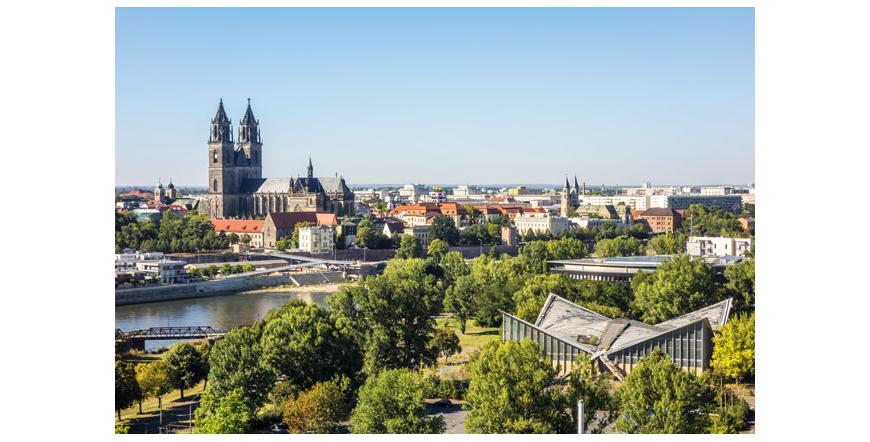
Magdeburg is a city in eastern Germany, the center of the state of Saxony-Anhalt. Magdeburg plays the role of a river port as it is located on the Elbe River. Magdeburg is a center of metallurgy, engineering, sugar industry, etc. Magdeburg is among the most important medieval cities of Europe.
Magdeburg owes some of its fame to Emperor Otto I, the first Roman emperor, who lived for much of his time in the city and was buried in the cathedral after his death. Magdeburg is also known for its interpretation of German city law, known as Magdeburg Law. This version spread throughout Central and Eastern Europe.
The city is also famous for the so-called The "1631 sacks of Magdeburg" that cemented Protestant resistance during the Thirty Years' War. Founded by Charlemagne in 805 as Magadoburg - the name probably derives from the words magado - big, strong, and burga - fortress, in Old German, the city was fortified in 919 by King Henry I against Magyar raids and Slavs.
In 929, Edward's older daughter Edith became the head of the city after she married Henry's son Otto I - this city was simply a gift to the bride after the first wedding night. Edith loves the city very much and spent a large part of her time in it. After her death, she was buried in the crypt of the Benedictine Abbey of Saint-Maurice, which was later rebuilt as a cathedral. In 937 Magdeburg was the seat of the royal assembly.
The Archbishopric of Magdeburg was founded in 968, and Adalbert of Magdeburg was consecrated as the first archbishop. The archdiocese includes the dioceses of Havelberg, Brandenburg, Merseburg, Meissen and Zeit-Haumburg. The archdiocese played an important role in the German colonization of the Slavic lands east of the Elbe River.
In 1035, Magdeburg received exclusive rights in the field of trade, and this happened thanks to the so-called Magdeburg rules spread throughout Central and Eastern Europe. As a result, visitors from many countries began to trade in Magdeburg, but unfortunately the city was almost destroyed by a fire in 1118.
In the 13th century, Magdeburg became a member of the Hanseatic League. Recovered from the fire, Magdeburg became one of the largest cities in the Holy Roman Empire. The city developed an active maritime trade westward to Flanders, with the countries of the North Sea.
In 1631, during the Thirty Years' War, the imperial troops of the count of Tilly Johan, invaded the city and carried out a massive and cruel massacre of about 20,000 inhabitants, and burned the city in the so-called. sacks of Magdeburg. The city managed to withstand the first siege of Albrecht von Wallenstein in 1629, but after the disastrous 1631, only 400 people remained. According to the Peace of Westphalia of 1648, Magdeburg became part of Brandenburg-Prussia as the semi-autonomous Duchy of Magdeburg, immediately after the death of the ruler August von Saxe-Weissenfels.
Magdeburg's troubles did not end there - it experienced several foreign occupations, but the sun still rose above it. By the end of the Second World War, the city already had a population of about 340 thousand and was declared the capital of the province of Magdeburg.
Magdeburg is a city that initially fascinates with incredible cleanliness, smiling and kind people, absolutely benevolent and ready to help. Among the sights of the city are the imposing and majestic cathedrals "St. Johannes", "St. Sebastian" and "St. James" perched on the banks of the Elbe.
Undoubtedly, the symbol of the city is the Magdeburg Cathedral, which is officially called the Cathedral of Saint Catherine and Mauritius. It is the first Gothic cathedral in Germany and is the tallest in East Germany, as high as 104 meters. The cathedral is built on the only solid rock called Cathedral Rock. Today's cathedral was built on the remains of the very first construction of the cathedral, which was completely destroyed and excavations are now being carried out to establish some hitherto unknown facts.
A favorite place of many tourists is an incredible creation in pink - the "Green Citadel", as the modernist buildings and the Hussermann Citadel are perhaps one of the genius creations in Magdeburg. The interesting thing about this citadel building is that it is all pink, and the word "green" is present in its name.
The "Devil's Fountain" is extremely interesting - not only with its appearance, but also with its design, which aims to show human weaknesses. Magdeburg is also full of parks. Not to be missed is the Alley of the Romantic Community, which in Magdeburg is right in the center of the Romantic area. It is in this area that there are many castles, museums and beautiful parks, the zoo, where the endangered snow leopard can be seen.
Vote:
Rating 5 from 1 voted
More sights in Germany


