

Mahatma Gandhi – the great soul of India
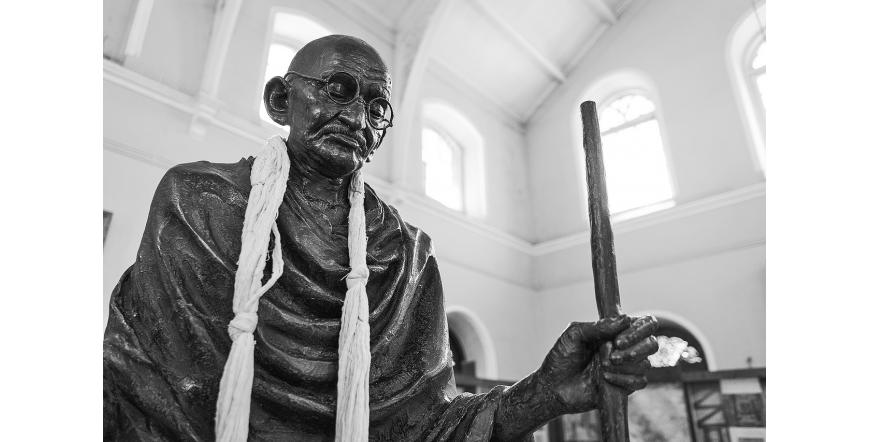
He wanted to change the world with love and kindness. Do it. He lives to show the way for the planet to live after him. A path where malice, hatred and violence do not exist. He is a lawyer, politician, pacifist, fighter for human freedom. He created India. He became the father of the nation and its spiritual leader. He is Mahatma Gandhi – the great soul of India.
"Future generations will find it hard to believe that such a man, of flesh and blood, ever walked the earth." These are the words of the genius Albert Einstein, who lived in the time and era of Gandhi. They say it all about one of the greatest personalities known to mankind. 149 years have passed since the day Gandhi was born, but his vows still resonate everywhere on earth. Inspiring millions in their personal life journey.
Today, Gandhi's spirit lives on all over the country, but there is one place that must be visited. A place not to be missed on a trip to India - Aga Khan Palace in Pune, Gandhi's memorial. The majestic White Palace was built in 1892 by Sultan Muhammed Shah Aga Khan III. In 1942, Gandhi was imprisoned for nearly 2 years there along with his wife Kasturba Gandhi and his long-time secretary Mahadev Desai for his struggle for India's independence from the British Empire, during which time his two closest companions in life died. In 1969, the palace was donated to the Indian people by the Aga Khan IV as a mark of respect for Gandhi and his philosophy, and nowadays there is a memorial there to house his ashes. These facts make the place sacred for the entire Indian people. Every year, pilgrims arrive from all over the country, and thousands of adherents of Gandhi's philosophical views from all over the world receive visas for India to honor his memory and that of his relatives.
The life of the father of the Indian nation is a harrowing story of struggle. Struggle to live with dignity and be free. A struggle in which there is only love and not a drop of violence. It all began in 1893. Then Gandhi, a 23-year-old lawyer, arrived to work in South Africa. He immediately faced horrific discrimination because of the color of his skin, to which he became a victim more than once and twice. He began political activity in the country, fighting for more rights for Indians and developed a concept of non-violent resistance that he called "Satyagraha", which later became an inspiration for figures such as Martin Luther King and Nelson Mandela.
In 1915, Gandhi returned to India and began a long struggle for the country's independence. His weapons against the British Raj were peaceful resistance, non-violence and non-cooperation. It organizes hundreds of initiatives, campaigns and marches among the local population. Calls for a mass boycott of all British goods, British educational institutions and courtrooms. Makes people leave government jobs and leave British titles and honors. However, he never uses force in the fight, strictly following his principle that any form of violence is evil and cannot be justified. Gandhi was adamant: an eye for an eye ends only in the whole world becoming blind.
Over the years, the Father of the Indian Nation was arrested numerous times by the British colonial authorities, spending a total of eight years in prison. However, his answer is always only one - love. Three times during his tenure, he stopped large-scale campaigns that were about to achieve the much-desired independence, only because they reached the brink of violence. "Violence is the weapon of the weak," said Gandhi.
Eventually, on June 3, 1947, British Prime Minister Clement Attlee proclaimed the country's independence, dividing British India into two parts: predominantly Hindu India and predominantly Muslim Pakistan. Gandhi's words remain forever: "First they ignore you, then they laugh at you, then they fight you, and finally you win."
The father of the Indian nation passed away on January 30, 1948, while working on the draft constitution. Ten days earlier, there had been a failed attempt to assassinate him - the country's leader was addressing the faithful from the veranda of his home in Delhi when a refugee from Punjab threw a homemade bomb at him. There are no injuries. The government insisted that his security be strengthened, but Gandhi refused: "if I am destined to die by the bullet of a madman, I will do so with a smile."
On the fateful January 30, the Father of the Nation stepped out onto the lawn in front of his home, where he was greeted tumultuously by his supporters. At that moment he was overtaken by three bullets fired by Nathuram Godse, a Hindu nationalist, because of his tolerance of Muslims. Gandhi whispered “Oh Rama! O Rama!'' makes a sign that he forgives his murderer and closes his eyes forever.
After all, in our time, Gandhi's birthday, October 2, is celebrated all over the world as the International Day of Non-Violence. And his words "there is no way to peace - peace is the way" should be followed by every single world political leader. Then the world would be a better place. To be what Gandhi fought for.
Vote:
Rating 5 from 1 voted
More sights in India


