

Gangtok, India
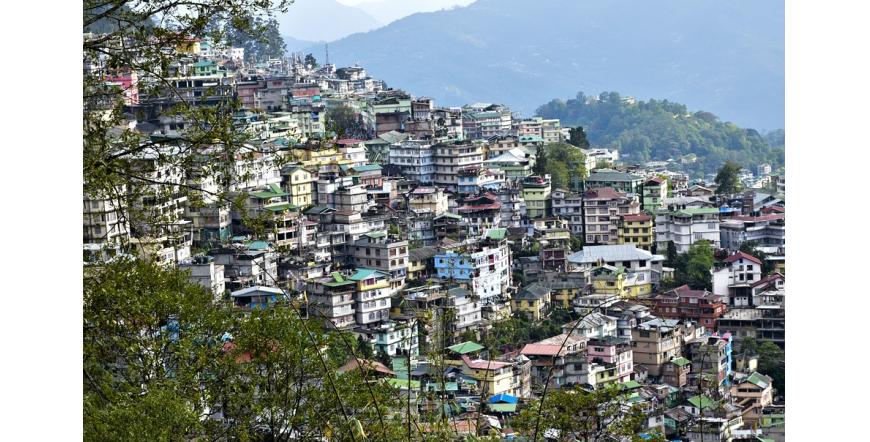
Gangtok is a city in India, beautifully situated in the eastern part of the Himalayas and the largest city of the province of Sikkim. Its population is about 100 thousand people. Nestled among one of the high hills of the Himalayas at an altitude of 1,780 m, Gangtok enjoys a temperate climate throughout the year and is therefore at the center of Sikkim's tourism industry. If you visit Gangtok in May, all along the winding mountain road, you will be delighted by the beautifully blooming rhododendrons. After 1894, when the British came to these lands, from a small settlement, Gangtok became a thriving city. Then it became the capital of the state of Sikkim. Gangtok is a center of Tibetan Buddhist culture with interesting houses painted in different colors and with pagoda-like roofs.
The city became famous after 1840, when the Enchei monastery was founded. According to legend, this is where the tantric master Lama Druptob Karpo landed after flying from the top of Menam Hill. The main Tibetan deities in the temple are Buddha and Guru Padmasambhava who are believed to have died at this place. On the walls of the temple there are extraordinary frescoes depicting Buddhist deities. According to believers, these deities always fulfill the wishes of their devotees.
One of the interesting places to visit in Gangtok is the building of the Namgyal Research Institute of Tibetology. A fine example of traditional Tibetan style, the museum impresses with its colored carvings and murals. A renowned center of Buddhist learning, the institute has one of the world's richest collections of rare Buddhist books, icons, manuscripts and thangka-banners with religious images. A thangka is a remarkable craft, an intricately hand-painted religious scroll in brilliant colors on cloth that hangs in a monastery or family altar.
Gangtok is a city with amazing scenery, but the best time to visit is from March to May. During the monsoon months from June to September, it is shrouded in fog and rains, but in January, the religious festival of Chaam takes place here. And a visit to the wonderful orchid park, where there are about 450 species of these remarkable flowers, is a wonderful experience.
On the beautiful flower-strewn road winding above the city, apart from the magnificent view of the Himalayas, one can see the governor's residence at one end of the road and the palace situated at an altitude of 1,800 m above sea level on the other side of the road. The palace is opened to visitors once a year during the Tibetan New Year holiday, when thousands of people flock to see the famous Black Crown Dance, symbolizing the victory of good over evil.
Besides the Enchei Monastery, which is the oldest in the city, other famous Buddhist temples are the Do-Drul Chorten Stupa and the Rumtekst Monastery. Do-Drul Chorten is a stupa built in 1945 by Trushlik, head of Nyingma Tibetan Buddhism. It is one of the largest and most important temples of its kind in Sikkim. It houses precious relics, holy books and mantras. Around the building are 108 mani or prayer wheels. The stupa also houses a religious school.
The Rumtek monastery, located on the outskirts of the city, was built in the 1960s, modeled after the Lhasa monastery in Tibet. It is one of Buddhism's holiest monasteries and houses some of the rarest Tibetan Buddhist scriptures. In addition, it offers an impressive view of the third highest peak in the world - Kangchendzong.
Near the city of Gangtok are the temples of Tashi and Hanuman, which are visited by many devotees who believe in the abilities of these gods to defeat dark forces.
Ecotourism is an important economic activity in the Gangtok city area, including trekking, mountaineering, river rafting and others. The amazing nature, the beautiful lakes near the city, the Botanical Garden and the parks are a great place to relax for local and foreign tourists. The nearest railway station is 124 km from Gangtok and the nearest airport is Vagdogra in the nearby town of Siliguri. Taxis are the most widely available form of public transport in Gangtok. Most of the city's residents travel by their own transport, as city buses account for only 1% of vehicles. There are many religious festivals in Gangtok because of the diverse ethnic population of Nepalese, Tibetans, Christians and Muslims. Christmas, Holi, Dashain, Tihar and many more are celebrated here.
A popular food in Gangtok is momo, a steamed dish of pork and beef with vegetables in a thick gravy. The local beer is called "chang" and is served in bamboo cups, with reed or bamboo straws. The people of Gangtok are very musical. Apart from local music, western rock music is also often heard, so a visit to this interesting Indian city can be a great experience.
Vote:
Rating 5 from 1 voted
More sights in India


