

Mysore Palace, India
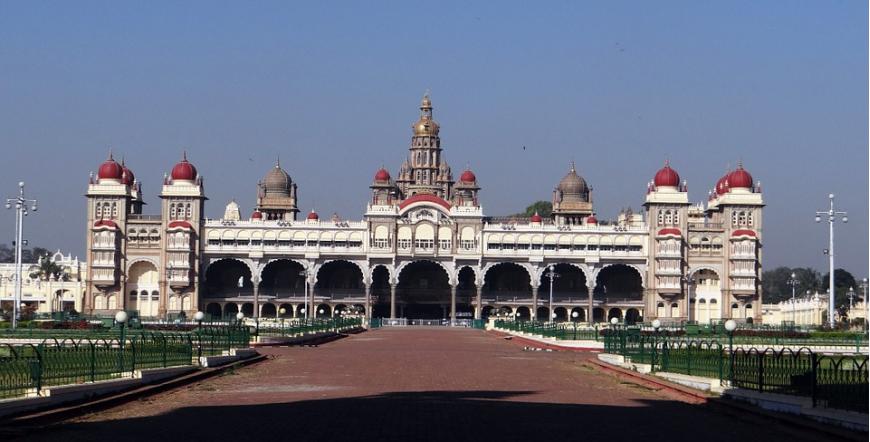
The Mysore Palace, defined as one of the most magnificent royal buildings in India, is located in the city of the same name in Karnataka, South India. Mysore Palace is located in the central region of the interior of Mysore, opposite the Haundiya Hills to the east. The palace was the official residence and seat of the rulers of the royal family of Mysore, which ruled the country from 1399 to 1950.
The Mysore Palace is a fabulous palace, representing the three-storied stone building, which is made of fine gray granite and pink marble domes. The architecture of the Mysore Palace is subordinate to the Indo-Saracenic style. This jewel in the crown of the city of Mysore Palace is distinguished by the 145-foot (1 foot = 30.48 cm) five-storied tower with a gilded dome. Its facade is decorated with large arches supported by tall columns. In the palace complex, apart from the so-called durbar halls – ceremonial meeting rooms of the royal court, include many unique rooms, impressive courtyards, gardens and 12 Hindu temples. Another memorable landmark is a wooden elephant lavishly decorated with 84 kilograms of gold.
The history of the Mysore Palace began in the 14th century when King Yaduraja first built a palace in the Old Fort of Mysore. This palace was destroyed and rebuilt several times. The Regent of Mysore, Her Majesty Maharani Vani Vila Sannidna and her son, the Maharaja of Mysore, His Highness Rajashi Krishnaraja Udidar IV commissioned the British architect Lord Henry Irwin to erect a new palace to replace the old one, which had been reduced to ashes in a massive fire. During the period when the new palace was being built, the royal family stayed at the nearby Jaganmohan Palace. The construction is going on under the watchful supervision of BP Raghavulu Naidu who is the Executive Engineer at Divizia Mysore Palace. He carried out a number of elaborate architectural studies during visits to Delhi, Madras and Calcutta, thanks to which he gathered ideas that he used in planning the new palace. Eventually, the Mysore Palace was completed in 1912 and became a magnificent masterpiece that is visited daily by hundreds of people from all over the world. The lavishly decorated interior of stained glass windows, mirrors, carved wooden doors, mosaic floors and a spectacular garden draw more than 6 million visitors a year. The scenes of every detail in and around the palace are very eye-catching, but there is a ban on photography in the main palace complex by the authorities.
As we have already said, the construction of the present palace was commissioned in 1897, completed in 1912. The Mysore Palace was extended in 1940 (including the addition of the present Durbar Hall public wing) during the reign of His Highness Maharaja Jayamamajdra Wadiyar, who was the last Maharaja of the Kingdom of Mysore. Despite the fact that the construction of this architectural wonder ended in 1912, the fortress continued to be decorated and expanded, and its inhabitants slowly moved to the newer fortification built in the palace.
The architectural appearance of the Mysore Palace is a mixture of Hindu, Muslim, Rajut and Gothic styles. Mysore Palace is surrounded by a large garden. The entrance gate and archway hold the emblem and coat of arms of the kingdom of Mysore, around which is written the kingdom's motto in Sanskrit "never be dismayed". This beautiful building is 245 Ft long and 156 Ft wide. The Mysore Palace has three entrances – the East Gate, the South Gate (open to the public) and the West Gate (usually open only during Dasara). In addition, the palace complex has numerous secret tunnels starting from the palace courtyard and leading to Srirangapatna, other palaces and confidential areas.
The palace building in Mysore has a facade with several expansive arches and two smaller ones flanking the central arch, which is supported by tall pillars. Above the central arch is a sculpture of the goddess of wealth, prosperity, luck and abundance with her elephants. There are three main exclusive temple buildings within the Old Fort and about eighteen within the palace building. The Maharajas of Mysore Palace were very devoted to Goddess Chamunddi, so the palace faced the Haundi Hills. This is how the ritual practice for the blessing of the goddess Chamuni was performed.
As mentioned above, the palace complex includes twelve Hindu temples. The oldest was built in the 14th century and the latest was built in 1953. Some of the more famous temples are:
Smeshevara temple dedicated to Lord Shiva
Lakshmiramana Temple dedicated to Lord Vishnu
Shwetha Varahaswamy Temple dedicated to Lord Varahaswamy, one of the 10 incarnations of Lord Vishnu
Sri Bhuvanveshwari Temple
Sri Gayatri Temple
At present, a large part of the palace is under the control of the Government of Karnataka. Only a small part of the palace, towards the West Gate, is in the possession of Princess Pramodadevi Wadiyar. In fact, the Karnataka High Court has ruled in favor of late Prince H.H. Sryankadada Narasimharaja Wadiyar, that the palace belongs to the royal family. However, the Karnataka government appealed the case to the Supreme Court. The case is still pending as the prince died on December 10, 2013 and was unable to continue his fight against the government.
The Mysore Palace looks stunning, especially on weekends when it is illuminated by nearly 100,000 lights that highlight its majestic profile at night. The Mysore Palace is open to the public, with tours organized daily. Visitors can enjoy a collection of sculptures, paintings and artefacts, including 700 weapons of the Maharaja, including spears, swords, pistols and more, dating back to the 14th century.
The Palace in Misro is ten minutes from the Central Railway Station and the Suburban Bus Station, and twenty minutes from the Mysore Airport. The domestic airport is directly connected to the international airports at Bangalore, Chennai, Thiruvanvanhapuram, Hyderabad, Mangalore and Bombay.
Vote:
Rating 5 from 1 voted
More sights in India


