

Agra Fort, India
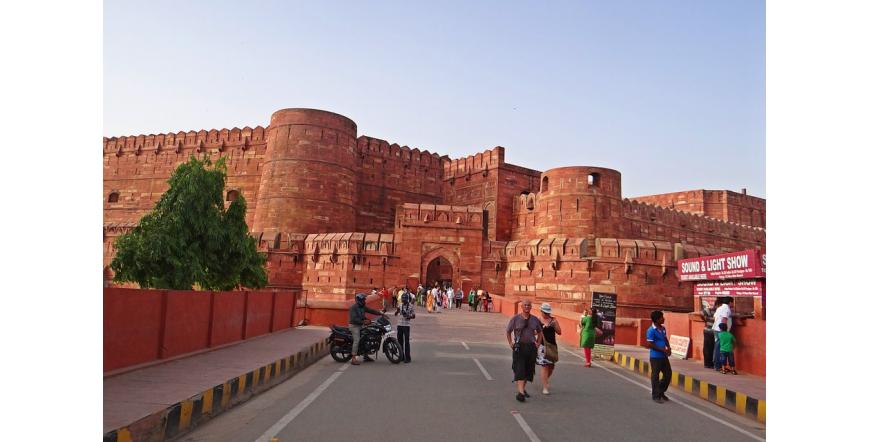
If you decide to travel to India, what you can expect is variety. A variety of foods, cultures, landscapes and languages. A variety of objects that fall into the list of UNESCO's world cultural and natural heritage. India can boast of as many as 35 such sites. The curious thing is, however, that tourists en masse visit about a dozen of them, while the rest stay somewhat aside. We will tell you about one such object now. Agra Fort or the Red Fort, located in the city of Agra, should not be missed on a trip to India, although it is often overshadowed by the Taj Mahal. The following lines will convince you of this.
The year is 1573. For nearly 20 years, the Mughals and their Mughal Empire have ruled the Indian subcontinent. Then, during the reign of Akbar, the third emperor of the dynasty, Agra Fort was rebuilt to become the main residence until the capital of the empire was moved to Delhi. The emperor wanted the power and impregnability of the fortress to correspond to the greatness of his rule. The construction lasted more than 8 years, and more than 4,000 workers were involved in it.
Built of red stone and spread over 380,000 sq. m., Agra Fort amazes with its architecture. It contains a mixture of Persian, European and Indian ornaments. The fortress has an irregular shape and is surrounded by two walls making many curves - the outer one is 40 meters high, and the inner one - 70 meters. Powerful battlements with small firing holes were erected at certain distances, which made it difficult for the enemy and protected the defenders of Agra. For additional security, a deep ditch was dug around the fort. Where the Yamuna River abutted the fort, no such moat existed because it sufficiently protected the walls.
The construction of the fortress continued under the fifth emperor of the dynasty - Shah Jahan, and if you get a visa for India today and visit it, you will understand that its external appearance is only a small part of its greatness. Inside the fortress, there are many amazing buildings that impress with their architecture and elegance. Most of them were built precisely by Shah Jahan, the creator of the Taj Mahal.
One of the lavish buildings is the Jahangiri Mahal. The palace is built of red stone and is an intricate tangle of corridors, rooms, halls, galleries and balconies. A strikingly beautiful example of Mughal architecture at its best. It was mainly used by the wives of Emperor Akbar.
Another gem of Agra Fort is the Nagina Masjid. The mosque was built in 1631 by Shah Jahan and is made of white marble. There is a marble courtyard enclosed by walls on the north, south and east. The prayer room is on the west side, the central facade of which contains three arches supported by columns, the main arch being larger than the other two. On both sides of the entrance there are openwork marble parapets, which add additional beauty to the building. The roof of the mosque ends in three bulbous domes with tops resembling an inverted lotus.
From the reign of Shah Jahan, there is another palace in Agra Fort – Shah Jahani Mahal. It was remodeled to the emperor's taste in 1628, and its walls were decorated with beautiful floral elements. The pavilion, which faces the river, is octagonal in shape and contains one large central hall. The palace has two rooms facing the east side, one room facing the south side and a central corridor. According to historians, Shah Jahani Mahal is proof that during his reign Shah Jahan wanted to "dress" Agra Fort entirely in white. The emperor demolished some of the buildings built during the time of his grandfather Akbar and replaced them with buildings of white marble, according to his design. For this reason, the structure of Shah Jahani Mahal, originally created from red stone, was covered with white limestone plaster that imitated marble.
Shah Jahan's love for white marble as a building material is also evidenced by the Diwan-I-Am - the hall for meetings and holding meetings with the representatives of the Mughal court. The hall is divided into three wings, and the facade is decorated with nine gracefully curved arches. The issued room, from which the emperor addressed the assembled people, is surrounded by three arches and richly ornamented with precious stones forming floral motifs.
The Diwan-i-Khas was the private meeting place used by the emperor when visiting other rulers, nobles and ambassadors. Both issues affecting the ruler's personal life and important state affairs were discussed here. The building contains numerous marble columns decorated with floral motifs. On the terrace were two thrones, one of white marble and the other of Jahangir, of black marble. Unfortunately, the interior was completely looted after the Indian Rebellion in 1857.
Nowadays, regardless of the vicissitudes of time, Agra Fort jealously guards the spirit of the Mughal Empire era and a trip to India will convince you of this. The majesty of the emperors builds from the exquisite halls, the wonderful gardens, the mystical mosques. At all from the entire Agra Fort. Greatness in red.
Vote:
Rating 5 from 2 voted
More sights in India


