

Golden Temple, India
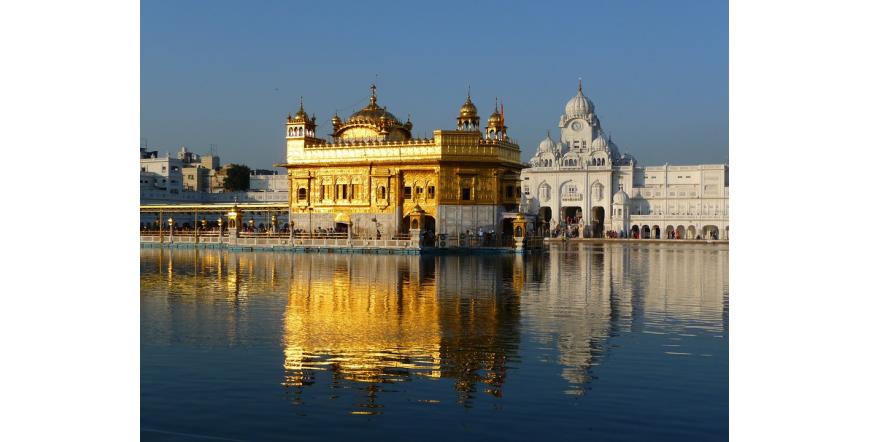
The Golden Temple in India is the holiest shrine for Sikhs. It is located in the city of Amritsar, which was founded in 1577 by Guru Ram Dass, the fourth Guru of the Sikhs. The city is a center of Sikh history and culture. The Golden Temple stands on a rectangular platform surrounded by a pool of water.
The construction of the Golden Temple, also known as Harimandir Sahib, was prompted by the idea of building a place of worship where men and women of all classes and religions could approach God as equals. To cement the purity of his purpose and prove his sincerity, Guru Aryan specially invited the Muslim Sufi saint Hazrat Mian Mir to lay the foundation stone of the Golden Temple. The four entrances (representing the four directions of the world) through which one enters the Harimandir Sahib also symbolize the Sikh openness to all people and religions. Over 100,000 people visit the shrine daily for worship and also participate jointly in preparing free food for all irrespective of class and religious differences.
The story goes that Guru Amar Das ordered Guru Ram Das to dig a corner well to serve as a place of worship for the Sikh religion. Guru Ram Das instructed all Sikhs to join the work, entrusting everything to Bhaha Buddha. This well is to be the home of God and whoever bathes in it is to receive all spiritual and temporal benefits. This well is called "Amrita Sarovar" or "Well of Nectar".
In 1578, Guru Ram Das dug the well that later became known as Amritsar, and which gave its name to the city that grew up around it. Ultimately, the Golden Temple was erected in the middle of this rectangular well and became the supreme center of Sikhism. The new shrine houses the Adi Granth and other saints believed to have espoused Sikh values and philosophies, such as Baba Farid and Kabir. Around the well today there are offices, warehouses, dining room, kitchen, guest house and observation towers.
Originally, the idea of creating a holy place of worship for Sikhs was Guru Aryan's. The land for the Golden Temple was acquired earlier by the Guru Sahibi against payment. At the same time, a plan to build an urban settlement was developed, with construction of the reservoir and the city beginning simultaneously in 1570. Work on both projects was completed in 1577.
Let's take a look at the architecture of the Golden Temple, which is a blend of Hindu and Muslim styles. The complex has four entrances, symbolizing the openness of Sikhism. The idea of these four entrances is to show that followers of all religions are allowed inside. At the northern entrance is the famous Clock Tower, and next to the western entrance is the tower-shaped Ahal Takht building, which serves as the seat of the Sikh Supreme Council.
The Golden Temple is a marble building that is reached by a path known as Bridge Guru. In its current form, the three-story marble temple dates back to the 18th century. The reason for its new appearance was heavy destruction by the Afghans. Therefore, today's architecture of the Golden Temple is subordinate to late Mongolian architecture. Colonnades, pointed towers, niches, balconies and parapets are extremely characteristic of mosques and palaces of that time.
The upper floor of the Golden Temple is gilded and topped with a 100-kilogram gold dome in the shape of an inverted lotus, symbolizing the Sikh concern for the problems of this world. The first rays of dawn bathe the temple and create an ethereal atmosphere of the complex. The sunset bathes the Golden Temple and offers countless magnificent and captivating views.
The exterior of the Golden Temple is gilded on the upper two levels, and the interior is decorated with inlaid marble, wood carving, ivory mosaic, embossed gold, frescoes, and embossed gold and silver.
Vote:
Rating 5 from 1 voted
More sights in India


Weather in Golden Temple, India

30.97 °C
Wind: 1.54 m/s
Humidity: 74 %
Pressure: 1002 hpa
Clouds: 75 %
Wind: 1.54 m/s
Humidity: 74 %
Pressure: 1002 hpa
Clouds: 75 %