

Jaipur, India
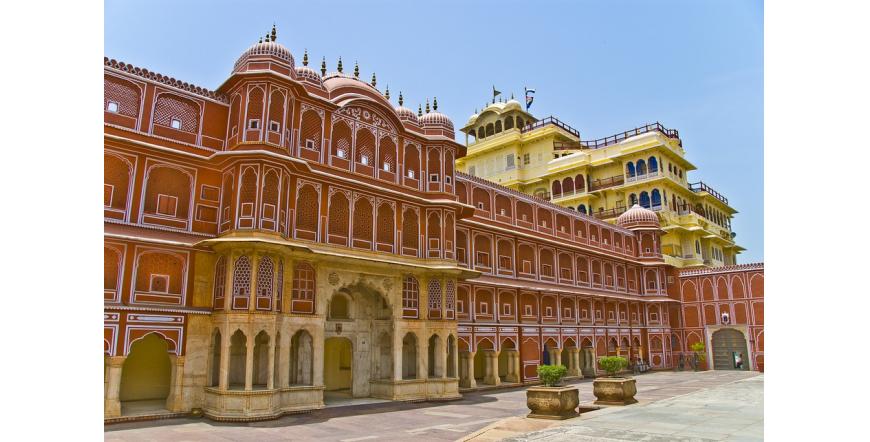
Jaipur is a city in India, located in its northwestern part and the capital of the state of Rajasthan - the ancient desert country of the Rajputs - an Indian caste of warriors, revered by both the Mughals and the British authorities. The population of Jaipur is about 3 million inhabitants. It was founded in 1727 by Jai Singh II and is 265 km from the capital Delhi. The city of Jaipur is called the "Pink City" because of the pink color of the stone used in the construction of the buildings.
Jaipur is believed to be the first city in India with a town plan. It was built using an ancient Hindu architectural doctrine based on astrological signs. The city is built in the form of a mandala (circle) of nine parts, each of which corresponds to one of the astrological signs. All streets in the city follow an east-west and north-south direction. The whole is surrounded by a fortress wall. Long ago the city extended beyond the fortress, but even now the gates of the fortress open at sunrise and close at sunset. The ruler Jai Singh had architectural and astronomical knowledge and built the city of Jaipur as the fulfillment of his quest for grandeur and beauty. Jaipur's fame also comes from being home to the world's largest gem processing center and also one of the largest producers of hand-knotted carpets. Because of its interesting sights, it is a desirable place for tourists to visit.
One of the biggest attractions of Jaipur is the Palace of Winds (Hawa Mahal). Built in 1799, it is shaped like the crown of the Indian god Krishna. This imposing building, built of pink sandstone, has five floors. There are 935 small windows on the central facade, from which women could observe life outside the palace without anyone noticing them. In addition, the palace is built in such a way that the breeze that passes by the numerous windows creates coolness even in the summer heat.
The City Palace is the other landmark of Jaipur. Located in the city itself, it was built between 1729 and 1732. The City Palace is actually a whole complex of palaces and gardens. Unique in architecture, all the buildings are predominantly pink. The inner interior of the palace is dominated by columns, which are not just columns, but are richly decorated, with every two columns forming an arch, and they are numerous. Fantastic lampshades hang from the ceilings and the ceilings and walls are painted with lavish designs.
In one of the halls of the palace there is a weapons collection with about 2,000 exhibits, including pistols encrusted with gold and diamonds, double-edged daggers, helmets and steel maces. In one of the palace's entrances are displayed two large silver water vessels specially made to carry holy water from the Ganges River when the Maharaja visited London in 1902. Today, most of the Palace Complex is home to the Royal Family.
Jantar Mantar is a collection of astronomical facilities built by Maharaja Jai Singh II between 1727 and 1734. The astronomical observatory in Jaipur was modeled after the one in Delhi. It is called Jantar Mantar, which literally means instruments of calculation. This stone astronomical observatory is considered the largest in the world. With its help, the movement of the planets and stars is predicted and an accurate weather forecast is made to this day. The sundial on its territory is the largest in the world. The Jantar Mantar Astronomical Observatory is a UNESCO World Heritage Site.
The Water Palace or Jal Mahal was built in the 18th century in the man-made lake Man Sagar, which is located between the historic city of Amber and Jaipur. The name of the palace comes from the fact that it is located in the middle of the lake itself. It was used for summer residence and wild duck hunting. There is a specially made road to the palace. The palace has five floors, but only the top floor is above water, the others being underwater. Only in the summer, when the water of the lake decreases, the other four floors are visible. A walk through the palace garden and the view from the beautiful balconies of the surrounding Nagargarh hills is impressive.
The Amber Fort is located 11 km from the city of Jaipur and is situated on a hill with dense vegetation. The location was chosen this way for better defensive security. The construction of the fort began in the 16th century by Raja Man Sigha I, but was completed much later by his successor Je Singh I. This fort-palace is an architectural masterpiece that shows the influence of Hindu and Muslim cultures. Amber Fortress is divided into 4 main parts, each with its own entrance and courtyard. The most important was the entrance from the eastern part of the fortress, which was intended for the ruler and was called the "Door of the Sun". This entrance led to the courtyard where the raja held a review of the defenders of the fort. Here was also the place for the horses.
From the second courtyard an imposing staircase led up to the drawing room, which is supported by a double row of columns, each with elephant-shaped capitals. The third part of the fortress is completely separated from the royal palaces. Here is the hall of thousands of mirrors, where a single lamp is reflected in the many mirrors and illuminates the entire room, turning it into a fairy world. The fourth part of the fort belonged to the Raja's wives and concubines. Each of their rooms was connected to the maharaja's bedroom by secret staircases and corridors. The walls of the palace are decorated with wonderful paintings of hunting scenes. The ceilings are beautifully painted and together with the carvings is something to admire.
The palace complex overlooks the calm waters of Lake Maota and looks fabulous, especially in the evening. The foot of the fortress can be reached by bus. Upstairs, the elephant ride to the fort gate is very popular. It is especially interesting to visit Jaipur in March when Holi or the Festival of Flowers and the Festival of Elephants are celebrated.
Vote:
Rating 5 from 1 voted
More sights in India


Weather in Jaipur, India

30.62 °C
Wind: 2.06 m/s
Humidity: 74 %
Pressure: 1003 hpa
Clouds: 75 %
Wind: 2.06 m/s
Humidity: 74 %
Pressure: 1003 hpa
Clouds: 75 %