

Victoria Memorial, India
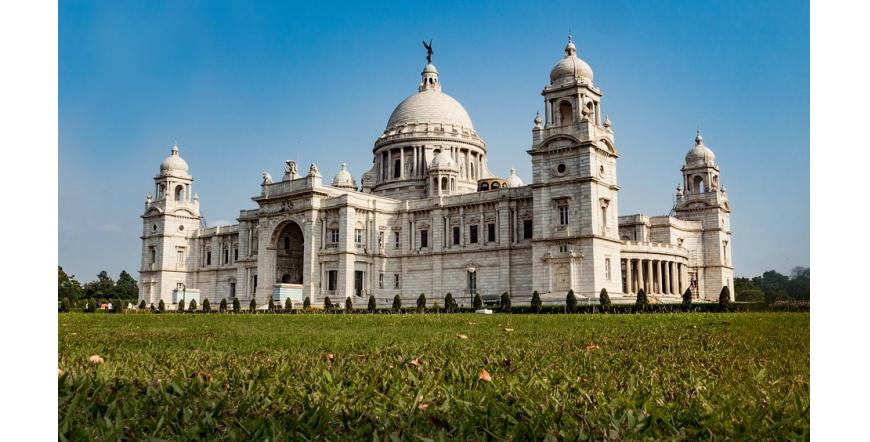
Victoria Memorial, located in Kolkata, is a monument erected to perpetuate the British rule of India. The memorial is dedicated to the British Queen Victoria, who held the title of Empress of India. Currently, the Victoria memorial is used as a museum and is one of the tourist attractions of Kolkata under the auspices of the Ministry of Culture.
The large marble building of the Victoria Memorial is located in Kolkata, West Bengal, India, on the banks of the Hooghly River, near Jawaharlal Nehru Road. The monument was built between 1906 and 1921. The bright white monument is set in the middle of 27 hectares of gardens and rises majestically above the city itself. The memorial is crowned with a bronze statue of the "Victoria's Angel", 4.8 meters high.
The idea of erecting the Victoria Memorial belonged to Lord Curzon, who was the Governor of India in the period 1899-1905. His desire was, after the death of Queen Victoria in 1901, to build a large building with a museum and gardens, and the power of his ambition was reinforced by the words:
"Therefore, let us have a building, magnificent, spacious, monumental, and grand, to which every newcomer to Calcutta will turn, to which all the population, European and native, will turn, where all classes will learn the lessons of history, and their eyes will see revived the wonders of the past."
The Prince of Wales, later King George V, laid the foundation stone of the monument on January 4, 1906, and the official opening to the public took place in 1921. A little earlier in 1912, shortly before the completion of the Victoria Memorial, King George V announced the transfer of the capital of India from Kolkata to New Delhi. Thus, the "Victoria" memorial was built in a provincial town, not in a capital city.
It is interesting that the "Victoria" memorial was financed by India itself. The princes and people of India responded generously to Curzon's appeal for funds, and thus the total cost of building the monument was provided.
The architect of the Victoria Memorial was William Emerson, who was president of the Royal Institute of British Architects. The design is in the Indo-Saracenic Revival style, using a mixture of British and Mughal elements with Venetian, Egyptian, Deccan and Islamic architectural influences. The building measures 103 meters by 69 meters and rises to a height of 56 meters. It is built of white Makran marble. The Victoria Memorial Gardens were designed by Lord Redesdale and David Prain. Emerson's assistant, Vincent Jerome Esch, designed the north aspect bridge and garden gates.
The marble for the construction of the monument was supplied from the quarry in Jodhpur, where the marble for the Taj Mahal came from. The corner towers of the memorial are built in the Mughal style. The walls of the "Victoria" memorial are connected by open colonnades. The south entrance, reached by a triumphal arch in memory of Edward VII, is adorned with a statue of Lord Curzon. The vestibule of the monument is bustling with bronze busts and marble statues of royalty. On the walls, decoration is provided by panels depicting scenes from the life and being of Queen Victoria and texts from imperial proclamations. The Victoria Memorial exhibits a treasure trove of paintings, sculptures, artefacts, books and manuscripts – all relating to the British royal family and empire.
Vote:
Rating 5 from 1 voted
More sights in India


