

Hawa Mahal (Palace of Winds), India
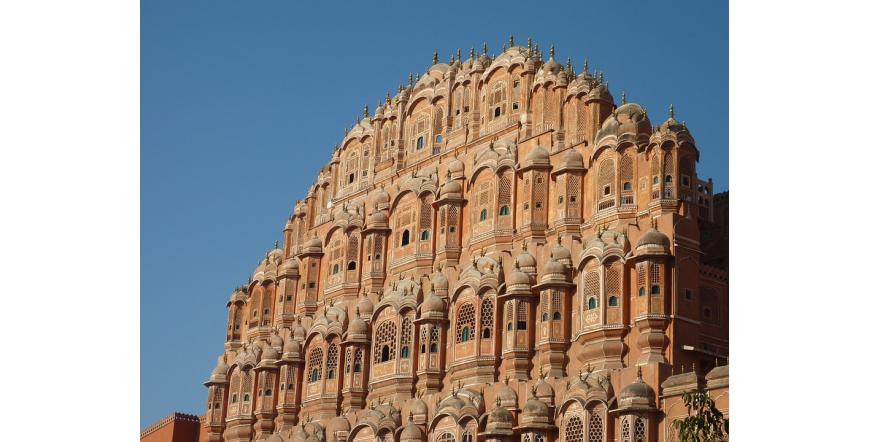
Pink color in India is believed to be the color of hospitality. Perhaps that is why Jaipur - India's "Pink City" - has been designated as the worthy home of the Hawa Mahal. A five-story salmon-pink building lavishly decorated with delicate floral motifs and tracery windows. This is he, the palace of the winds, the royal lover's pastime. Behind this most extraordinary, complex and eye-catching facade, the women of the royal palace enjoyed the gentle breeze as they watched the state processions or the parade of everyday life below them. Part of the city's palace complex, this asymmetrical, exotic mix of Rajasthani and Mughal architecture, the work of master craftsmen, grabs the eye and leaves you breathless with just one glance.
The Palace of Winds or Hawa Mahal was built for Maharaja Sawai Pratap Singh in 1799, initially as a temple and later changed its status to a palace. This was the time when women in the royal family were forced to live in strict seclusion. Hawa Mahal is actually an extension of the main palace and is constructed in such a way as to provide the women with the opportunity to watch life go by, but at the same time remain completely isolated and hidden from the eyes of passers-by. Sawai Pratap Singh is said to have been a devoted follower of the Hindu deity Krishna, to whom he actually dedicated the Palace of Winds. Therefore, it is said that the shape of Hawa Mahal resembles the likeness of the crown worn by the god. Some people liken the palace to a carved jewel box, others to an anthill, others to a honeycomb. But everyone unanimously admits that it is a unique building, an architectural pearl of the city, without a doubt one of the symbols of the Pink City of the state of Rajasthan.
The Hawa Mahal (Palace of the Winds) is perched on a high platform that borders the city wall and boasts the most elegant facade in the entire city. With its architecture, Hawa Mahal resembles an enormous honeycomb with its symmetrical 15-meter five-story facade. The Palace of Winds is built of red and pink sandstone, which is extremely characteristic of many buildings in Jaipur. The Duvoret is outlined with white motifs painted with lime. The facade of the Hawa Mahal is arched and composed of 953 beautiful small windows, each with a neat little balcony and a vaulted roof with a hanging cornice. Typical of the idea of women staying out of sight of passers-by, the portholes have peephole-sized openings. The upper three stories of the Palace of the Winds are a single room, which has an arched entrance from the west that leads to a courtyard, on three sides of which is a two-story building. The fourth wall of the courtyard rises above the other three by another floor. An interesting fact in the architecture of the Palace of Winds is that there are no stairs, only inclined ramps. The lack of decoration in the Palace of the Winds suggests that it was built only for observation, not for habitation.
Perhaps many people wonder why the building is called the "Palace of the Winds". All due to the fact that the windows of the palace are not just a decorative element. In fact, they are part of a complex ventilation system, and together with internal pipes and other openings in the building create a constant light draft of air in the premises. Thanks to this, even on the hottest days, a light cool breeze blows into the rooms. It was precisely this feature that caused the palace to bear this name.
The Palace of Winds, called "a model of fantastic architecture", is located south of the city of Jaipur, at the main road junction called Badi Chaupad. The city of Jaipur is well connected by road, rail and air links with the rest of the country. Jaipur railway station is a central head station of the broad gauge line of the Indian Railways. Additionally, Jaipur is connected by major roads and the Sanganar International Airport, located at a distance of 13 kilometers from the city.
The entry to Hawa Mahal is not from the front side but from a side road to the back end. Visitors have the opportunity to climb to the top to enjoy the views of the main street of the Old City from any of the hundreds of windows of the Hawa Mahal. It is most beautiful to see in the late afternoon light, when the sun's rays bathe the palace and the variations of pink, orange and rust give it a unique appearance. The 953 windows undoubtedly make Hawa Mahal the most beautiful projection veranda in the world.
Vote:
Rating 5 from 1 voted
More sights in India


