

Mysore, India
Mysore is the third largest city in the South Indian state of Karnataka. It is located at the foot of the Chamundi Hills, with a population of about 900,000 people. Mysore was the capital of the Kingdom of Mysore, ruled by the Wadiair dynasty for 6 centuries between 1399 and 1956. Its rulers - Hyder Ali and his son Tip Sultan, were patrons of art and culture and contributed to the significant cultural growth of the city of Mysore, which became the cultural capital of the state of Karnataka. There are 17 palaces in the city of Mysore, hence it is called the 'City of Palaces'.
The city is a center for yoga related to health tourism and attracts local and foreign visitors. Mysore is most visited during the ten-day Desara festival in September-October. As an attraction for tourists, the city still has auto-rickshaws and tonga-horses. One of India's cleanest cities, Mysore has also seen growth in the IT industry in recent years. The many parks and lakes with places to relax are one of the things that attract in this very romantic city.
Mysore airport has been modernized but airlines still face difficulties in servicing it. One of the assumptions about the name of the city is that it is part of the name of the evil demon Mahisashura, who ruled the area around Mysore according to Hindu mythology. He was killed by Goddess Chamundeshwari and a temple was built in her honor on the top of Chamundi Hills which is called 'Mahisashura'. Thus the city took the name Mahisuru, which became Mysore under the British. In 2014, the city was renamed Mysore.
Apart from the palaces, Mysore is famous for its sarees with its own Mysore brand. They are made of pure silk with gold thread woven in.
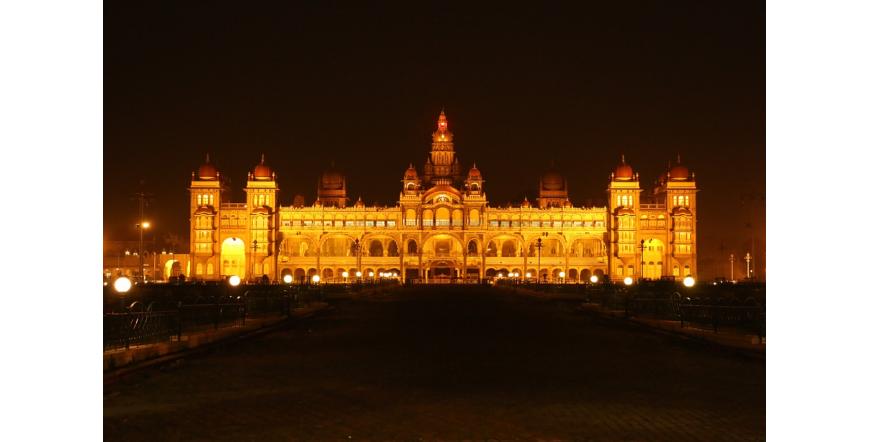
Coming to Mysore, a tourist cannot fail to visit the Mysore Palace - one of the most beautiful palaces in the world, also known as Amba Vilas. Designed by British architect Henry Irwin, it was built in the Indo-Arabic style between 1897 and 1912 and was the official residence of the royal families of the Wodeyar dynasty. It occupies a huge area and is made with such grace, as if it were a fairy-tale creature. The palace has three floors with gray granite walls and pink marble domes. Its facade has seven spacious arches and two smaller ones that accompany the central arch, whose tall columns are unique. Above the central arch rises the impressive sculpture of Gajalakshmi, the Indian goddess of wealth, luck and abundance, and around her are modeled elephants. Following the tradition, entering the palace the visitor has to take off his shoes, and photography is not allowed and only the pleasure of touching this beauty remains.
Apart from the opulent interior, the Mysore Palace houses the Armory, which houses a collection of weapons that belonged to members of the royal family. Among them are spears and swords from the 14th century and also weapons from the early 20th century. The collection of costumes is also interesting, but the most impressive is the maharajah's throne, which was placed on his elephant. It is made of gold and decorated with precious stones. On Saturdays, Sundays and holidays, the Mysore Palace is illuminated in the evening by 100 thousand light bulbs and is very beautiful.
During the Drasara festival lasting 10 days, Mysore is the most visited. The center of the festivities is the Mysore Palace. These celebrations were introduced by King Raja Wodeyar in 1610. The first days of the festival are accompanied by many dances, music, merriment, wrestling competitions and many other attractions. On the tenth day of the Dasara festival, a procession takes place through the streets of Mysore. The idol of the goddess is placed on a gilded mantle on the back of a decorated elephant, which is accompanied by musical bands and other decorated elephants, camels and horses. The procession starts from the Mysore Palace and proceeds to a designated place where mass is performed. The festivities end at night with a torchlight parade. Indians believe that Dasara will help them fulfill their wishes.
Jaganmohan Palace was the original seat of the royal family. It was destroyed by fire in 1897, and the new palace was rebuilt in 1912. In 1915, it was converted into an Art Gallery containing more than 2,000 paintings. A significant part of them belong to the Indian artist Raja Ravi Varma. Interesting are the paintings painted in the "Mysore" style, in which gold foil is also used in the image. He studied at the Vijayanagar School of Art in Mysore.
The palace concert hall hosts dance performances, music festivals and other cultural events during the Dasara festival.
The church "St. Philomena' is one of the largest in India. Built in Gothic style, it reminds of the famous Cologne Cathedral, which with its 157 m is one of the tallest cathedrals in the world. The highest part of the church "St. Filomena" is 53 m. It is included in the UNESCO World Heritage List.
Tip Sultan's summer palace, impressive with its architecture, beautiful frescoes and furnishings speaks volumes for its owner. Tip Sultan is known by the nickname "Tiger of Mysore" and is considered one of the most enlightened rulers of India. He fiercely resisted British colonization in South India.
A visit to Devaraja Market, a colorful fruit and vegetable market, is an adventure and entertainment.
Brindavan Park, located 15 km from Mysore is a wonderful place for walking and relaxation. Established in 1932, it is a beautiful jewel with the lake and musical fountain being the main attraction of the park. It is visited by 2 million tourists annually, although the entrance is paid.
Mysore - the city with a rich heritage of myths, romantic stories and pristine nature is worth a visit.
Vote:
Rating 5 from 1 voted
More sights in India


Weather in Mysore, India

25 °C
Wind: 7.2 m/s
Humidity: 78 %
Pressure: 1011 hpa
Clouds: 75 %
Wind: 7.2 m/s
Humidity: 78 %
Pressure: 1011 hpa
Clouds: 75 %