

Milan, Italy
The second largest city in Italy, the economic heart of the site, the capital of the Lombardy region - this is the beautiful city of Milan (Milano). Located in the plains of Lombardy, near the river Po. Milan is the most developed and populated region in Italy, but also one of the most developed European regions.
Everything in Milan revolves around the textile industry. It is a well-known secret that in this city the most famous designers work and the most popular fashion houses are located. The heart of Milan's fashion industry is beating in the area locked between the streets of Della Spiga and Montenapoleone.
Apart from fashion, other "economic languages" are spoken in Milan. The city is the seat of the Italian stock exchange. In addition, the largest fair in Italy is held here every year, which is also one of the largest fairs in Europe.
A star also shines above the Milan Polytechnic. This University of Milan is the largest technical university in Italy, as well as a leading school of engineering, architecture and industrial design.
Milan is defined as one of the most inventive European cities. It is full of known and unknown entertainments and pleasures. Theaters, cinemas, promising club stages, sleek restaurants and cozy neighborhood restaurants, where lunch is not lunch without osobuco and Milanese risotto, thrive in perfect symbiosis with the prevailing fashion environment.
Many historical and architectural landmarks are concentrated in the historic center of Milan. For example, La Scala Opera House and Milan Cathedral are located there.
The history of Milan began to be written around 400 BC, when the Celtic insubs inhabited the lands of present-day Milan, as well as the surrounding area. The next inhabitants of Milan were the Romans, who conquered the settlement in 222 and gave it the name Mediolanum. The Romans ruled the settlement for several centuries. Therefore, in 293, Milan was built as the capital of the Western Roman Empire, whose emperor at the time was Diocletian.
The Visigoths besieged Milan in 402, so the emperor's residence was moved to Ravenna. The Huns conquered Milan in 452. The Ostrogoths in 539 were an active force in the so-called "Gothic war" against the Byzantine emperor Justinian I, and it was during this war that they succeeded in capturing and destroying Milan. The next rulers of Milan were the Lombards, and their rule over the city began in the summer of 569. 774 came and with that new rulers - Milan voluntarily surrendered his rule to the Franks, and Charlemagne was crowned "King of the Lombards".
Archbishop Otto Visconti managed to retain power over Milan after winning an undisputed victory in 1277. The monarchical form of government replaced the republican one, and the Visconti family ruled Milan until 1450. After Visconti, the Sforza dynasty celebrated its brilliant presence in the city's development. During the reign of this dynasty, the names of ingenious artists such as Donato Bramante and Leonardo were recorded. In the transition between the 15th and 16th centuries, the Duchy of Milan became an apple of discord between the Spanish Habsburgs and the French Valois dynasty.
It is difficult to determine what Milan is best known for - fashion, car factories, football, panettone /traditional Christmas Easter cake/, tourism, sightseeing, food. Maybe with everything, because all this is the reason why the city is among the most visited and preferred by tourists.
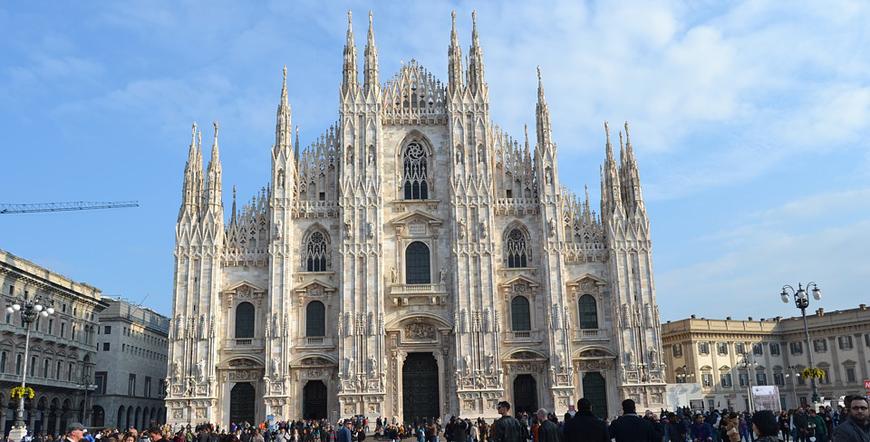
One of the emblems of Milan, which is the heart of the city, is the huge neo-Gothic Milan Cathedral, famous for Vittorio De Sica's film "The Miracle in Milan". The construction of this architectural pearl, 108 m high and 158 m long, lasted over five hundred years - from 1386 to 1820. In strict and with great pride is kept a nail from the Holy Cross. Although bizarre shapes such as hedgehogs, wedding cakes, etc. have been copied on the cathedral, everyone is dumbfounded by the elegance of the Gothic masterpiece. Napoleon and Leonardo da Vinci contributed to the elegance of the Duomo. It is an indescribable feeling to climb on the roof of the cathedral - among the 135 towers stand out the 4-meter statue of the Madonna, figures of gorgons, angels and biblical characters. In the immediate vicinity of the Duomo can be seen the famous covered gallery of Victor Emmanuel, which has the shape of a cross with glazed ceilings, and which houses the most famous shops and restaurants. On the other side of them is the unique La Scala - one of the world's most prestigious opera houses, defined as "an explosion of baroque sculptures, red velvet and gold."
The Church of Santa Maria delle Grazie in Milan is famous for its legendary Last Supper fresco, which has withstood many restorations. Regardless of their number, the spirit of the Renaissance has not been lost to this day. The flow of visitors to this mind-blowing and disarming beauty has not subsided since the 15th century.
Sforzesco Castle is definitely one of Milan's priceless jewels. It was built in the 15th century, and it is believed that Leonardo da Vinci found a creative atmosphere in his rooms to create his masterpieces. Behind its walls are hidden the secrets of many historical dramas - wars, jealousy, love, betrayal. Today, Sforzesco Castle houses the Prehistoric Museum and the Museum of Ancient Egypt, whose exhibits are rich in clothing, musical instruments, utensils, furniture, coins and tapestries. Among other valuable specimens, Michelangelo's last unfinished sculpture is preserved.
The Cimitero Monumentale di Milano should not be missed. It is said that this place is very far from the idea of a place of eternal peace and is rather a museum of sculptures. Each memorial in this cemetery is unique and no second similar can be seen.
Art connoisseurs must cross the threshold and immerse themselves in the exclusive atmosphere of the Brera Pinakothek. The museum is dedicated to the original works of all famous Italians from Raphael and Veronese to Modigliani. And through the glass at the exit you can watch the restoration of old paintings. Contemporary art is extremely well presented in the Novecento Gallery and Museum.
For those who have come to Milan and for whom shopping is a passion, there are sacred places: the Victor Emmanuel Gallery and the Golden Square, which is delineated by the streets of Monte Napoleone, Manzoni, Spiga and Sant’Andrea. The famous Montenapoleone Street has an impressive area of about 4 acres - a huge area dotted with magnificent windows, just a paradise for people with deep pockets.
Maybe the children know that if you are in Italy, you must eat ice cream. Apart from the eight types of only chocolate ice cream, it will be indecent if you do not try the ice creams with cinnamon and chili, rum, cognac and orange peel and others. But in addition to ice cream, there is another temptation in Milan, to which even models succumb - the armor. This Milanese breakfast has some addictive ingredients, since no one can resist it in any way.
Football fans know that there are only two teams in Milan - Inter and Milan, respectively, fans, regardless of gender and age, are divided into fans of "Inter" and fans of "Milan". But in addition to the names of these two football giants, there is another name - "San Siro". The stadium, which is home to both clubs, has grandstands that have experienced and seen some of the strongest emotions that came out of the experience of watching your favorite team.
Vote:
Rating 5 from 1 voted
More sights in Italy


Weather in Milan, Italy

20.94 °C
Wind: 1.54 m/s
Humidity: 90 %
Pressure: 1009 hpa
Clouds: 75 %
Wind: 1.54 m/s
Humidity: 90 %
Pressure: 1009 hpa
Clouds: 75 %