

Nizhny Novgorod, Russia
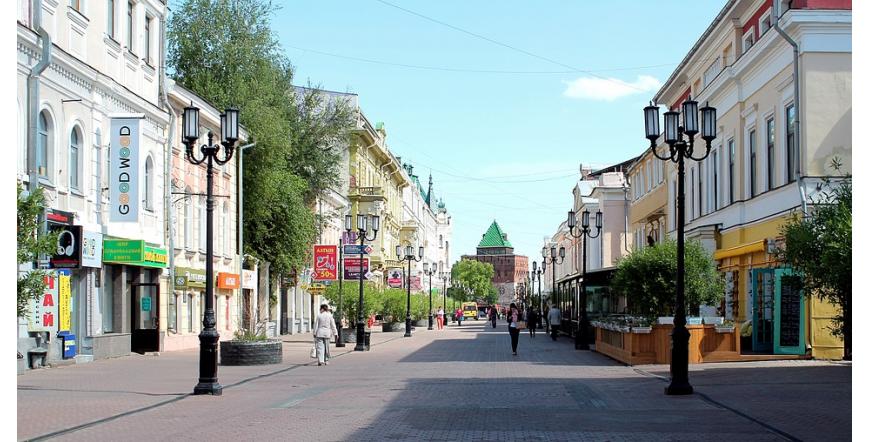
Nizhny Novgorod is a city with impressive architecture and history worthy of respect. Closed to foreign tourists for about 30 years, after 1991, Nizhny Novgorod grew as a modern and ennobled city. With a population of about 1.2 million, today Nizhny Novgorod is the largest cruise tourism center in Russia.
Nizhny Novgorod was founded in 1221 by Grand Duke Yuri Vsevolodich, and from 1341 to 1392 was the capital of the Nizhny Novgorod-Suzdal principality. In 1392, the city was annexed to the Moscow principality. Built at the confluence of the two rivers Volga and Oka in the European part of Russia, Nizhny Novgorod became known as a defender of the Moscow principality against the Kazan Tatars. The huge Kremlin fortress, built in 1508-1511 of red bricks on the right high bank, rises against the backdrop of the city with its 11 towers.
On the territory of the fortress survived only the church "Archangel Michael" from the 13th century and restored in 1624. In it is buried Kuzma Minin, who together with Prince Pozharsky, organized a people's militia to liberate Moscow from the Polish army in 1612. The two brave men rise on the "Square of National Unity" in front of the beautiful church of St. John the Baptist.
In 1896, a huge Renaissance palace was built for the Russian Trade Fair, where various goods were exhibited - from tea, grain, wool, fishing tackle, to larger metal products. It was visited by numerous dealers from all over the world, which was a prerequisite for starting the production of trucks and cars in 1932, together with the Ford company at the Gorky Automobile Plant. Today, the amazing fair building is the Main Exhibition Center of Nizhny Novgorod, where the exhibition "Russia - My History" is located. In 2005 an interesting exhibition of the photographer Igor Pshenitsyn was opened here. It is 10 canvases with an area of 160 square meters, on which in 100 thousand fragments of miniature photographs are presented the architectural monuments of the city.
In honor of the socialist writer Maxim Gorky, born in Nizhny Novgorod in 1868, Stalin changed the name of the city in 1932 and Nizhny Novgorod was called Gorky until 1991, when the city regained its old name. By decree in 1959, the city of Gorky was declared inaccessible to foreign nationals. While Gorky was a closed city, the Soviet nuclear physicist, public figure and human rights defender Andrei Sakharov (1921-1989) was sent here in 1980. Today, in his honor in Nizhny Novgorod is held an annual Music Festival from April to September. Visited by many tourists, the city regains its charm. The historic Bolshaya Pokrovskaya Street is once again full of life as it once was, when a number of beautiful houses and institutions from the 19th century rose here.
Some of the preserved buildings with amazing architecture are the Drama Theater and the State Bank from 1913, which is a masterpiece. There are also a large number of bronze statues on the street, some of them as attractive as the Merry Goat. The cafes and terraces of the bars on Varvarska Street are full of guests and residents of the city, especially during the festival. The other historical street of Nizhny Novgorod - Rozhdestvenskaya starts from the "Square of National Unity", where the most interesting landmark is the so-called Christmas Church, built by the famous merchant Grigory Stroganov in 1719. The house of the fur trader Pushnikov is the only preserved building from the 17th century and it is a monument of civil architecture of federal significance.
The Arrow is one of the main natural landmarks of the city, located in the historic part, at the confluence of the Volga and Oka rivers. Alexander Nevsky Cathedral from 1880 is here, and the huge stadium built for the 2018 FIFA World Cup completes the complex, which looks captivating in the evening, lit by colorful lights.
If you want to climb the longest staircase in Russia, go to the banks of the Volga in Alexander Park. Hang a ribbon or souvenir on the propeller of the small warship at the beginning of "Chkalov's Ladder". The 560 steps in the shape of an eight will take you to the monument to the Chkalov-Soviet pilot, born in a village near Nizhny Novgorod, who made the first flight from the USSR to the USA through the North Pole in 1937. On one side of the stairs is the Kremlin wall with the St. George's Tower.
Not to be missed is the 5-domed Ascension Cathedral from 1632, which adorns the medieval Pechersky Ascension Monastery, located on the banks of the Volga and at the foot of a mountain range.
Located 400 km from the capital, Nizhny Novgorod seeks to maintain its 15 parks, the largest of which is "Switzerland". It occupies an area of 52 ha on the slope above the Oka River.
The city's economy is associated with automotive, shipbuilding, aircraft and armaments. In January 2019, Nizhny Novgorod ranked first among Russian cities in quality of life. Throughout its long history, the city has accumulated invaluable sites popular with tourists from around the world.
Vote:
Rating 5 from 1 voted
More sights in Russia


