

Nevsky Prospect, St. Petersburg
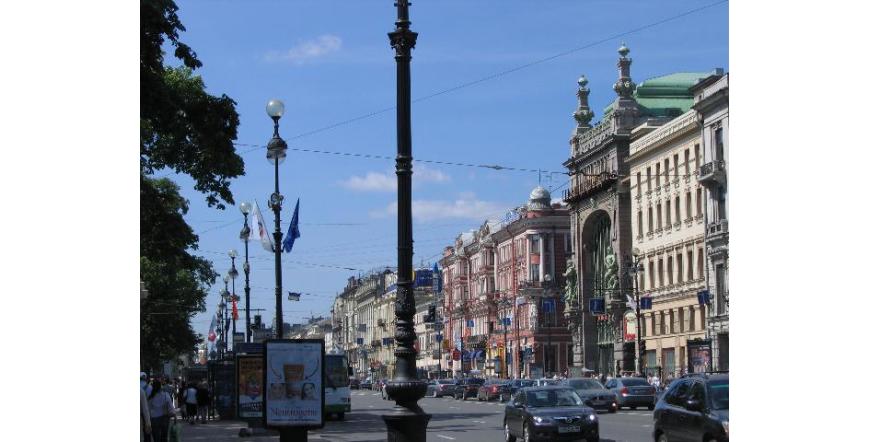
Nevsky Prospect is the most emblematic street of St. Petersburg. Built in 1710, it stretches from the famous Admiralty to the Alexander Nevsky Lavra at a distance of 4.5 km, and its name comes from the name of the monastery. The charm of this main street comes from the fact that it crosses the Moyka River with the Green Bridge, the Griboyedov Canal with the Kazan Bridge and the Fontanka River with the remarkable Anichkov Bridge. The largest width of Nevsky Prospect is 60 m at the Gostiny Dvor and the smallest - 25 m at the Moika River. Initially, the new street was known as Bolshoi Perspective Road, later as Nevsky Prospect and finally as Nevsky Prospect. The facades of the 240 apartments overlook this remarkable street. Informally, it has two sides - the right, called the "shadow" and the left, called the "sun", which is more popular for walking.
The pulse of the city can be felt on Nevsky Prospect. It is no coincidence that the Russian writer N. Gogol wrote: "In St. Petersburg there is nothing better than Nevsky Prospect, because here is everything ..." Today there is no glamor from the 30s of the 19th century, when on this street noble ladies walked with their cavaliers and passed carriages with exquisite crews. Nevertheless, Nevsky Prospect remains one of the main thoroughfares of St. Petersburg and a place where the past and the present meet. The noble estates and houses built here in the 18th century impress with their beauty and aristocracy. In the next century, the area expanded to the south, where many shopping and financial centers appeared. During the communist regime, construction on this famous street was small, but instead, these architecturally exceptional buildings became the administrative institutions of the new government.
By the end of the 20th century, Nevsky Prospect was again a shopping street, where you can see clubs, cafes, neon lights and walking tourists and locals of St. Petersburg. Nevsky Prospect is a business card of the city with many architectural monuments, museums and theaters.
The walk along Nevsky Prospect could start with the biggest landmark - the Alexander Nevsky Lavra, founded by Peter the Great in 1710. Prince Alexander Nevsky is a national hero who wins the victory over the German and Swedish invaders and pushes them east of the territory. of Russia in 1240, and the decisive battle took place 20 km from the place where the monastery was built. In 1724, by order of Peter the Great, the remains of Alexander Nevsky were laid to rest in the laurel.
The next landmarks are Vastanie Square and the Anichkov Bridge over the Fontanka River. Built in the early 18th century as a wooden, by a regiment of Mikhail Anichkov, the bridge marks the end of St. Petersburg and there was a round-the-clock guard that strictly checked those entering the city. In the following years, the Anichkov Bridge was reconstructed and is considered one of the most beautiful in St. Petersburg. Bronze sculptures of horses by Peter Clotte from 1841 rise in every corner of the bridge.
The magnificent Anichkov Palace is the other landmark of Nevsky Prospect. This is the oldest surviving building on this street, and its name comes from the nearby Anichkov Bridge. The palace was built by order of Empress Elizabeth for her favorite Alexei Razumovsky in 1741-1750. The palace, with its beautiful gardens, flower alleys, fountains and extravagant furniture, resembled Peterhof Palace. A canal was laid from the Fontanka River to the entrance of the palace with a small pier for guests. Changing owners over the years, today this delightful building has been turned into the Palace of Youth.
The beautiful building of the National Library of Russia rises on Ostrovsky Square. Opened in 1814 as an imperial library, today it houses over 20 million volumes. Most of the interior is preserved, including statues of philosophers, poets and gods. Unfortunately, the library cannot be visited by tourists.
The oldest drama theater in St. Petersburg, Alexander Pushkin, is also on Ostrovsky Square, which is very close to Nevsky Prospect. The theater was built in 1828-1832 in neoclassical style and impresses with its six Corinthian columns on the facade and chariot of Apollo above the entrance to the theater.
To go to St. Petersburg and not visit the huge department store from 1757 is unthinkable. Called Gostinin Dvor, it actually offers everything a tourist would want to buy.
The walk along Nevsky Prospect continues ... Next is the blue and white building of the Armenian church "St. Ekaterina” from 1771, which after the restoration most of the inhabitants of the town call “The Blue Pearl” on Nevsky Prospect. The Catholic Church "St. Ekaterina” is a brilliant combination of the baroque and classical style from 1763. It houses the tomb of the last Polish king Stanislaw Poniatowski.
On the opposite side of Nevsky Prospect is the town hall of the city from the tsarist era, known as the City Word with the Clock Tower, built on a European model by Ferrari in 1799.
The largest bookstore in St. Petersburg, the House of Books, is also on this unusual street. During the pre-revolutionary period, this huge building housed the Singer sewing machine company, whose interesting round trademark still adorns the roof.
The Kazan Cathedral is a magnificent temple, built by order of Tsar Paul I, after his visit to Rome. The desire of the ruler is to create an Orthodox church that rivals in its beauty the cathedral "St. Peter” in the Eternal City. The majestic cathedral, located on Nevsky Prospect, was built between 1801 and 1811 as a place to pay military honors. The exterior and interior of the temple are distinguished by their lavish decoration. General Kutuzov was buried in the northern chapel of the church, where he said his prayer before taking command of the Russian troops against those of Napoleon in 1812.
If you need a break with a cup of coffee, the so-called Literary Cafe is very suitable. According to many, Pushkin stopped here before heading to the place of the fatal duel. Nearby is the Chicherin House, which is an architectural monument because of its interesting facade. Nearby is a building with an inscription on a blue sign warning pedestrians that in the event of an air attack, the other side of the street is safer. During the siege of Leningrad, there were many such signs around the city. On the day of the victory - May 9, fresh flowers are always placed here ...
Continuing the walk along Nevsky Prospect, before the bridge over the Moyka River, you can see the green building of the former Stroganov Palace, completed in 1754. This example of the Russian Baroque is the most perfect work of Rastrelli. Above the arch at the entrance you can still see the coat of arms of the famous family: two samurai with a shield, above which is depicted a bear's head. All this symbolizes the main source of wealth of the Stroganovs, namely their endless Siberian possessions, abundant in wild animals with valuable skins.
At the end of Nevsky Prospect, the Admiralty building shines. The spire tower of this wonderful complex can be seen from all over St. Petersburg. The first building here is the shipyard of Peter the Great. Later, the stone building and other surrounding buildings were built. Today, the Admiralty building is the main headquarters of the Navy. And in the time of Tsar Alexander a beautiful park was created to the complex.
Palace Square and the Winter Palace are very close to the right of the Admiralty.
There is not a single modern building on Nevsky Prospect, and literally each of the existing ones has its own history and appearance. Therefore, when visiting St. Petersburg, you should definitely take a walk on this street, which tells stories ...
Vote:
Rating 1 from 1 voted
More sights in Russia


