

Petrodvorets (Petergof), Russia
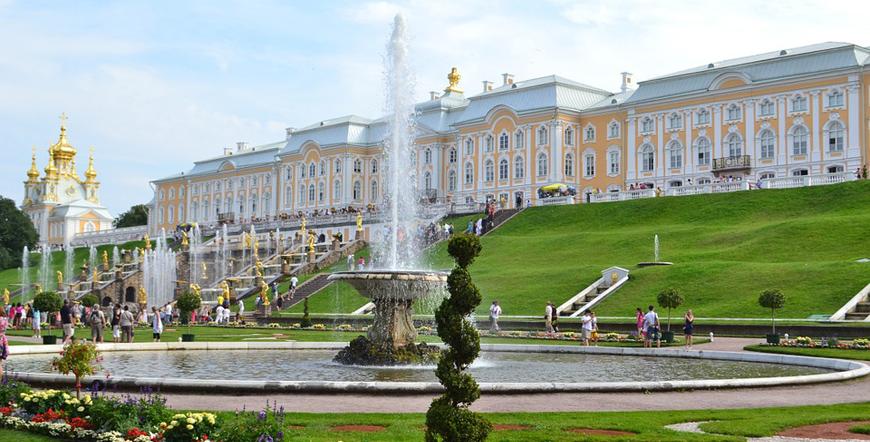
Petrodvorets (Petergof) is located 29 km from St. Petersburg on the southern shores of the Gulf of Finland. At the end of World War II, Petergof and the other imperial residences were demolished, the area in ruins. Fortunately, most of the valuables stored in the palaces were moved to a safe place before the German invasion. After several decades of restoration activities, today the palaces once again captivate visitors with their former splendor. The best season for a trip to Petergof is summer. In clear weather, the most suitable means of getting to the site is a hydrofoil. From aboard it reveals a fabulous view of the huge palace that towers over the sea.
The gardens and residences in Petergof were designed by Peter the Great himself. The king began to prepare their original plans from 1720. Thus conceived and built, the palace in an amazing way emphasizes the huge role of water as a source of vital energy and strength for the city of Peter the Great.
There are many fountains and cascades in the gardens of the palace. By order of the king, a lover of entertainment and witty jokes, some fountains are installed in the trees and in various secluded places. Their mechanisms are triggered by the occurrence of a stone or the movement of a lever.
The oldest building in the Petergof complex is named Montplesier. It was inhabited by Peter the Great before the construction of the main imperial residence.
Petergof's famous Hermitage (a place of solitude) was built in 1725. The building was originally used as a banquet hall for high-ranking officials. Subsequently, it is equipped with a lifting mechanism, through which the tables together with the guests and the rest of the furniture are moved from the ground floor to the dining room located above it.
The attraction of the Petergof complex is the Grand Cascade. The ensemble of the cascade consists of three waterfalls, 64 fountains and 37 gilded statues. A gilded statue of Samson rises among the waterfalls. From the wide open jaws of the lion, with which the hero is in a fight, a stream of water comes out. The monument was built in honor of the Russian troops who defeated the Swedish invaders at the Battle of Poltava.
The magnificent Grand Palace is located on the ridge above the cascade. Here you can see the remains of the original building, erected between 1724 and 1725. The building was renovated and expanded by the daughter of Peter the Great - Elizabeth. After numerous reconstructions in its authentic form from the time of Peter the Great, only the Oak Cabinet has been preserved. The exquisite wall cladding is the work of the French sculptor Pino. The furniture of the room is also made of wood. Only the fireplace is made of white marble.
One of the largest halls in the palace is the Throne Room. In the past, this elegant room was used for receptions and official ceremonies. The ceiling is decorated with intricate ornaments, and the chandeliers strike with their brilliance. Behind the throne of Peter the Great, hangs a huge portrait of Catherine the Great, created after her successful coup. The Empress is depicted on a horse, dressed in the uniform of the royal guard, with whose support she seizes power.
The Chinese cabinets were designed by Valen de la Motte in the 1960s. The rooms are richly decorated with Chinese-style scenes. The images are painted on black lacquered, finely carved boards. 368 oil paintings by the Italian artist Rotary are exhibited in the Art Hall. In creating all the paintings, he used only eight oils.
Vote:
Rating 5 from 1 voted
More sights in Russia


