

The Peter and Paul Fortress, Saint Petersburg
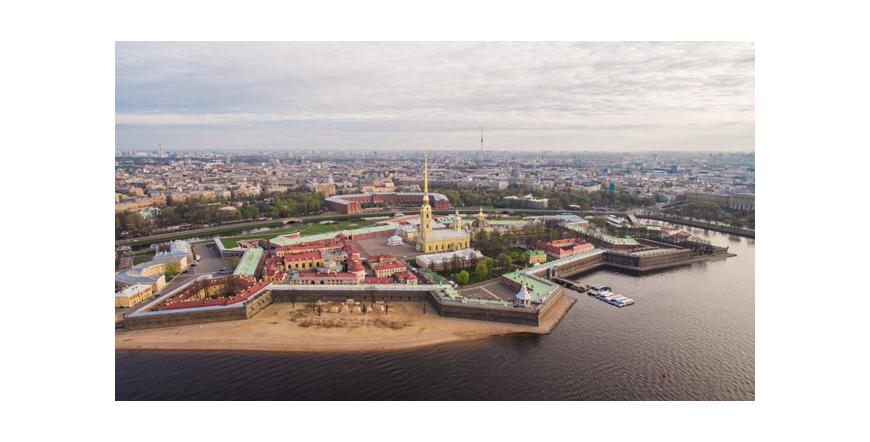
In 1703, Peter the Great laid the foundations of the first fortress on Rabbit Island. From that moment on, the small hexagonal island became the center of St. Petersburg. The most interesting landmark here is the Peter and Paul Fortress. It was built in just one year (1703-1704) as a defensive facility during the Northern Wars against Sweden. The Petrovski gates lead to the inner fortress. They were designed by the Swiss architect Domenico Trezzini.
Interesting are the double-headed eagle, a symbol of the Romanov dynasty and a woodcarving with the images of Simon the Magi and the Apostle Peter. The idea behind this work is to inspire in the Russian people faight in the victory of Peter the Great. And the truly successful end of hostilities occurred in 1721. The most interesting attraction of the fortress is the Peter and Paul Cathedral. It was designed by Domenico Trezzini and decorated by Bartolomeo Rastrelli. Peter the Great and the ruling Russian rulers are buried in this temple.
Near the temple is the long pink and white building of the Commandant's House. This house served as a courtroom and it was here in 1826 that the trial against the insurgent Decembrists took place. The hall in which the events take place is part of the exhibition dedicated to the history of the city from its founding in 1703 to 1917.
The prisoners passed through the Nevsky Gate before being executed. In the Tibetan bastion, today there is a museum. In addition to exhibits including prison uniforms, cells can be seen here, whose chilling appearance from the pre-revolutionary era has been reliably restored. Here was the son of Peter the Great - Alexei; writers such as Fyodor Dostoevsky and Nikolai Chernyshevsky are serving their sentences here; the kidnappers of Alexander II; Lenin's older brother, Alexander, who tried to assassinate Alexander III. In 1997, a printing workshop was set up in the premises near the Nevsky Gate. Here are offered excellent works of graphic art, which are created with authentic presses from the late nineteenth century.
Vote:
Rating 5 from 1 voted
More sights in Russia


