

Maulbronn Monastery, Germany
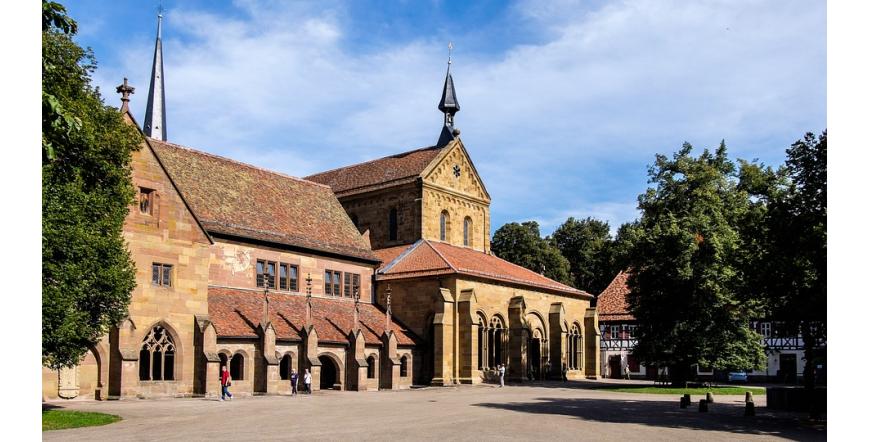
Its existence Maulbronn Monastery owes to an unpleasant event, shook Europe at the beginning of the XII century Europe. The political battle for power between the Pope and the emperor flooded the continent with complete disorder. The bishops and monasteries are also dragged into this chaos. People suffer but tolerate.
However, a monk, called Bernard Clairvo, began a reformist movement against the secularization of the church and abbeys. He is a supporter of the idea of returning to the original Christian ideas and soon founded the Order of which he became the leader - the Order of the Cistercians. The new religious wave is rapidly spreading across Burgundy and beyond the Rhine. Thus, 12 monks coming from Alsace reach the Valley of the Salzak River, in the marshy forests somewhere between the German cities of Heidelberg and Stuttgart, in 1147. There, the bishop of Schweier gave them some land on which they began to build a monastery - the Maulbonian abbey.
The Maulbronn Monastery is one of the hundreds of Cistercian abbeys founded during the time of Bernard Clave. Looking for quiet valleys in sometimes the inhospitable forests, the monks want to live their lives in prayer for greater glory of their God.
Like all other abbeys from this period, Maulbronn Monastery was built in the form of a cross with entrances from east and west. The unusual in the architecture of the monastery is that Metoha is on the north side, with service premises attached to it. There is a requirement for Bernard's abbeys to be simple and it is forbidden to raise bell tower. With that, the restrictions do not end. The veto was also imposed on the existence in the monastery of icons, sculptures, and larger ornaments-nothing should disturb the monks during prayer.
With the death of Bernard, the construction of Maulbronn Monastery was not ended, and in 1178 it continued to grow. Persistence and courage are the main engines that give the Cistyrians the power to work hard and expand their abbey - as a result, the Order acquires real estate, more warehouses, workshops and mills are built.
Viewed from an architectural point of view, the entrance of the church is in Gothic style with a lobby called "paradise". Its southern wing is in a late Roman style.
The manger has a high vault with columns, and the highly located long narrow windows are high arches. With its generous proportions, the Magger is one of the most magnificent surviving large halls in Germany. The simple forms of Maulbronn Monastery's architecture of the Roman period develop in an extremely diverse Gothic splendor. The arches in Metoha are light and transparent.
Maulbronn Monastery's appearance changed quite only in the fourteenth and fourteenth centuries to get his churches today. Arches are added to the ceiling of the nefa. Huge painted windows were added to the Eastern Choir, and the altar of the old Cistercian church was finally covered in light.
Monolithic stone is the material used to make the Maulbronn Monastery crucifix. All Cistercian abbeys are dedicated to Mary as the queen of heaven. Bernard Cleivo, which prohibits all images in the churches, makes exceptions to the Virgin Mary. The Reformation turns both the abbey and the property into a Protestant, which expels the Cistercians from their monastery. The new secular masters do not waste their time and have not entered the possession of this shrine, immediately build a hunting hut inside the monastery.
Maybe nothing is capable of eraser the spirit of Cisastery in the Maulbronn Monastery. After 400 years of poverty, work and asceticism, there remains a majestic building where the stones themselves tell about ideas and values and answers to questions can be found that people nowadays may start asking themselves again. Today, Maulbronn Monastery is the only intact monastery complex north of the Alps.
Vote:
Rating 5 from 1 voted
More sights in Germany


