

Rügen Island, Germany
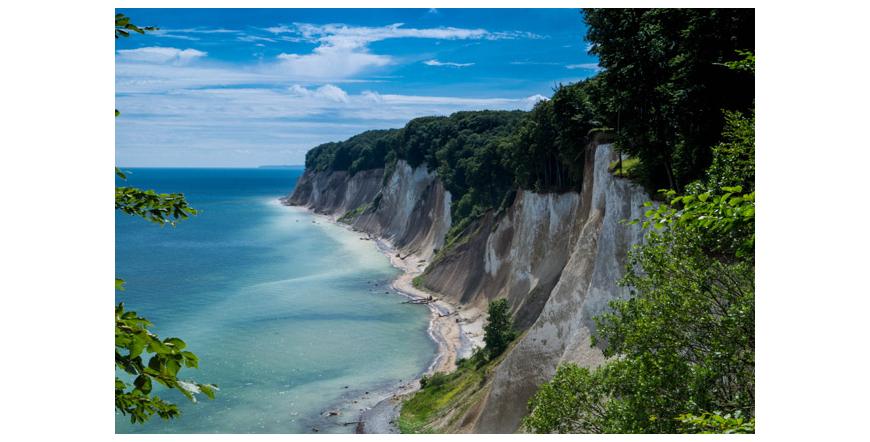
Rügen is the largest German island, which together with its smaller islands Hidensee and Umanz formed the administrative district of Rügen. It is located in the Baltic Sea, off the coast of the province of Mecklenburg-Western Pomerania.
According to historical records, the island of Rügen has been inhabited since about 4000 BC. Its later settlers were the German Rugi tribe, which actually gave the island its present name.
After the Germans, the Slavic tribes Ranu and Ruyan occupied these lands in the VI-VII century. The Slavs founded their own principality, as the capital of which they chose the medieval city of Arkona, which became a religious center for the surrounding Slavic tribes. Unfortunately, Danish crusaders destroyed Rügen in 1168 and the island began a process of Christianization.
Exhausting civil wars ensued, and as a result, in 1325, Rügen was conquered by the Duke of Pomerania. The city existed as part of Swedish Pomerania in the period 1648-1815, after which it was successfully attracted to the possessions of Prussia.
The history and archeology of the island of Rügen are especially important for the study of the Slavic religion, as there were temples of many Slavic gods, such as Svetovit, Rugevit, Porevit, etc.
Rügen is one of the most visited tourist destinations in Germany. The island is rich in mineral springs, the first of which was discovered in 1794 around Sagard. In 1818, the suburb of Lauterbach became the first seaside resort in Rügen. The next resorts to be born on the island were Sassnitz in 1860, followed by Binz in 1880.
Today, the most popular seaside resorts are on the beaches between Altenkirchen and Juliusruh, in the eastern part between Sassnitz and Göhren, including Prora, Binz, Celine and Baabe, as well as many other beautiful paradises. However, the seaside resorts do not exhaust the tourist destinations of Rügen. Also of interest are Cape Arkona, the forested Stubenkammer hill, the Granitz hills and the Jagdzschloss Granitz towering over them.
Rügen is also extremely attractive for surfers. The island offers more than fifteen different places for surfing, the most popular places being Dranske, Rosengarten, Suhrendorf and Wieck.
Vote:
Rating 5 from 1 voted
More sights in Germany


