

Berlin Wall, Germany
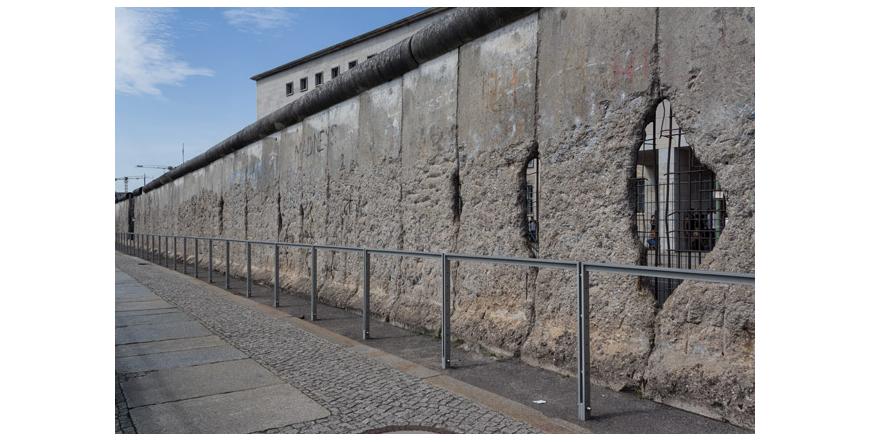
The Berlin Wall is the German symbol that recreates the historical events in the country in the XX and XXI century. This wall is too important for Berlin - it would not have been the German capital since October 3, 1990 if the Berlin Wall had not fallen. The Berlin Wall is the place in Berlin that forms part of the border between the Federal Republic of Germany and the German Democratic Republic from 13 August 1961 to 9 November 1989, separating West Berlin from the eastern part of the city and the GDR.
The Berlin Wall has become one of the most famous symbols of the Cold War. The Berlin wall, although a simple architectural building, is a place where between 125 and 206 people from the GDR lost their lives - trying to cross the wall to escape to the West.
The erection of the Berlin Wall is not just a decision to erect an architectural structure. The Berlin Wall, or rather its creation, has its great history. After the Second World War, Berlin was divided into four occupation zones between the victorious countries - the USSR, the USA, Great Britain and France. However, the main problem that arises is that there is no physical border between the different zones and this leads to conflict and mass transfer of specialists and citizens from East Berlin to Germany.
Thus, on August 13, 1961, on a signed order by Walter Ulbricht, in a period of intensified opposition and aggravation of relations between the USSR and the USA, the construction of the Berlin wall began. In fact, this violates the post-war agreement of the victorious countries, according to which Britain, the Soviet Union, the United States and France have equal rights to govern all of Berlin.
The construction of the Berlin Wall and its continuous redevelopment cover the period 1962-1975. In its final form, the Berlin Wall is an architectural compilation of 45,000 concrete blocks with rounded tops, each measuring 3.6 m by 1.5 m.
This form of the fragments of the Berlin Wall was deliberately chosen - the purpose was to thwart attempts to escape from the other side. But even the rounded peaks do not stop nearly 5,000 people from fleeing to West Germany. Among the most famous cases are the mass escape through a 149-meter-long tunnel and hang gliding. Harry Detterling, an East German driver, hijacked an eight-car train and drove 24 friends and relatives through the Berlin Wall in December 1961.
The Berlin Wall remains the undisputed symbol of the complete failure of the communist regime in Germany. On 23 August 1989, Hungary lifted the restrictions on its border with Austria, and a large number of refugees from the GDR took advantage of this. A series of actions leading to the removal of the wall's status was continued in September by GDR leader Erich Honecker, who is resigning.
On November 9, East German Prime Minister Guenter Schabowski announced the lifting of restrictions on leaving the German Democratic Republic, marking the beginning of the end of the Berlin Wall. The population is dismantling it. To date, only a few sections of the Berlin Wall have been preserved - in the area of Potsdamer Platz and Bernauer Straße.
Even after its fall, the Berlin Wall is still significant - it is becoming a lucrative business. Its fragments are quickly starting to be traded at extremely good prices. Many of the Berlin Wall fragments were bought in the United States, there is a stone block at Microsoft, another was bought for CIA headquarters, and so on. On May 16, 2006, Bulgaria also received a part of the Berlin Wall, and a segment of the Berlin Wall was donated to Sofia, exhibited next to the Memorial to the Victims of Totalitarianism.
In 1989, the Berlin Wall became a kilometer-long "exhibition" of graffiti, including many of them of high artistic value.
Vote:
Rating 5 from 1 voted
More sights in Germany


