

Volgograd, Russia
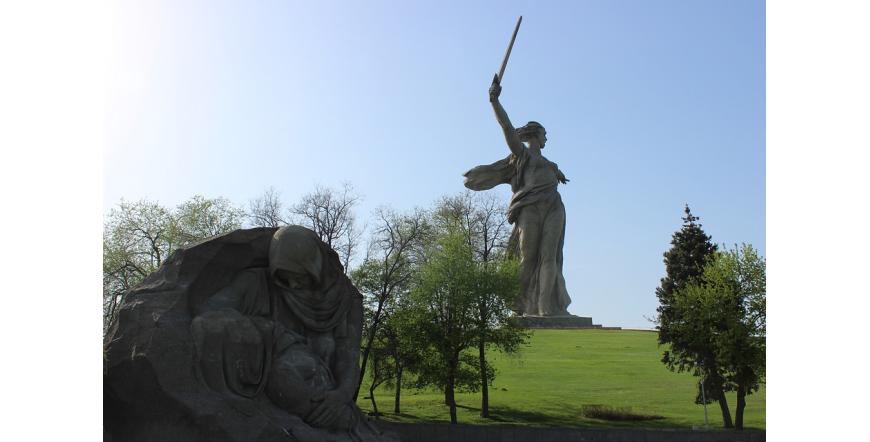
Volgograd is inextricably linked with the historic Battle of Stalingrad, which reversed the course of World War II. After that, the Russian people regained their faith in victory. The monuments, erected in honor of the hundreds of thousands who died, are also a call to future generations not to allow this to happen again.
Located on the lower reaches of the Volga River on its west bank, Volgograd occupies a strategic position - the oil deposits of the Caucasus are on the way. The length of the city on the Volga River is about 90 km and its population is 1.02 million people. Founded in 1589 with its oldest name Tsaritsyn, the city serves to strengthen the southern border of Russia. It bore this name until 1925, when it was renamed Stalingrad - until 1961 and then Volgograd. The city of Tsaritsyn flourished during the reign of Tsar Peter I. 1775 can be considered a new stage in the development of the city, as the Volga Cossack Army was liquidated and the fortified Azov-Mozdok line took over the defensive function of Russia's southern border. A little later, Tsaritsyn's urban plan was adopted, which does not need fortress walls.
The city grew as if besides Russian subjects, German colonists settled in it at the invitation of Catherine the Great. They bring a new social way of life and different technologies in the most important branches of industry and education. The first school, pharmacy, cafe, the first potato and tobacco plantations appeared in the colony of Sarepta-on-Volga, near Tsaritsyn. In 1812 the first mustard processing factory was established, which still exists in Volgograd. In 1862 the Volga-Don railway was built, which is a great advantage for the city's trade.
The First World War and the October Revolution caused turmoil in the life of the city. But after the renaming of the city of Stalingrad, in the field of its industrialization, there was a rise. Enterprises and new residential and administrative buildings are being built.
One of the largest plants in the city is the Stalingrad Tractor Plant, which during World War II retrained to produce the famous T-34 tanks. But in 1932-33, the city and the whole area were affected by famine and poverty. Still unresponsive to this disaster, another threat to the people of Russia and the city of Stalingrad is war. The Battle of Stalingrad in 1942-43 was perhaps the greatest defense of the people who decided to fight to the last drop of blood for the city and their Fatherland. The local population has been mobilized, all factories are working for the front, new roads are being built and everything necessary is being done so that the city can withstand the attacks. The battle between Hitler's and Soviet troops lasted 200 days. The turning point was the counterattack on the Mamayev Kurgan hill. General Paulus was captured and signed the surrender on January 31, 1943. There were countless casualties and the city was completely destroyed, but with the support of the government, locals and prisoners of war, Stalingrad gradually regained its appearance.
The historic hill Mamyaev Kurgan becomes the biggest landmark of Volgograd. At the insistence of the inhabitants of the city, a memorial complex was built here, called "To the heroes of the Battle of Stalingrad", to commemorate the victims. The sculpture "The Motherland Calls" is part of this monumental ensemble, located on top of the hill. The statue, completed in 1967, is the work of sculptor E.V. Vucetic and the architect Nikitin represent a figure of a woman stepping forward with a raised sword and is an allegorical image of the Motherland, which invites its sons to battle with the enemy. The total height of the monument is 87 m, with the mounting plate, its mass is 8 thousand tons, and the sword is 33 m long and weighs 14 tons. The statue is the tallest in Russia and one of the tallest in the world. From the foot of the hill to the monument there are 200 steps, as long as the battle of Stalingrad lasted. In the evening, when the statue is illuminated by spotlights, it is even more impressive.
Near the monument "Motherland Calls" are buried: Marshal of the Soviet Union Vasily Chuikov, who participated as a strategist in hostilities; the famous sniper Vasily Zaitsev, an ordinary hunter from Chelyabinsk, who killed 225 enemy soldiers during the battle, including 11 snipers.
The Battle of Stalingrad Panoramic Museum has existed since 1937, but the new building has an interesting architectural design and includes 8 themed exhibition halls, triumphal and panoramic halls. Among the most famous exhibits of the museum is the "Sword of Stalingrad", a gift from King George VI of Great Britain in awe of the admiration of the British people for the unparalleled heroism of the people of Stalingrad. The 122 cm long sword is considered a masterpiece of the blacksmith's trade of the modern era.
Gerhardt's Mill mill from the beginning of the 20th century was equipped with a steam mill. Destroyed during the historic Battle of Stalingrad, it has not been rebuilt and is a reminder of the destructive power of the war. The mill is part of the museum-reserve "Battle of Stalingrad".
Going to Volgograd, the tourist must at least once get on the high-speed tram that connects the northern regions of the city with the central part. This tram system with metro elements is 17.1 km long, the 7.1 km section is underground and the rest is an overpass over the river bay.
Планетариумът във Волгоград е другата забележителност на града. Открит през 1954 г., The Planetarium in Volgograd is the other landmark of the city. Opened in 1954, the Volgograd Planetarium is entirely a gift from the workers of the former GDR on the eve of Stalin's 70th birthday. The "Star Hall" can accommodate 450 spectators, and with the help of the dome screen and a large planetarium, more than 6,000 stars and planets can be observed. In addition, watching the sunrise and sunset, the flight of comets and meteors is a wonderful experience. In this hall there is an opportunity to simulate flights in outer space. A telescope with a refractor has been installed in the 26-meter tower of the observatory, with the help of which the Sun and its spots, the Moon with its craters, the planets Venus, Mars, Jupiter and Saturn can be observed under the guidance of specialists. Foucault's pendulum is also on display at the Planetarium. In the lobby at the entrance to the Planetarium is a large mosaic portrait of Stalin, made of mother-of-pearl, jasper and malachite.
The building of the central railway station of Volgograd is recognized as an architectural monument. It is called Volgograd 1 and is used for long-distance travel - to Krasnodar, Rostov-on-Don, Moscow, Saratov and Astrakhan. Built in 1862, it is built of red bricks, its facade is lined with granite and the interior walls are marble. The entrance of the railway station from the city is amazing. On either side of the gray granite staircase are two multi-figure sculptures, and above the entrance is a symbolic sculptural composition representing how the mother crowns the winners with a laurel wreath. Many frescoes are used in the interior, and the ceiling is exceptional with its artistic painting.
The Volga-Don Canal is the other landmark of Volgograd. Built in 1952, it connects the Volga near Volgograd with the Don River near the town of Kalah on the Don and is 101 km long. Through it the city is connected by water with the Caspian Sea, which is important for the development of maritime shipping. A huge monument to Lenin was erected on the portal of the canal from the Volga. The composer Sergei Prokofiev wrote the orchestral work "Meeting of the Volga with the Don" for the opening of the Volga-Don Canal. During the Battle of Stalingrad, the station was partially destroyed, but immediately after the war was one of the first restored buildings.
The Kazan Cathedral in Volgograd has a unique architecture. Severely damaged in the battle of Stalingrad, it was later restored and amazes visitors with its beauty.
"Victory Park" is located on the banks of the majestic Volga river and is a favorite place for walks of residents and guests of the city. Founded in 1952, the park is beautiful with its flower beds, wide alleys decorated with art lanterns. In the center of the park is a charming fountain, in which on a high pedestal are sculpted sculptures of three dancing girls in traditional costumes. In the evening it is magnetically beautiful to watch and listen to the background of the river, the light music of the fountain. At the entrance to the park, giant vases are mounted on tall columns, and behind it you can see a skyscraper in the shape of sails. At one end of the park is the original church "St. John the Baptist ”, which was founded in 1589, but after many reconstructions, today adorns the Victory Park.
Volgograd's newest museum, Russia - My History, was built in less than a year and opened in 2017. It uses modern technology to display and view exhibits with touch screens and light boxes. The historic park is equipped with a projection dome, holograms, audio guides, sound and light systems and occupies more than 7,000 square meters, with a capacity of 600 people.
In the Museum of Russian Fairy Tales, which is a favorite place for children, all visitors participate in games, competitions and magic and meet favorite characters from fairy tales.
Vote:
Rating 4 from 1 voted
More sights in Russia


