

Toronto, Canada
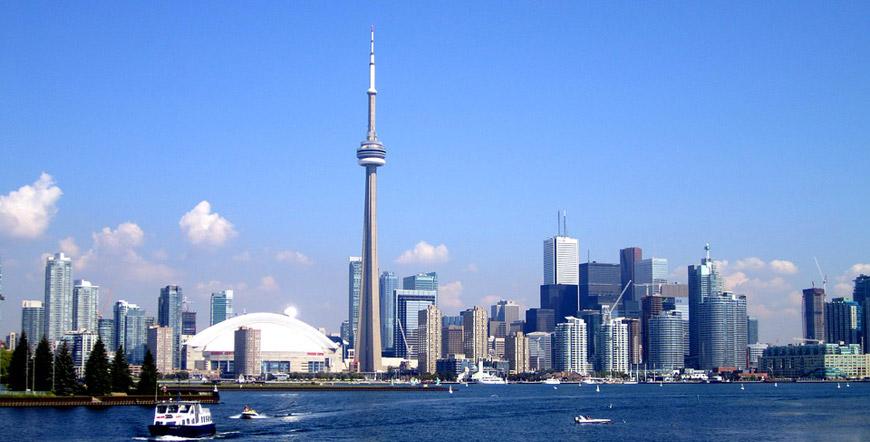
Toronto is the capital of the province of Ontario and the most populous city in Canada. Toronto is the fifth largest city in North America after Mexico City, New York, Los Angeles and Chicago. The city is located on the northwestern shore of Lake Ontario, through which the border between the United States and Canada passes. Toronto is an international center for business, finance, arts and culture and is recognized as one of the most multicultural and cosmopolitan cities in the world.
Toronto is a prominent center for music, theatre, film and television production. The city is also home to the headquarters of Canada's major national networks and media channels. The diverse cultural institutions, including numerous museums and galleries, festivals, public events, entertainment, national historic sites, and sporting activities, attract more than 43 million tourists each year. Toronto is known for its many skyscrapers and tall buildings. It is home to the phenomenal and tallest free-standing structure in the Western Hemisphere, the CN Tower.
Toronto's diverse population reflects its current and historical role as an important destination for immigrants to Canada. Over 50 percent of residents belong to a visible minority group, with over 200 distinct ethnic groups among its residents. While the majority of Torontonians speak English as their primary language, over 160 other languages can be spoken in the city.
People have roamed and inhabited the Toronto area, located on a broad sloping plateau intersected by rivers, deep ravines and an urban forest, more than 10,000 years ago. In 1793, Governor John Graves Simcoe founded the city of York, naming it after Prince Frederick, Duke of York and Albany. Simcoe decided to move the capital of Upper Canada from Newark to York, believing that the new city would be less vulnerable to attack by the United States. The York garrison was built at the entrance to the city's natural harbour. The city was formed at the eastern end of the harbor behind the peninsula, near today's intersection of Parliament Street and Front Street (in the Old Town area).
During the War of 1812, the town was the site of the Battle of York and suffered heavy damage from American troops. In 1813, the Battle of York ended with its capture and sack by United States troops. John Strachan negotiated the surrender of the city. American soldiers destroyed much of the garrison and set fire to the parliament buildings during their five-day occupation. Because of the extensive damage to York, British troops retaliated later in the war by burning Washington, DC.
The City of York became Toronto on March 6, 1834, reverting to its original name. Reform politician William Lyon Mackenzie became the first mayor of Toronto and in 1837 led the failed rebellion of Upper Canada against the British colonial government. Toronto was designated as the capital of the province of Ontario in 1867 at the time of Canadian Confederation. Since then, the city has expanded from its original boundaries, both by annexation and incorporation, to its current area. Toronto became the capital of the province of Ontario after its official establishment in 1867. Due to its status as the provincial capital, the city housed the seat of government.
A great Toronto fire in 1904 destroyed much of downtown Toronto, but the city quickly rebuilt. The fire caused more than $10 million in damage, and it led to stricter fire safety laws and an expansion of the city's fire department.
As a major destination for immigrants to Canada, Toronto grew rapidly during the remainder of the 19th century. The first significant wave of immigrants was from Irish Catholics. By 1851, the Irish-born population had become the largest single ethnic group in the city. The Scottish and English populations account for smaller numbers of Irish Protestant immigrants.
When Europeans first arrived at the site of present-day Toronto, the surrounding area was inhabited by the Iroquois. The name Toronto probably derives from the Iroquois word tkaronto, which translates to "place where the trees stand in the water." This refers to the northern end of what is now Lake Simcoe. However, the word "Toronto", meaning "abundance", also appears in the 1632 French lexicon of the Huron language, which is also an Iroquoian language. Toronto also appears on French maps in various places.
Lawrence Richards, a member of the Faculty of Architecture at the University of Toronto, says that Toronto is a bold new place, a vast and bold mix of periods and styles.' Toronto's buildings vary in design and age. Many structures from the early 19th century stand out, as well as prominent buildings built in the first decade of the 21st century. The houses of Old Toronto are a distinctive architectural feature of the city.
Old Toronto is home to many historic gems such as Yorkville, Rosedale, Lawrence Park, Layton Park, Deer Park, Casa Loma and more. East and west of downtown, neighborhoods like Chinatown, Leslieville, Market Kensington, Cabbagetown, and Riverdale are home to vibrant commercial and cultural areas, as well as artist communities with studio lofts. Other neighborhoods in the central city retain an ethnic identity, including two smaller Chinatowns, the Girstone area, Little Italy, Portugal and Little India.
Toronto has a diverse array of public spaces, from city squares to public parks. Nathan Phillips Square is the main square in the city centre. Yonge-Dundas Square, located near City Hall, has also attracted attention in recent years as one of the city's busiest gathering spots. Other squares are Harbourfront Square on Toronto's waterfront and Mel Lastman Square in North York. In recent years, Nathan Phillips Square has been revamped with new facilities and the central waterfront along Quay Quay West has been transformed with new street architecture and a new plaza.
Toronto has many large parks among which stand out Allan Gardens, Christie Pits, Grange Park, Moss Park, Queen's Park, Riverdale Park and Trinity Bellwoods Park. South of the city center are two large waterfront parks: Tommy Thompson Park, which has a nature reserve, and Toronto Islands, accessible from the city center by ferry.
Major parks outside of Toronto are High Park, Humber Bay Park, Centennial Park, Downsview Park, Guild Park and Gardens, and Morningside Park. Toronto also operates several public golf courses. Most of Toronto's river flats and river banks have been converted into public parks. After Hurricane Hazel in 1954, building construction on floodplains was prohibited.
In addition to the public parks managed by the municipal government, there are parts of Rouge National Urban Park, which is the largest urban park in North America. It is located on the east side of Toronto. Managed by Parks Canada, the national park is centered around the Rouge River and encompasses several municipalities in the Greater Toronto Area.
Toronto is a popular tourist destination. A tour around the city is a kind of delight for the senses. There are many attractions and it would be difficult to describe them all, but let's highlight some of them anyway.
The Royal Ontario Museum is a museum of world culture and natural history. The Toronto Zoo is home to over 5,000 animals, more than 460 different species. The Art Gallery of Ontario houses a large collection of Canadian, European, African and contemporary art. It also hosts exhibits from museums and galleries from around the world. The Museum of Ceramic Art is the only museum in Canada dedicated entirely to ceramics. The museum's collection contains more than 2,900 ceramic works from Asia, North and South America and Europe. Toronto is also home to the Ontario Science Centre, the Shoe Museum and the Textile Museum of Canada.
Other prominent art galleries and museums are the Design Exchange, the Inuit Art Museum, the Museum of Contemporary Art, the Institute of Contemporary Culture, the Sculpture Garden, the CBC Museum, the Sugar Museum, the University of Toronto Art Centre, Hart House, the Inuit Art Gallery and the Aga Khan Museum.
The CN Tower is a 553.3 m high concrete communications and observation tower located in downtown Toronto. It was completed in 1976. Its name "CN" originally referred to Canadian National, the railway company that built the tower. It is an icon for Toronto and attracts more than two million international visitors annually.
The CN Tower held the record for the world's tallest free-standing structure for 32 years until 2007, when it was surpassed by the Burj Khalifa. It is now the ninth tallest free-standing structure in the world and remains the tallest free-standing structure on land in the Western Hemisphere. In 1995, the CN Tower was named one of the modern Seven Wonders of the World by the American Society of Civil Engineers.
It is an icon for Toronto and attracts more than two million international visitors annually.
Vote:
Rating 5 from 1 voted
More sights in Canada


Weather in Toronto, Canada

15.9 °C
Wind: 8.05 m/s
Humidity: 70 %
Pressure: 1016 hpa
Clouds: 100 %
Wind: 8.05 m/s
Humidity: 70 %
Pressure: 1016 hpa
Clouds: 100 %