

Montreal (Montréal), Canada
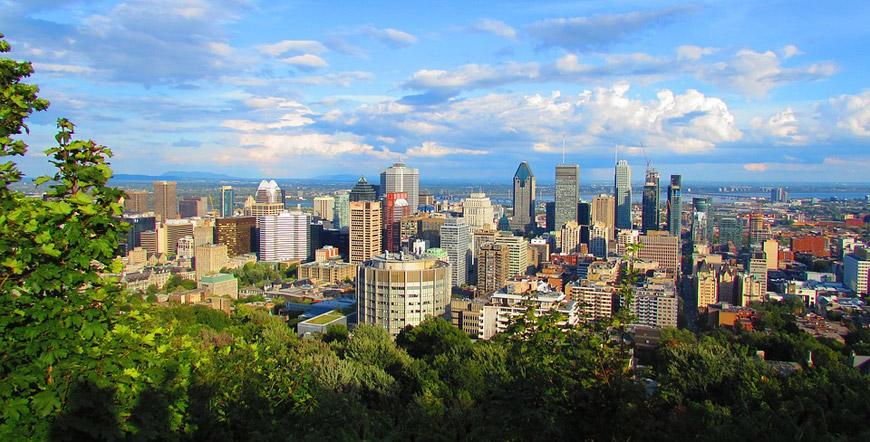
Montreal (Montréal) is the most populous municipality in the Canadian province of Quebec and the second most populous municipality in Canada. The city of Montreal covers most of the island of Montreal. Geographically, the city is located at the confluence of the St. Lawrence and Ottawa rivers. The Port of Montreal is located at one end of the St. Lawrence Seaway, the "river gateway" that stretches from the Great Lakes to the Atlantic Ocean.
Originally called Vili-Marie, or "City of Mary", the city is named after Mount Royal, a three-peaked hill in the heart of the city. The city of Montreal is located on the island of Montreal, which takes its name from the same hill. The island has several much smaller outlying islands, the largest of which is Ile Bizard.
French is the official language of Montreal and is spoken by about half of its population. After French comes English, followed by some other languages. The Montreal agglomeration is one of the most bilingual cities in Quebec and Canada, with over 59% of the population able to speak both English and French. Montreal is the second largest predominantly French-speaking city in the developed world, after Paris of course.
Montreal is the commercial capital of Canada. In the 1970s, however, Toronto overtook it in terms of population and economic growth. Despite everything, Montreal remains an important center of commerce, transportation, finance, pharmaceuticals, technology, design, education, art, culture, tourism, food, fashion, gaming, film and world affairs. Montreal has the second largest number of consulates in North America. The city was chosen to host the headquarters of the International Civil Aviation Organization. In 2006, Montreal was declared a city of design by UNESCO. In 2017, Montreal was ranked the 12th most liveable city in the world by the Economic Intelligence Service in its annual Global Liveability Ranking.
Montreal has hosted numerous international conferences and events, including the 1967 International and Universal Exposition, as well as the 1976 Summer Olympics. It is the only Canadian city to host the quadrennial Summer Olympics. In 2018, Montreal has hosted the Canadian Formula One Grand Prix, the Montreal International Jazz Festival and the Just for Laughs festival since 2016.
The first records of Montreal date back to ancient times. Archaeologists found that the local population, called the First People, occupied the island of Montreal as early as 4,000 years ago. They began to develop their livelihood, expressed in the cultivation of corn. For about several hundred years, they managed to build fortified villages. The Iroquois, an ethnically and culturally distinct group, founded the village of Hohelaga at the foot of Mount Royal two centuries before the arrival of the French. Archaeologists have found evidence of their habitation, both there and elsewhere in the valley, dating back to at least the 14th century. The French explorer Jacques Cartier visited Hochelaga on 2 October 1535 and estimated the population of native people in Hochelaga to be "over a thousand souls". Evidence of earlier occupation of the island, such as that found in 1642 during the construction of Fort Vila-Marie, has been effectively removed.
Seventy years later, the French explorer Samuel de Champlain reported that the Iroquois of St. Lawrence and their settlements have completely disappeared from the St. Lawrence. This is thought to be due to emigration, European disease epidemics, or intertribal warfare. In 1611, Champlain established a fur trading post on the island of Montreal, at a place originally called La Place Royale. At the point where the rivers Malka Riviere and the river St. Lawrence is today where present-day Pointe-Ca-Calliere is located. In his map of 1616, Samuel de Champlain named the island Lille de Villemenon, the name coming in honor of the Venerable de Villemenon, a French dignitary who sought the viceroyalty of New France.
The colonists left France in 1641 and arrived on the island the following year. On May 17, 1642, Ville-Marie was founded on the south coast of the island of Montreal. The settlement included a chapel and a hospital under the command of Jeanne Mance. By 1643, Willy-Marie had already been attacked by the Iroquois, whose attacks became so vicious that in 1651 the end of Willy-Marie was thought to have already come. The first governor of Ville-Marie, Maisonneuve, encouraged all the settlers to find refuge in the fortress. By 1652 the Montreal colony was so reduced that he was forced to return to France to raise 100 volunteers to follow him to the colony the following year. If his efforts had not been successful, Montreal was to be abandoned and the survivors moved down the river to Quebec City. Before these 100 arrived in the fall of 1653, the population of Montreal was only 50 people.
Ville-Marie remained the name of a settlement that appeared in all official documents in 1705. From that year on, the settlement was renamed Montreal.
Montreal was officially declared a city in 1832. The construction of the Victoria Bridge made Montreal a major railway junction. The city is developing and the business community is growing. Montreal business leaders began making their homes in the Golden Square (about 2.6 sq km) from around 1850. By 1860, Montreal was the largest municipality in British North America and the undisputed economic and cultural center of Canada.
Montreal was the provincial capital of Canada from 1844 to 1849, but lost its status when a mob burned down Parliament to protest the passage of a heavy-handed bill. After that, the cities of Quebec and Toronto became the capitals, until in 1857 Queen Victoria herself chose Ottawa as the capital for strategic reasons. One is that Ottawa is located in the interior of the Canadian province and is therefore not as vulnerable to US attacks. The more important reason is that the city lies on the border between French and English Canada. Ottawa retained its status as the capital of Canada when the Province of Canada joined with Nova Scotia and New Brunswick to form the Dominion of Canada in 1867.
Montreal was amalgamated with the 27 surrounding municipalities on the island of Montreal on January 1, 2002, creating a single island-wide city. As expected, the move proved unpopular and several mergers later were called off. The resettlement took place on January 1, 2006, leaving 15 municipalities on the island, including Montreal. The separate municipalities remain connected to the city through an agglomeration council, which collects taxes from them to pay for numerous common services. The 2002 mergers were not the first in the city's history. Montreal annexed 27 other cities, towns and villages beginning with Hochelaga in 1883, the last before 2002 being Pointe-aux-Trembles in 1982.
The 21st century brings with it a revival of Montreal's economic and cultural landscape. The construction of new residential skyscrapers, two super-hospitals, reconstructions of road arteries, metro line extensions and the purchase of new metro cars, the complete revitalization and expansion of the international airport, the completion of Quebec Autoroute 30, the reconstruction of existing and the construction of new bridges.
For more than a century and a half, Montreal has been designated the industrial and financial center of Canada. This status has left it as a historical and architectural heritage many buildings, including factories, warehouses, mills and refineries, thanks to which today an invaluable insight into the history of the city is recreated. The experience of time travel is strongest in the city center and in the Old Port area. Montreal has 50 National Historic Sites, more than any other city.
Some of the earliest surviving buildings in Montreal date from the late 17th century and early 18th century. They feature a unique French influence style and gray stone construction. Although most are clustered around the Old Montreal area, architectural examples such as the Selpice Seminary, the 1687 Notre Dame Basilica and the 1705 Chateau Ramezay are outstanding examples of early colonial architecture and dot the entire city. Located in Lachine, Le Ber-Le Moyne House is the oldest complete building in the city. At Point St. Charles, visitors can see the Maison Saint-Gabriel, which can trace Montreal's history back to 1698. Old Montreal has many historic buildings preserved in their original form.
The main building of the University of Montreal, the Olympic Stadium and the surrounding structures are just a few of the notable examples of architecture characteristic of the twentieth century. The pavilions designed for the 1967 International and Universal Exposition, also popularly known as Expo 67, displayed a wide range of architectural designs. Although most pavilions were temporary structures, some have become landmarks, including the Buckminster Fuller Geodetic Dome, the U.S. Pavilion, and others.
In 2006, Montreal was named a UNESCO City of Design, making it one of the three design capitals of the world (the others being Berlin and Buenos Aires).
The underground city of Rezo is an important tourist attraction. It is the set of interconnected commercial complexes (both above and below ground). This impressive network connects pedestrian thoroughfares with universities, hotels, restaurants, bistros, subway stations and more, in and around the city center. The central city area is home to numerous museums, including the amazing Museum of Fine Arts.
Scattered throughout the Montreal metro are many pieces of public art belonging to some of the biggest names in Quebec culture.
Montreal's Old Town is a historic area located southeast of downtown Montreal. It has concentrated attractions such as the Old Port of Montreal, Jacques Cartier, Montreal City Hall, the Market, the Pointe-à-Callière Museum, Notre Dame Basilica and the Montreal Science Center.
The architecture and cobblestone streets of Old Montreal have been maintained or restored. Old Montreal is accessible from the city center via the underground city of Rezo and is served by several STM bus routes and metro stations, ferries to the South Shore, and a network of bike paths.
The area of the river immediately adjacent to Old Montreal is known as the Old Port. The Old Port was the site of the Port of Montreal, but later the loading and unloading operations were moved to another more extensive site downstream, leaving the former location as a recreation and historical activity area. The New Port of Montreal is the largest container port and the largest inland port on Earth.
Mount Royal Park is one of Montreal's largest green spaces. The park, which is mostly wooded, was designed by Frederick Law Olmsted, who also designed New York's Central Park. Parc du Mont-Royal, or Royal Mountain, is named after the only higher peak and looks more like a large hill, from where there is a wonderful panoramic view of the city surrounded by the huge St. Lawrence River.
Vote:
Rating 5 from 1 voted
More sights in Canada


Weather in Montreal (Montréal), Canada

13.07 °C
Wind: 2.95 m/s
Humidity: 80 %
Pressure: 1016 hpa
Clouds: 50 %
Wind: 2.95 m/s
Humidity: 80 %
Pressure: 1016 hpa
Clouds: 50 %