

Banff Park, Canada
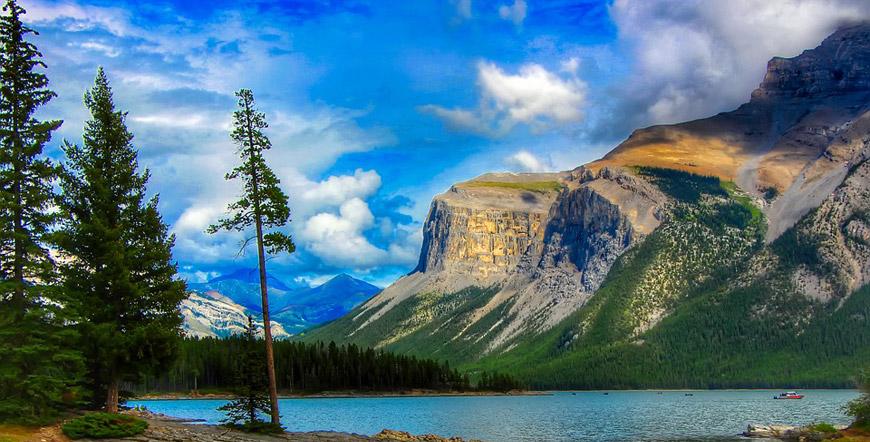
The Canadian Rocky Mountain Parks World Heritage Site is one of the largest protected areas in the world. It consists of three national parks - "Yoho", "Jasper" and "Banff".
Banff Park is known as Canada's first national park. It first entered the protected area with its modest size of 26 sq km in 1885, but today it is already a giant, stretching over an area of 6,879 sq km. Today, Banff National Park is Canada's number one tourist destination.
Banff Park is located in the Rocky Mountains, 110-180 kilometers west of Calgary in the province of Alberta. It is a mountainous terrain, with numerous glaciers and ice fields, dense coniferous forest and beautiful alpine landscapes.
In 1902, Banff Park was expanded and covered 11,400 square kilometers, with areas around Lake Lewis included in its territory. Pressure to use the green spaces of Banff Park for grazing and logging reduced the size of the park in 1911 to 4,663 sq km, eliminating many areas of the eastern foothills from the park. The boundaries of the park changed several more times until 1930, when the area of Banff Park was fixed at 6,697 square kilometers with the passage of the National Parks Act. The Act, which came into effect on May 30, 1930, also affected the development of Banff National Park. Along with other minor changes to the park boundaries in 1949, the boundaries of Banff Park reached 6,641 sq km.
In the beginning, Banff Park was popular with wealthy European and American tourists, the first of whom arrived in Canada via transatlantic luxury liner and continued west by rail. Some visitors participated in mountain activities, for which they often hired local guides.
Since 1906, the Alpine Club of Canada began organizing climbs, hikes and camps in the park. Until 1911, Banff was accessible by car from Calgary. In early 1916, motor coach tours of Banff began to be offered.
Banff Park is extremely popular especially for its lakes - Lewis and Moraine, picturesquely surrounded by the mountains that rise like sentinels, whose snow-capped peaks look out into the alien jade-green waters.
Lake Lewis is more popular due to several facts. For example, its ski area is very popular. The lake also owes its fame to the famous Fairmont Chateau Lake Louise Hotel, described as a lavish Edwardian dream, and perhaps the finest of all hotels in the Rockies. Lake Lewis is also very proud of its resort village. Icefields Parkway is the road that connects Jasper National Park with the lake. At first reading, someone will say "well, what so much, just a road".
No, it's not just a road. It is a tale telling of a futuristic landscape dotted with overhanging glaciers and subalpine forests, waterfalls and deep river valleys. However, the jewel in the crown is the Columbia Icefield - the ice field, which with its 300 square km. is one of the largest ice masses accumulated in one place.
Moraine Lake is located about 13 km east of Lewes. This lake in Canada's Balfe National Park is a much-loved spot whose beauty and atmosphere appeal to all those looking for a less commercial experience. It has an interesting hiking trail that runs along its northern shore, just below the 3,000-meter-high mountain peaks. There are also great hiking opportunities to the southeast – look for Johnston Canyon, which offers you a route that runs between 30m sheer cliffs, tunnels, crosses wooden and narrow footbridges, all to lead you to the magical Inkpots – seven waterfalls with emerald green bodies of water.
Banff National Park has a subarctic climate with three ecoregions including montane, subalpine and alpine. The forest vegetation is dominated by vine pine, at lower elevations spruce is found. Mammals such as grizzlies, cougar, moose, sheep, as well as hundreds of bird species are found. Reptiles and amphibians have also been found, but only a limited number of species have been recorded. The mountains were formed from sedimentary rocks that were thrust eastward over newer rock layers between 80 and 55 million years ago. In the past few million years, glaciers covered most of the park in places, but today they are only found on the mountain slopes. Erosion by water and ice carved the mountains into their current shapes.
Since the 1960s, park sites in Banff Park have been open year-round, with annual tourist visits to Banff growing to over 5 million in the 1990s. Millions of people pass through the park on the Trans-Canada Highway. As Banff has millions of visitors a year, the health of its ecosystem is at risk. In the mid-1990s, management recommendations and new policies aimed at preserving ecological integrity were made.
Vote:
Rating 5 from 1 voted


