

Halifax (Halifax Regional Municipality), Canada
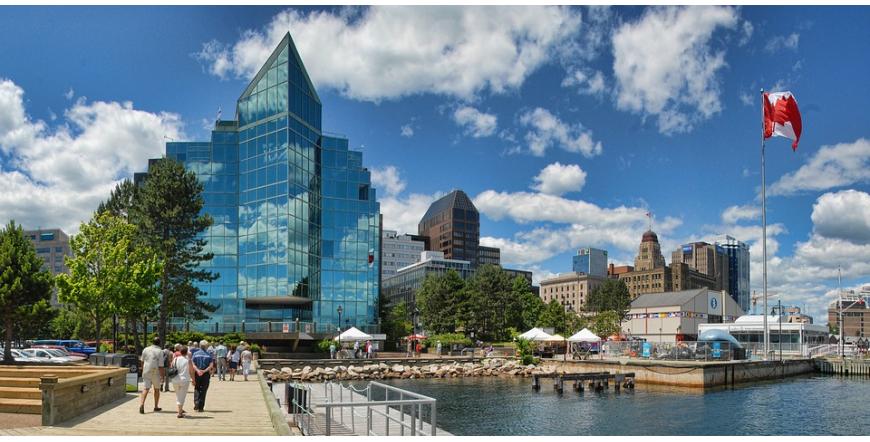
Halifax, officially known as the Halifax Regional Municipality, is the capital of the Canadian province of Nova Scotia. Halifax Regional Municipality consists of four former municipalities that were amalgamated in 1996: Halifax, Dartmouth, Bedford and Halifax County.
Halifax is a major economic center in Atlantic Canada, with a large concentration of government offices and private sector companies. Mainly jobs and income in Halifax come from the Department of National Defence, Dalhousie University, St. Mary's University, Halifax Shipyard, various levels of government and the Port of Halifax. Agriculture, fishing, forestry and natural gas extraction are the main resources for production in the rural areas of the municipality.
Halifax began its development on the lands of the Mi'kmaq indigenous peoples. The tribe is believed to have resided in Nova Scotia, New Brunswick and Prince Edward Island from before 1400 – 1500.
The establishment of the city of Halifax in 1749, named after the second Earl of Halifax, saw the transfer of the colonial capital from Annapolis Royal. The establishment of Halifax marked the beginning of Father Le Loutre's war. The war began when Edward Cornwallis arrived to establish Halifax on June 21, 1749. The founding of Halifax was an act by which the British violated earlier treaties with the Mi'kmaq of 1726 that had been signed after Father Rall's War. Cornwallis brought 1,176 settlers and their families to the lands of present-day Halifax. To guard against Mi'kmaq attacks, the British built fortifications - Citadel Hill in 1749, Bedford in 1749, Dartmouth in 1750, and Lawrencetown in 1754.
A huge explosion on December 6, 1917 almost completely demolished Halifax. The explosion was caused by a crash between 2 ships. On board the French vessel were carried 200 tons of trinitrotoluene, 2,300 tons of pyroxic acid and 35 tons of highly flammable benzene in iron barrels, explosives and weapons intended for use in the First World War.
On April 1, 1996, the provincial government merged all the municipal governments in Halifax County to create the Halifax Regional Municipality.
After amalgamation, the region officially became known as Halifax Regional Municipality (HRM), although Halifax remained municipal for short. On April 15, 2014, the regional council approved the implementation of a new campaign for the region, developed by the local company Revolve Marketing. The campaign referred to the region as just Halifax, although "Halifax Regional Municipality" remains the region's official name. The proposed rebranding has been met with a mixed reaction from residents, some of whom believe the change will alienate other communities in the borough by perceiving the new scheme will focus only on metropolitan Halifax, while others express relief.
The Halifax Regional Municipality is an amalgamation of four municipalities comprising urban and rural areas. Halifax County has over 200 official rural and urban communities that have retained their original geographical names, including the cities of Halifax and Dartmouth and the town of Bedford. The Halifax Regional Municipality is divided into eighteen districts, which are further divided into neighborhoods or villages.
Halifax is renowned for the quality of several of its neighborhoods. Spring Garden, adjacent to downtown Halifax, is a vibrant neighborhood with a variety of shopping and entertainment options, as well as a new central library. Over the past few years, the area has seen land development, with new residential areas being created. The North End is a multicultural and artistic district with a long history, famous for Göttingen and the Hydrostone shopping areas. North Preston, located outside of Dartmouth, is Canada's largest and oldest black community.
Halifax's urban core is home to a number of notable buildings. In addition, significant historical buildings and neighborhoods have been preserved here. The downtown office towers are overshadowed by the Citadel Hill fortress with its iconic Halifax City Clock.
The architecture of the South End of Halifax is known for its large Victorian houses, while the West End and North End have many blocks and well-preserved half-timbered tenements, such as the "Halifax Porch". Dalhousie University's campus is often featured in movies and documentaries. There are also preserved historic districts around areas of the borough, including Dartmouth and Bedford.
The urban core is home to several blocks of typical North American high-rises. However, there are height restrictions in the center that prevent buildings from obstructing certain sight lines between Citadel Hill and Halifax Harbour. This has led to some modern high rises being built at unusual angles or locations.
The Halifax area has a variety of public spaces ranging from urban gardens, public squares, extensive wooded parks and historic sites. The original grid plan, created when Halifax was founded in 1749, included a central military square called the Grand Parade. Today, the square houses the town hall and is a popular venue for concerts, political demonstrations, and the annual Remembrance Day ceremony at the central cenotaph.
Vote:
Rating 5 from 1 voted
More sights in Canada


Weather in Halifax (Halifax Regional Municipality), Canada

13.52 °C
Wind: 0.45 m/s
Humidity: 85 %
Pressure: 1015 hpa
Clouds: 3 %
Wind: 0.45 m/s
Humidity: 85 %
Pressure: 1015 hpa
Clouds: 3 %