

Quebec, Canada
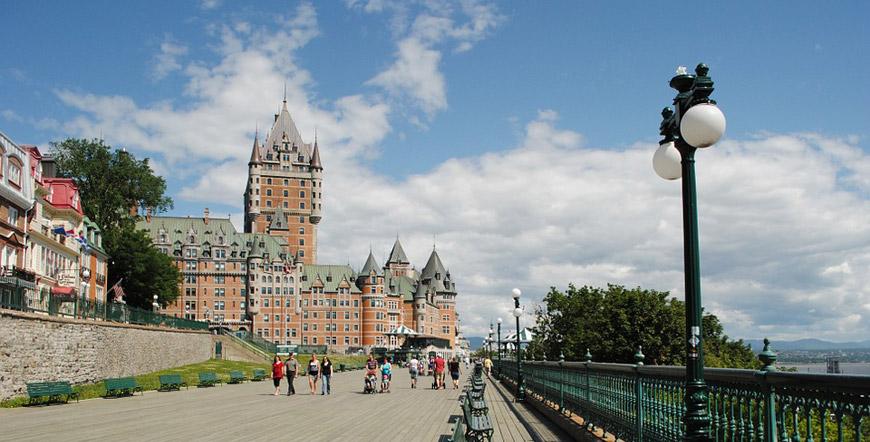
Quebec is the largest province in Canada. The capital of the province is Quebec City, and the largest city is Montreal. The province is bordered on the west by the province of Ontario and the waters of James Bay and Hudson Bay; on the north by Hudson Strait and Ungava Bay; on the east by the Gulf of St. Lawrence and the provinces of Newfoundland and Labrador; to the south with the province of New Brunswick and the US states of Maine, New Hampshire, Vermont and New York. Quebec also shares maritime borders with Nunavut, Prince Edward Island and Nova Scotia. Quebec is the largest province in Canada and is the second largest administrative unit, only the territory of Nunavut is larger. Historically and politically, they are considered, with Ontario, to be part of Central Canada.
Quebec is the second most populous province in Canada, after Ontario, and the only one with a predominantly French-speaking population, with French being the province's only official language. Most residents live in urban areas near the St. Lawrence River. Approximately half of Quebecers live in the Greater Montreal area. English-speaking communities and English-language institutions are concentrated in the west of the island of Montreal, but are also significantly present in the Outaouais, Eastern Townships and Gaspé regions. The Nord-Du-Québec region, occupying the northern half of the province, is sparsely populated, mostly by aboriginal peoples.
Quebec is a vibrant multicultural province that often earns its recognition as the "Europe of North America". Quebec is known for its vast forests, rolling hills and countless waterways. In fact, Quebec has approximately 1 million lakes and waterways, giving it more fresh water than any other province.
The name "Quebec" means "where the river narrows". It was originally the name of the area around Quebec City where the St. Lawrence River narrows to a cliff-faced chasm. The French explorer Samuel de Champlain in 1608 chose Quebec as the name of the area he would set aside as the administrative seat for the French colony of New France. Sometimes the province is called "La Belle Province" ("the beautiful province").
The province of Quebec was founded by Royal Proclamation in 1763 after the Treaty of Paris officially transferred the French colony of Canada to Great Britain following the Seven Years' War. The proclamation limited the province to an area along the banks of the St. Lawrence River. The Quebec Act of 1774 expanded the province's territory to include the Great Lakes and Ohio River Valley and to the south Rupert's Lands, more or less restoring the boundaries that had existed under French rule prior to the 1760 conquest. The Treaty of Paris of 1783 ceded territories south of the Great Lakes to the United States. After the Constitution Act of 1791, the territory was divided between Lower Canada (present-day Quebec) and Upper Canada (present-day Ontario). In 1840 they became Canada East and Canada West after the British Parliament united Upper and Lower Canada into the province of Canada. This territory was reassigned to the provinces of Quebec and Ontario in 1867.
In 1898, the Canadian Parliament passed the first Quebec Boundary Extension Act, thanks to which the province extended its borders north to include the lands of local Aboriginal peoples. The last addition was that of Ungava County through the Quebec Boundary Extension Act of 1912. It drew the northernmost Inuit lands to create the modern province of Quebec. In 1927 the boundary between Quebec and Newfoundland and Labrador was established by the British Judicial Committee of the Privy Council. Quebec formally disputes this boundary.
The province has its own coat of arms, with the original coat of arms adopted in 1868 and used during the reign of Queen Victoria. The Quebec coat of arms was changed in 1939 by the government of Quebec, and the purpose of the change was to be able to perpetuate the province's history through eras of government through heraldry. Today, Quebec's coat of arms depicts a shield with three lilies on a blue background at the top, commemorating the first political regime, the era of New France. Below it is a golden leopard, symbolizing the British crown, and at the bottom is a three-leafed maple branch.
Quebec's economy is highly industrialized and diversified. Quebec's extensive manufacturing sector provides a wide variety of export products, such as air traffic control equipment, software, subway trains, helicopters, compact discs, air purifiers and toys. Montreal, the province's commercial capital, has developed competitive industries such as aerospace, pharmaceuticals, telecommunications, energy, transportation and finance.
The province of Quebec is very rich in natural resources. Quebec produces more than a third of Canada's pulp and paper products. Thanks to Quebec's vast power generation capacity, the state-owned energy sector produces and sells large amounts of hydropower to neighboring provinces and the United States. Income from agriculture is also significant. International exports now account for over 30 percent of the province's gross domestic product.
Quebec is a home to a vibrant culture that plays a key role in attracting visitors from across Canada and around the world. Efforts to preserve the province's Francophone heritage ensure that one can find art, cuisine and cultural events that cannot be found anywhere else in the world.
Quebec City is the political and administrative capital of the province. It has some of the best-preserved heritage sites in North America. Old Quebec City is recognized as a UNESCO World Heritage Site. Quebec is just a motley tangle of old cobblestone roads and a modern cosmopolitan city look.
As the province's largest city, the city of Montreal is known worldwide for its unique multicultural atmosphere. Since its inception, Montreal has been home to significant English and French communities, making it a truly bilingual city. Over time, Montreal has welcomed hundreds of thousands of immigrants as one of the top destinations for newcomers to Canada. The contribution of these people to the culture of Montreal can be easily seen as you walk the streets of the city and observe the "mosaic of cultures" from around the world.
Apart from everything else, Montreal is also known as a city of festivals and for hosting numerous events every year - street festivals, concerts and various other activities. Among them stand out the Just for Laughs comedy festival, the Montreal International Jazz Festival and the Canadian Grand Prix - world-renowned events that attract the world's best performers and athletes.
Vote:
Rating 5 from 1 voted
More sights in Canada


Weather in Quebec, Canada

8.83 °C
Wind: 2.21 m/s
Humidity: 90 %
Pressure: 1016 hpa
Clouds: 57 %
Wind: 2.21 m/s
Humidity: 90 %
Pressure: 1016 hpa
Clouds: 57 %