

Ottawa, Canada
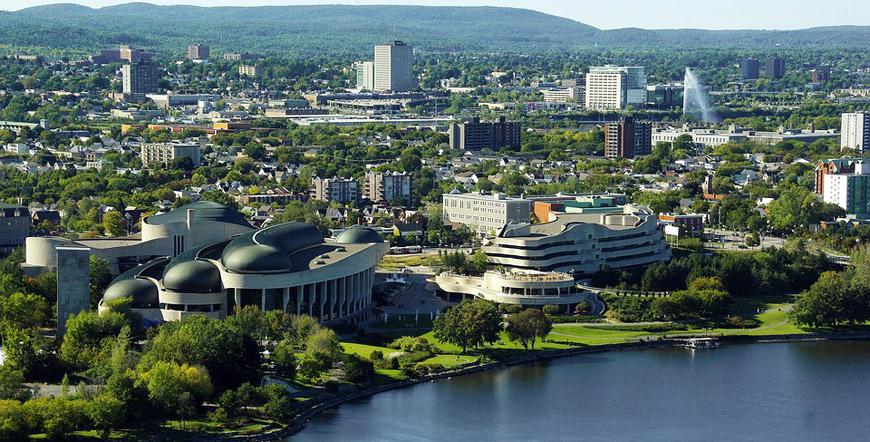
Lovely, calm and clean, this is Ottawa - the capital of Canada. It is located on the south bank of the Ottawa River in the eastern part of the province of Ontario. The city of Ottawa has the highest standard of living in the country and the lowest unemployment rate. Ottawa is undoubtedly the most beautiful tourist destination in North America.
Founded in 1826 as Bytown, and renamed in 1855 to Ottawa, the city became the political center of Canada. Its original boundaries were expanded through numerous annexations to include new territories, and eventually their merger in 2001 greatly increased its area. The city name "Ottawa" is borrowed from the Ottawa River, whose name means "to trade". The first settlers in Ottawa were Irish and French and thus the city became a multi-national city with a diverse population.
Ottawa has the most educated population of any Canadian city and is home to a number of research and cultural institutions, including the National Arts Centre, the National Gallery and numerous national museums. With the entry of the Champlain Sea about ten thousand years ago, the Ottawa Valley became habitable. Local people used the area for wild edible crops, hunting, fishing, trading, traveling and camping more than 6,500 years ago.
Three major rivers meet within Ottawa, which has been an important area of trade and travel for thousands of years. The Algonquins called the Ottawa River Kitchi Sibi or Kitchisippi, meaning "Big River" or "Grand River."
Etienne Brulet, considered the first European to travel the Ottawa River, passed through Ottawa in 1610 on his way to the Great Lakes. Three years later, Samuel de Champlain wrote about the falls in the area and his encounters with the Algonquins, who had used the Ottawa River for centuries. Philemon Wright was the Englishman who established the first settlement in the area on March 7, 1800 on the north side of the river. He, along with five other families and twenty-five workers, decided to create a farming community they called Wrightsville. Wright pioneered the lumber trade in the Ottawa Valley, transporting lumber by water from the Ottawa Valley to Quebec City. Bytown was the first name of the present-day city of Ottawa, which was founded as a community in 1826.
The city of Ottawa is located at the confluence of three major rivers: the Ottawa River, the Gatineau River and the Rideau River. The Ottawa and Gatineau rivers were historically important in the logging and logging industries, and the Rideau River was an important part of the Rideau Canal system for military and commercial purposes. The Rideau Canal is 202 km long. and was launched in 1832. It connects the St. Lawrence River at Lake Ontario in Kingston with the Ottawa River near Parliament Hill. It manages to bypass the unusual stretches of the Cataraqui and Rideau rivers and various small lakes along the waterway. On June 29, 2007, the Rideau Canal was recognized as a UNESCO World Heritage Site.
The city of Ottawa is a compact, clean, cleverly planned center of culture and politics and a suitable destination for every season. A sightseeing tour of Ottawa can start from the center of the architecturally beautiful National Gallery of Canada, pass through the Canadian Museum of Nature, the Canada Air and Space Museum and end again at an architectural, historical or cultural gem.
The Rideau Canal offers a unique experience - a boat ride in the summer and the world's largest ice rink in the winter. The Gatineau Park attracts cyclists and pedestrians - the green paradise, located on 361 square kilometers, is a favorite place for relaxation, hiking and cycling for both local residents and guests of the city. The City Hall building, the Mint and the National Gallery should not be missed. This gallery is the largest in Canada and is a spacious museum of Canadian art, with exhibitions of international works of art and a cafe.
The Parliament of Canada building is a neo-Gothic complex with lush gardens and works of art. A tourist attraction is a visit to Fulton's Pancake House & Sugarbush Maple Syrup Farm and Hilt Buyard Market.
Ottawa's architecture is heavily influenced by the fashions of government structures, so much of the city's architecture is formalistic and functional. Ottawa is also marked by romantic and picturesque architectural styles, such as the Gothic Revival architecture of the Parliament Buildings. The residential architecture of Ottawa is dominated by single-family houses and apartment buildings. Many buildings are "dressed" in bricks, with a small part covered with wood, stone or siding of various materials - the variations are different, mostly according to the neighborhood or the age of the homes and buildings.
There are restrictions on the height of buildings in Ottawa. The Peace Tower is 92.2m high and only a few buildings in the city are taller than it – the tallest on rue Albert is the 29-storey Place de Ville at 112m.
One of Canada's most famous museums and galleries is located in the city of Ottawa. The National Gallery of Canada stands out among them. It was designed by renowned architect Moshe Safdie and is the permanent home for Maman's sculpture. There are over 3.75 million artifacts in the Canadian Military Museum. The Canadian Museum of Nature was built in 1905, moved to another building in 2005, and underwent major renovations between 2004 and 2010.
Across the Ottawa River in Gatineau is the most visited museum in Canada – the Canadian Museum of History. Designed by Canadian architect Douglas Cardinal, the curved complex was built at a cost of US$340 million. The complex also houses the Canadian Children's Museum, the Canadian Postal Museum and a 3D IMAX theater.
The Rideau Canal is the oldest continuously operated canal in North America. In addition to this national site, Ottawa is home to 24 other National Historic Sites of Canada – Central Chambers, Central Experimental Farm, Laurier Castle, Confederation Square, the former Ottawa Teachers College, the Prime Minister's Office and the Privy Council and Parliament Buildings. Many other cultural assets are designated as "heritage features" of the City of Ottawa under Part IV of the Ontario Heritage Act.
Ottawa's local cuisine is a pleasant surprise - a colorful palette, a wonderful mix of different culinary currents that came from France, Africa and the Caribbean, passed through Eastern Europe
and exotic Southeast Asia.
Vote:
Rating 5 from 1 voted


