

Menshikov Palace, Russia
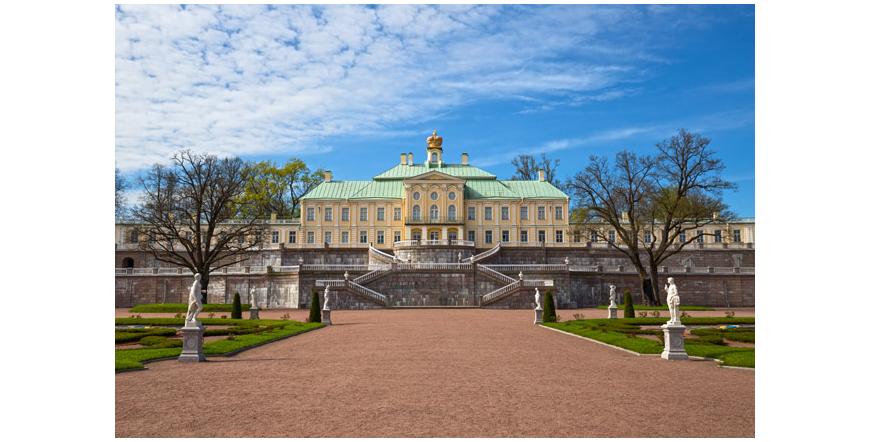
Menshikov Palace is one of the masterpieces of Peter the Great, distinguished by splendor in the furniture and interior of the external facade. A close friend and favorite of the tsar, Menshikov was the first governor-general of St. Petersburg. One of the historians writes about him: "His merit to Russia was great, his life was incredible, his personal condition was one of the greatest in the empire and his greed knew no bounds."
Construction of the palace began in 1710, after the brilliant victory of Russian troops on June 27, 1709 at Poltava, which was a turning point in the Northern War against the Swedes and in which Alexander Menshikov was given the lead role. The palace, intended as Menshikov's residence, without which "Peter would probably never have become Great, but only the First, would remain," is located on the banks of the Golyama Neva arm on Vasilevsky Island in St. Petersburg. For the design of this first stone building in the city, Peter I invited the Italian-Swedish architect Giovanni Maria Fontana and the German architect Gottfried Johann Schedel.
The construction of the palace is carried out in several stages. Initially, only a floor and a half were built, but soon two more side wings were added, to which a unifying gallery was added. The architectural style of the Menshikov Palace is baroque as a combination of the baroque styles of Swedish, German and Dutch architecture with a Russian flavor at the will of Peter the Great. The facade of the building is accentuated by the presence of columns with stone capitals, while the side wings have intricate pediments with gilded princely crowns and monograms. Above the main portal was a beautiful loggia, where musicians welcomed guests, moored their boats at the small pier on the Neva. In the beautiful garden, guests enjoyed the many greenery, interesting sculptures, exquisite fountains and greenhouses with rare flowers.
Unfortunately, only the palace, of which the grand staircase and four of the rooms are best preserved, has survived to this day: the room of Varvara, the sister of Menshikov's wife, who was the babysitter of his children; the walnut cabinet; Menshikov's bedroom and the vestibule. About 50,000 painted azulejo ceramic tiles were used to decorate the palace, which give a charming look to the interior. After the reconstruction of the palace, their number has halved and these wonderful tiles adorn the walls of only these four rooms. Apart from them, gold, silver, marble, expensive wood, crystal chandeliers, large Venetian mirrors, tapestry and silk Chinese wallpapers have found a place in the interior of the palace.
The Menshikov Palace housed the richest collections of paintings, sculpture, applied art and numismatics. In the basement of the palace there were nine cellars for storage of Russian and foreign wines, as well as a place for storage of vegetables. On the ground floor you can see the load-bearing structures of one of the first stone buildings in the "swamp city". The three kitchens upstairs were designed to heat and decorate the dishes.
In the interior of the palace the central place is occupied by the Walnut cabinet - a spacious room, lined with walnut wood and preserving the decorative art from the time of Peter the Great. The ceiling in this impressive cabinet has been painted three times, the last layer being created by Philip Pillman at the end of Peter the Great's reign. The frescoes below it depict Peter the Great as a victorious warrior from the first half of the 18th century.
Two years after the death of Peter the Great, Menshikov was accused of treason and was sent into exile in Berezov with his family. In the second half of the 18th century, the palace was reconstructed for the needs of the Cadet Corps. In Soviet times, the palace housed a military-political school.
The revival of the Menshikov Palace took place in 1966, when it was decided to return it to its original appearance. Today, most of the palace has been restored and in more than 30 halls can be seen permanent exhibitions and temporary exhibitions. Menshikov's palace is a monument of architecture from the 18th century, representing the ingenuity and extravagance of its owner and is a branch of the Hermitage.
Visiting fees depend on the age and requirements of the visitors and every third Thursday of the month, March 8, May 18 and December 7, visits to the palace are free.
Vote:
Rating 5 from 1 voted
More sights in Russia


_31444.jpg)


