

Melrose Abbey
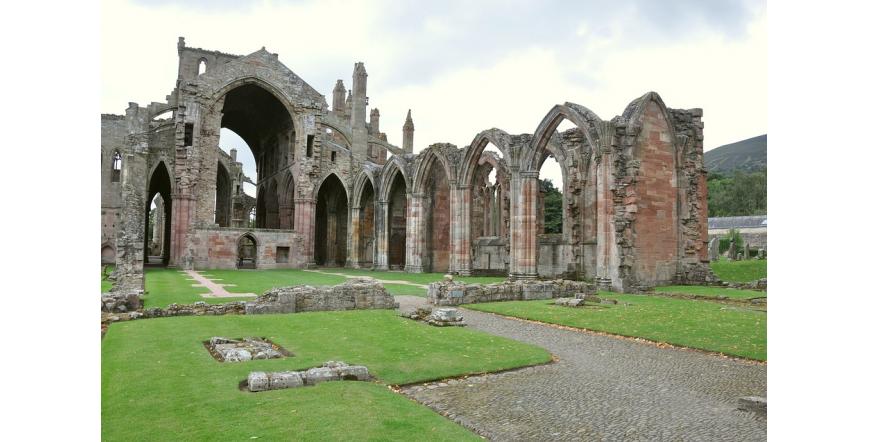
Melrose Abbey is a monastery founded in 12th century after King David I of Scotland requested the Cistercian monks to move to Melrose. His wish was having the abbey built at that exact location and dedicated it to St. Mary.
The king’s idea behind founding the Melrose Abbey was modernization of the agriculture and improving the level of education in the region. To achieve that the religious institution had to own enough land.
Melrose Abbey was destroyed after multiple English attacks, however it was afterwards restored. Only romantic ruins from it are currently left to be seen. After the last demolishing of the abbey, parts of it were used in the construction of other buildings by the locals.
Perhaps the most important and legendary story about the Melrose Abbey is connected to the death of King Robert the Bruce in 1329. Before his passing, Robert the Bruce asked that his heart was post-mortem removed, put in a metal urn and taken to Jerusalem to be buried in the church next to the tomb of Jesus Christ. Sir James Douglas, Sir William Sinclair, Sir William Keith of Galston and at least two other knights wended their way to the Holly Land to fulfill the last will of King Robert the Bruce in 1330. Sir James Douglas carried the necklace with the silver urn keeping the embalmed heart. Their route went through Spain where the group was defeated in battle during which Sir James Douglas lost his life.
The only survivor was Sir William Keith of Galston who managed to rescue the urn and keep the tradition of bringing it back to Scotland. He brought the mummified heart of Robert the Bruce to the Melrose Abbey and buried it under the eastern portals of the alter. In 1996 excavations were made and a metal urn containing embalmed heart was found. It is currently exhibited in the local museum.
Vote:
Rating 5 from 1 voted
More sights in Great Britain


