

Walhalla Monument, Germany
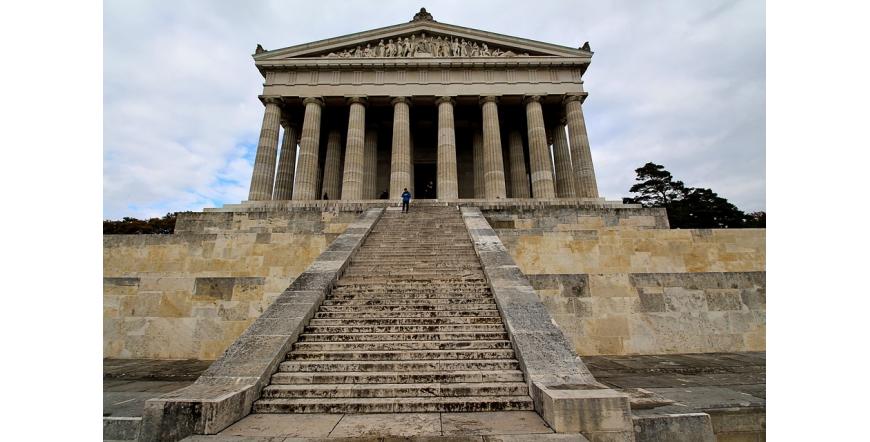
The Walhalla Monument - Palace of the Fallen Wars is located near Regensburg, Germany, and since 1842, it has honored famous Germans, as well as personalities associated with the history of Germany and the German-speaking peoples, with memorial busts and memorial plaques.
Its name comes from Walhalla, a mythical place located in Asgard, where the warriors who have fallen honorably in battle go in Norse mythology. Along with many other monuments, Walhalla ranks among the most monumental monuments in Germany. The place for the erection of Walhalla was chosen by Ludwig himself and the architect Klenze - high above the Danube, near Regensburg. Ludwig wanted to use the style of English landscape gardens and the Munich English Park as a site for the construction, but it turned out that the site was too narrow and not as spacious as the classical buildings that Ludwig became familiar with during his travels in Italy.
After a long hesitation, Walhalla was raised to its present location. The length of the building is 66.7 meters, the width is 31.6 m, and the height is 20 m. In total, with the foundations, the length is 125 m, and the height is 55 m. Inside, Walhalla is 48.5 m high, 14 m wide and high 15.5 m.
The creation of the Walhalla monument was provoked by Ludwig's decision, as mentioned in the first inscription on the floor, to build a monument to 50 great Germans. To determine the names, Ludwig consulted the Swiss writer and storyteller Johannes von Müller, who actually suggested the name Walhalla.
The individuals designated range from long-ago emperors to the recently deceased such as Friedrich Schiller to contemporaries such as Goethe and Joseph Haydn. A number of sculptors were entrusted with the task of depicting the busts of the great Germans, the most famous of whom were Johann Gottfried Schadow, his son Rudolf Schadow and Christian Friedrich Tieck.
The project of Walhalla was assigned to the architect Leo von Klenze - he was challenged to build a monument "Temple of Glory". The skill of Klenze, the money – of Ludwig I of Bavaria. As a result of this good tandem, in the period 1830-1842, the Walhalla monument was erected in a classical style and outwardly resembling a marble Greek temple - like the Parthenon in Athens.
At the opening, 160 people were honored with 96 busts and 64 memorial plaques. Today, Walhalla houses 128 busts and 65 memorial plaques, which are sculpted in honor of 193 people or groups. Walhalla is owned by the Free State of Bavaria, and any citizen can nominate a significant person from the German-speaking language group who died at least 20 years ago. Only eleven of the honorees were women, although Ludwig I mentioned that “No class, not even the female sex, is forbidden. Equality reigns in Walhalla; death cancels all earthly distinction.”
Vote:
Rating 4 from 1 voted
More sights in Germany


