

Amsterdam, Netherlands
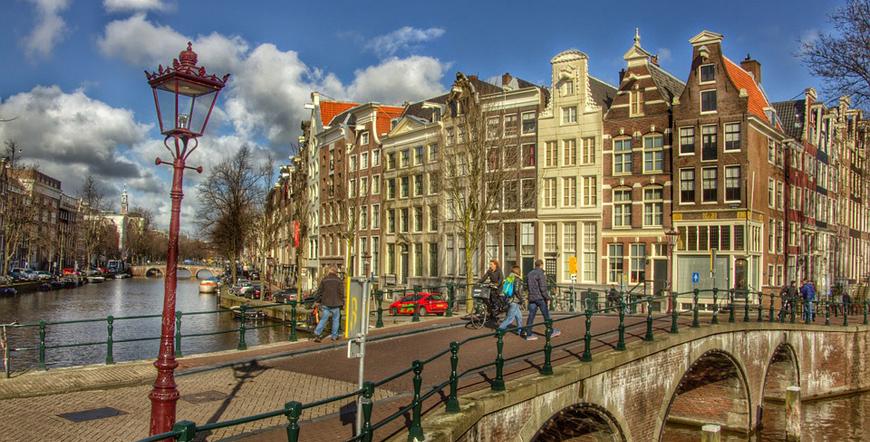
Amsterdam is a real pearl in the necklace of European cities. The old part of the city consists of canals and narrow streets, starting radially from a point like the spokes of a wheel.
1. The Royal Palace in Amsterdam is a huge classical structure built on 13,659 pylons driven into the marshy ground. Construction was completed in 1655. The large sculptures on the pediment allegorically represent Amsterdam surrounded by Neptune and sea creatures. Here is the official royal residence.
2. The Netherlands Maritime Museum in Amsterdam displays restored vessels and an exact replica of a three-masted merchant ship from 1749. The museum traces the history of Dutch shipping from carved canoes to modern tankers using maps, paintings and models.
3. Anne Frank's house in Amsterdam is immortalized by the poignant diary of a Jewish girl from the period 1942-1944, when she and her family hid here from the German occupiers. This house by the canal has an exhibition of documents about the Holocaust and civil liberties.
4. Dam Square in Amsterdam is the widest square in the old part of the city. At one end of the square stands a monument to the Dutch victims of the Second World War.
5. Kantara is a monumental building in Amsterdam, built in 1488 as a city gate, later it became the Kantara and the center of the old guilds. The restored Anatomical Theater upstairs was completed in 1691 and served as the setting for Rembrandt's "The Anatomy Lesson of Dr. G...".
6. The New Church in Amsterdam is a massive Gothic building, extended until 1540. Destroyed by fire in 1645, it was rebuilt in an impressive Renaissance style.
The stained-glass windows and the huge organ from 1645 create an irresistible impression during major holidays, when the church is decorated with flowers. All coronations take place here.
7. The Old Church in Amsterdam is the oldest religious building in the city, which dates back to the beginning of the 14th century. It was destroyed by iconoclasts after the Reformation. The original bell tower and several remarkable stained glass windows have been preserved. Rembrandt's wife Saskia is buried here.
8. The Wailing Tower in Amsterdam was built in 1480 for women whose husbands were on the high seas. A plaque marks the spot from which Henry Hudson set sail on the Crescent on April 4, 1609, to reach what is now New York City and the river that bears his name.
9. The West Church in Amsterdam has a group of bells that can play different tunes. The church tower is the highest in the city – 85 m. Rembrandt and his son Titue are buried here.
10. The Amsterdam Historical Museum traces the history of the city from its beginnings as a fishing village to the golden 17th century. Of material and cultural prosperity and the decline of the commercial empire in the 18th century.
11. The Amsterdam Mint was built in 1620 at a busy intersection, and the graceful tower, added later, has a clock and bells that convey the atmosphere of a bygone era.
12. The Jewish History Museum in Amsterdam is a complex of four synagogues, the oldest dating back to 1671. It was opened in 1987 as a unique museum. Founded by American and Dutch Jews, the museum presents religious relics in a cultural and historical context.
13. Munder Street in Amsterdam is a pedestrian area imbued with a historical atmosphere characteristic of the entire area. The entrances here are decorated with pelicans – a symbol of great love. According to legend, the mother pelican is ready to feed her young with her own blood.
14. The Rembrandt House Museum in Amsterdam has superb collections of his quotes as well as works by his contemporaries. From 1639 to 1658 Rembrandt lived at Jodenbreestraat 4.
15. The Amsterdam State Museum was founded in 1808, but the present magnificent building dates from 1885. The fame of the museum is due to its unrivaled collection of paintings by Dutch masters of the 16th and 17th centuries. Of the masterpieces of Rembrandt, the greatest interest is "Night Watch" hidden during the Second World War in the dungeons of Maastricht.
16. The Van Gogh Museum in Amsterdam contains the world's largest collection of the artist's works - 200 paintings and almost 500 drawings, as well as works by 50 of his contemporaries.
17. The Jordaan is part of the old part of Amsterdam. Here, the canals and intersections are named after trees, flowers and plants. It used to be the French quarter of the city known as le jardin (the garden) – a name which over the years has become the Jordaan.
18. In 1991, the former Amsterdam City Hall was converted into a luxury hotel. Parts of this elegant building date back to the 16th century, but most of it dates back to the early 20th century, when the country's best artists and architects were employed to create a building the city could be proud of.
Vote:
Rating 5 from 2 voted


Weather in Amsterdam, Netherlands

19.7 °C
Wind: 2.57 m/s
Humidity: 72 %
Pressure: 1003 hpa
Clouds: 0 %
Wind: 2.57 m/s
Humidity: 72 %
Pressure: 1003 hpa
Clouds: 0 %