

Utrecht, Netherlands
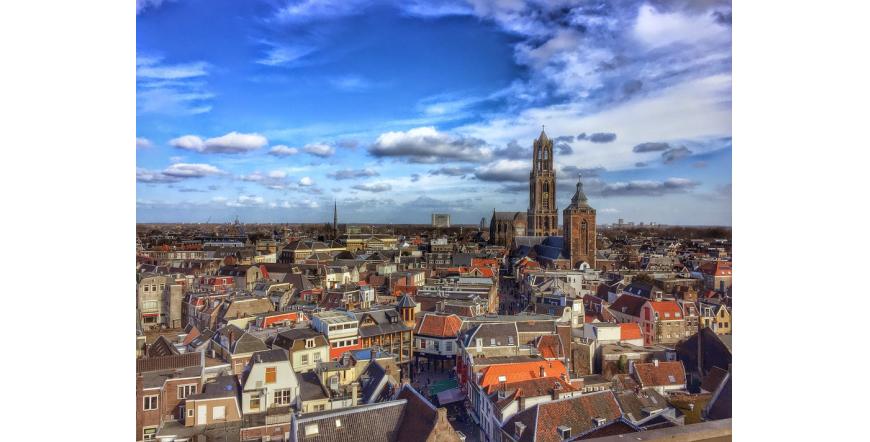
Utrecht is a city in the Netherlands, the capital of the province of Utrecht. It is the fourth largest city in the Netherlands and is part of the Randstad metropolis. Whether you call it a trip back in time, a walk up to the clouds or along the water channels running under streets and sidewalks, a visit to Utrecht is a real adventure and an amazing experience. This idyllic town is buzzing with life because of the young people - about 30,000 of whom are students at the city's popular Utrecht University. In many ways, the city resembles Amsterdam - narrow streets and canals, many sights and restaurants. But it differs from the capital in one way - Utrecht is much cozier than Amsterdam.
The foundations of the city were laid by the Romans in about 47 BC. Originally built of trees along the Rhine river, the settlement served as a frontier fortress of the Roman Empire. The locality was called Traiectum, which in translation means "place where the river is crossed". With the onset of the 2nd century, the wooden walls of today's Utrecht were replaced by stronger stone ones, remnants of which are still found today under the buildings around Dom Square. Near the fortress there was a small settlement, inhabited mainly by merchants and the families of the soldiers. Due to the frequent raids of the Germanic tribes on the Roman lands, by 270 Utrecht was abandoned by the Romans. Quite a long period of the history of today's Utrecht remains unknown. Light on the development of the city appears in the 6th century, when it is recorded in the annals that the Franks subjugated Utrecht. After his consecration as the first bishop of the Frisians in 695, Saint Willibrord established Utrecht as the center of the diocese.
Utrecht's heyday was undoubtedly in the Middle Ages, when the settlement became the most important city in the Northern Netherlands. Utrecht officially received the status of a city in 1122. A turning point in Utrecht's history was the signing in 1597 of the Union of Utrecht, directed against Spanish rule. With this union between the seven provinces of the "Low Countries" the Dutch Republic was founded, which was the first bourgeois country in the world.
After the opening in 1843 of a railway connecting Utrecht with Amsterdam, the city increased its importance and became a major railway centre. The development of Utrecht continued even after the Industrial Revolution. It developed in full force and this helped the expansion of the city far beyond its medieval part, in particular the central part, and from 1880 onwards many new districts such as Houtwijk, Witte Frauen, Vogelenwijk began to be built.
The coming of the Second World War affected Utrecht and the city was occupied by German troops and remained under their rule until the final liberation of the Netherlands on May 5, 1945. On May 7, Canadian troops entered Utrecht solemnly, and after the war the city grew significantly with the construction of the new districts - Overwecht, Hograven, Luneten, Kanaleneiland and Leidse Rein.
Utrecht University is the largest in the country, located in the inner part of the city and in the student district Oithof, and is ranked 41st among the best universities in the world and 6th in Europe. Other quality schools in Utrecht are Utrecht University, Utrecht University of the Arts and the University of the Humanities.
Utrecht is a city with an active cultural life, with several theaters, the Vrendenburg Classical Music Center, Tivoli Rock Club, several cinemas, art galleries as well as several museums located in the city. One of Utrecht's landmarks is the 1924 Rietveld Schröder House, which is a UNESCO World Heritage Site.
Well-known museums in Utrecht are the Museum of Aboriginal Art, the Central Museum, the Katharineconvent Museum dedicated to the history of Christian culture and art in the Netherlands, the National Museum of Mechanical Musical Instruments, the Railway Museum, as well as the University Museum at Utrecht University. Utrecht, in addition to cultural sights, also offers a lot of architectural and historical sights, part of the country's heritage. One of them is the symbol of the city - the Gothic tower of St. Martin's Cathedral.
Another must-see attraction in Utrecht is the "Old Canal" - the moat that surrounded and protected the old city. The canal was created in the 12th century and runs through the entire city.
The center of Utrecht is ideal for walking. In it, the Middle Ages and modern times intertwine and create a unique atmosphere. In the center of Utrecht, there is a youthful spirit, night clubs and trendy establishments.
In the center of Utrecht there is another interesting landmark - the Papal House. This is the home of Hadrian VI, who built his home in Utrecht even before he became Pope. Unfortunately, he did not get to live in her, as he died in 1532 in Rome, a year after she became Pope.
Vote:
Rating 5 from 1 voted


Weather in Utrecht, Netherlands

20.92 °C
Wind: 0.89 m/s
Humidity: 67 %
Pressure: 1003 hpa
Clouds: 100 %
Wind: 0.89 m/s
Humidity: 67 %
Pressure: 1003 hpa
Clouds: 100 %