

Peace Palace, Hague
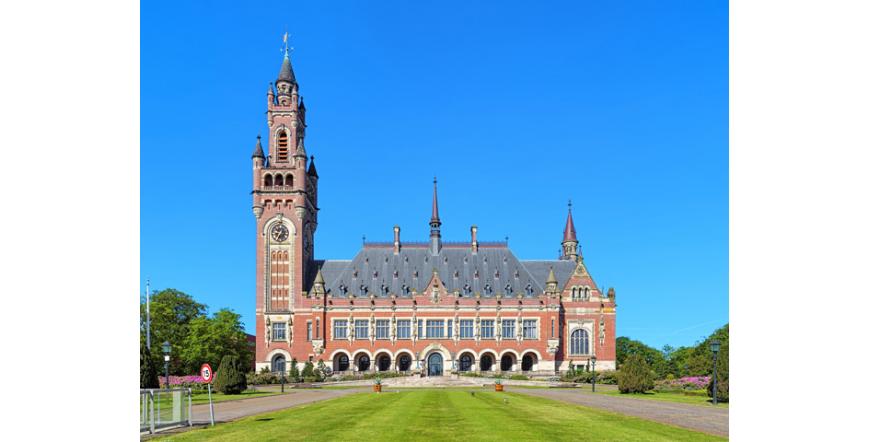
The Peace Palace, located in the Dutch city of The Hague, is one of the most important buildings in the world. This architectural relic has a rich hundred-year history and is a symbol of world peace and justice. The Peace Palace is home to the headquarters of the United Nations International Court of Justice, the Permanent Court of Arbitration, which is the oldest international legal instance, The Hague Academy of International Law and the largest Library of legal literature in the world. Despite the fact that the Peace Palace failed to prevent a major war, it managed to show something very important - the importance of international justice has grown over the 100 years of its existence, as evidenced by the series of international criminal tribunals established in recent decades, some of which also have their headquarters in The Hague.
The Peace Palace was completed on August 28, 1913, which means that even if it is part of the United Nations, it is older than both the organization and its predecessor, the League of Nations. The credit for the existence of the Peace Palace to a large extent belongs to the last Russian Tsar - Nicholas II, as well as to the American steel magnate Andrew Carnegie.
Nicholas II and Andrew Carnegie envisioned the Peace Palace as a temple that would send a message of peace through justice and the rule of law. Unfortunately, they did not have many followers for their idea, even more so at a time when the world was engulfed in an arms race.
Just when the European arms industry was in full swing and preparations for war were the main driving force behind many countries' economies, Nicholas II convened a peace conference in 1899, choosing The Hague as the host, as the city was easily accessible. International leaders from 26 countries gather in the summer palace of Queen Wilhelmina of the Netherlands. Despite the fact that the event was really spectacular, with balls and receptions, the result of the conference was quite modest. The best solution is to establish an international arbitration court to act as a mediator in case of conflict.
The courthouse was to be newly built. For this purpose, an architect was selected through an international competition. Thus, the French architect Louis Marie Cordonier was entrusted with the design, who proposed a neo-Renaissance style palace with Gothic and Baroque elements. Design was solved as a problem, but another appeared - the lack of money. However, it turns out that this is not an obstacle to erecting the courthouse. Carnegie, an entrepreneur who made a fortune from steel, donated the necessary 1.5 million dollars for the completion of the project, a huge sum for that time. Various parties contributed to the decoration and furnishings. For example, Thailand donated huge elephant tusks, Switzerland - a watch, Germany - the fence around the English gardens. The palace halls of the Peace Palace were unique with their magnificent decorations and silk wall hangings. In the middle of the grand staircase, reminiscent of the Paris Opera, is placed the royal gift - a vase, almost two meters high and weighing three tons. However, a war broke out a year after the establishment of the court.
The year 1922 came, during which the next important event in the court's history was recorded in the annals. The predecessor of the UN International Court of Justice, the League of Nations, decided that the Permanent Court of Arbitration was insufficient and established the Permanent International Court of Justice. However, this in no way prevents the outbreak of war - the Second World War is a fact. In 1946, the International Court of Justice began operating as the principal judicial organ of the United Nations. It has fifteen judges who, while largely incapable of imposing sanctions, parties tend to abide by their decisions.
Vote:
Rating 5 from 1 voted


