

Leiden, Netherlands
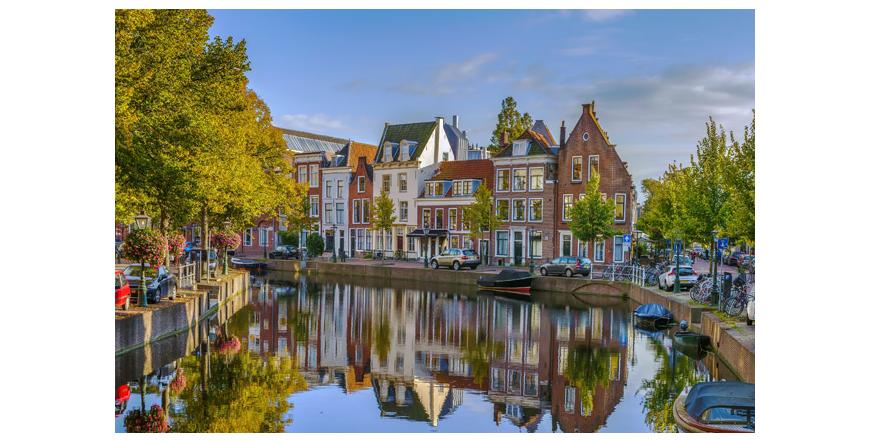
Leiden is a city in the Netherlands, belonging to the province of South Holland. The city is located on the river Rhine, more precisely on its part called the old Rhine. Leiden neighbors the cities of The Hague and Haarlem, together with which it is part of the Randstad administration.
The city largely owes its fame to the fact that it houses the oldest university in what is now the Netherlands and one of the oldest in Europe. The university opened its doors for the first time in 1575, and its founder was Wilhelm of Orange. Mainly because of him, after winning its independence from the Spanish king and Catholicism, Leiden quickly became one of the most influential intellectual centers in the world. Leiden also has great wealth, represented by numerous architectural monuments from the XII-XVII centuries.
Leiden arose on an artificial rise between the rivers Old and New Rhine, and received its official status as a city in 1266.
The main attractions in Leiden are the Antiquities Museum, which has an impressive collection of artefacts from ancient Egypt, Greece and Rome, as well as the Botanical Gardens, which were established in 1578 and are among the oldest in the world. The list continues with the church "St. Peter" and the Museum of Fine Arts. Generally, these sights are clustered close together and are centered around the main Leiden-Rappenburg canal. The city is home to one of the largest natural history museums in the world.
The pearl of Leiden, the University, is housed in a former monastery from the 16th century and several fortresses from the 11th and 13th centuries.
Leiden is known as the birthplace of the artists Rembrandt and Cornelius, and as the place where the Pilgrims gathered and lived before setting out for the New World. They call Leiden the old town with a light heart, as well as "Little Amsterdam". Leiden is just as charming as its larger sibling, but more intimate, less touristy, more cheerful and, thanks to the large number of students, visibly younger.
Vote:
Rating 5 from 1 voted


Weather in Leiden, Netherlands

18.47 °C
Wind: 1.79 m/s
Humidity: 86 %
Pressure: 1003 hpa
Clouds: 100 %
Wind: 1.79 m/s
Humidity: 86 %
Pressure: 1003 hpa
Clouds: 100 %