

Lighthouse of Alexandria, Egypt
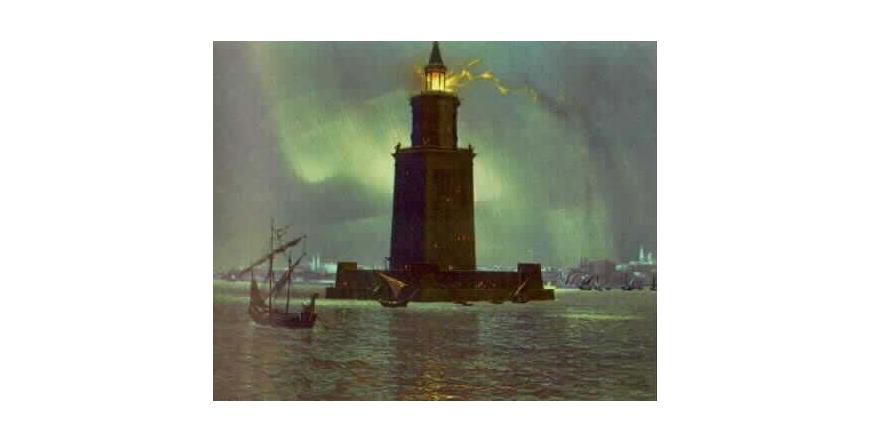
The Lighthouse of Alexandria is defined as the "youngest" of the seven wonders of the ancient world. It was built in 290 BC on the island of Pharos, near the city of Alexandria in Egypt. The light he radiated came from a great fire, and through mirrors it reflected into the sea. In an earthquake in 1375, the Lighthouse of Alexandria was destroyed, and from its remains at the end of the XV century Sultan Kite Bay built a fortress, which is there to this day. Documents and many stories of contemporaries manage to give a clear idea of its type and size, as well as the history of its construction.
In ancient history it is written that after the death of Alexander the Great in 323 BC, his empire was divided between his four generals Diodohi. The first of them, Ptolemy Sotir, gained power in Egypt and declared the city built by the Greek architect Dinocrates as the capital of the country, ordering its name to be Alexandria - in honor of the great ruler, and this name to remain forever. During their reign, Ptolemy and the citizens of the wealthy city of Alexandria decided to build a lighthouse on the beach to facilitate the arrival of ships.
The tradition of these lands at that time dictated that after careful study of several candidates, a construction manager should be elected. This is how the architect Zostrat Knidos won the project for the construction of the Alexandria lighthouse because of his good name and rich experience. In 290 BC he started the project of the lighthouse and finished in 285 BC. For five years, before the eyes of the world, a hitherto unseen lighthouse grew on the shores of the Mediterranean Sea, the light of which could be seen many kilometers from the shore. The light of the Lighthouse of Alexandria was a lifeline for many ships, as well as a source of pride for the citizens of Alexandria.
From an architectural point of view, the Lighthouse of Alexandria was a tower with a height of about 120-140 m, which at one time was one of the tallest structures created by man. The Lighthouse of Alexandrian is built of white marble and its architecture distinguishes beams, not arches. It had three floors, the lowest of which was a rectangular tower with a square base with a side of 30 m and a height of between 55 and 65 m. The four walls of the rectangular tower faced the four directions of the world. The second floor was octagonal in shape, in the directions of the eight main winds and was about 40 m high. The top floor of the Lighthouse of Alexandria was 8 meters high and in the shape of a cylindrical colonnade - 8 columns carried a dome crowned with an 8-meter bronze statue of the lord of the seas Poseidon. At the top of the floor was a metal concave mirror that reflected sunlight during the day and the light of burning tar or oil at night.
Twice, in 950 and 596, parts of the tower's surface cracked. Concerned, the builders took steps to strengthen it by reducing its height by 22 meters. Inside the Lighthouse of Alexandria, a spiral road was built to transport materials for the fire - usually firewood carried by slaves and loaded on donkeys. Zostratus built the Lighthouse of Alexandria as an incredibly stable building to withstand great storms, high waves and repeated earthquakes for almost two millennia. But because we are powerless against nature, monstrous earthquakes put an end to the architectural marvel.
The famous Sultan Salah al-Din took the task in 1272 of rebuilding the half-destroyed lighthouse, but all his aspirations were thwarted after a great earthquake in 1375 finally shattered the pride of Alexandria. The Sultan of Egypt, Quite Bay, cleared the ruins of the Lighthouse of Alexandria and built his fortress on the same site, which is still there today. However, one thing remains forever and nothing can erase or destroy it - until the appearance of the Lighthouse of Alexandria, the history of architecture did not know an example of a technical facility that became the subject of such universal admiration.
Vote:
Rating 4.44444 from 18 voted


