

Colossi of Memnon, Egypt
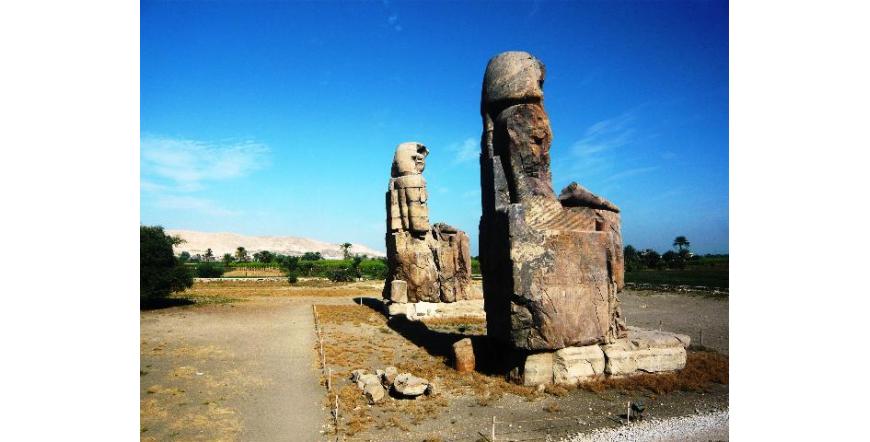
The Colossi of Memnon are two massive stone statues of Pharaoh Amenhotep III, son of Hapu. They are located in the Theban necropolis, near the present-day city of Luxor, and attach importance to the road to landmarks on the west coast, as they are the only remains of a great temple in Egypt - the burial temple of Amenhotep III.
The two twin statues represent Amenhotep III in a sitting position, with his hands on his knees and his gaze facing east, towards the river and the rising sun. in front of the throne, at his feet, are carved two smaller figures - of his wife Thea and his mother Mutemwiya, and the side panels depict the Nile god Hapi. The symbols of Upper and Lower Egypt (papyrus and lotus, symbols of the "two lands") depict the unity and integrity of a united Egypt.
Quartzite, brought from either Giza or Gebel el-Silsila, was used to make the Colossi of Memnon. The original idea for the Colossi of Memnon was for them to stand as guardians at the entrance to the funerary temple of Amenhotep, as the great temple was built while the pharaoh was still alive, and was worshiped here as the living god.
In those days the temple complex was the largest in Egypt, while those of its later rivals such as Rameses of Ramses II or Medinet Habu of Ramses III were not larger, even the Temple of Karnak from the time of Amenhotep was smaller.
The Colossi of Memnon are located at the level of the Nile River, and are therefore vulnerable to the annual floods of the river and have been exposed to the constant destructive force of the incoming water.
The Colossi of Memnon, surrounded by water, are recreated in the famous painting from the 40s of the 19th century by the artist David Roberts. The Greek historian and geographer Strabo tells of an earthquake in 27 BC that knocked down and damaged the northern (right) colossus. According to legend, as a result of this damage, this statue of dawn began to make sounds such as singing or human speech.
The legend of the "Singing Colossi", the belief that they bring good luck and fame, that they have prophetic power, spread far and wide and made the Colossi of Memnon an object of constant visits, including by some Roman emperors.
But Emperor Septimius in 199 ordered the restoration of the Colossi of Memnon, and this cut off the Mysterious Songs of the Half-Destroyed Colossi. Today, the phenomenon of "Singing Colossi" is attributed to the expansion of quartzite under the influence of the first rays of the sun.
In the Colossi of Memnon, the Greeks recognize Memnon, the son of Dawn and king of the Ethiopians, who was killed by Achilles during the Trojan War as he greeted his mother, Dawn, at sunrise.
Vote:
Rating 5 from 1 voted


